The Value of Staying Alive in an Age of AI
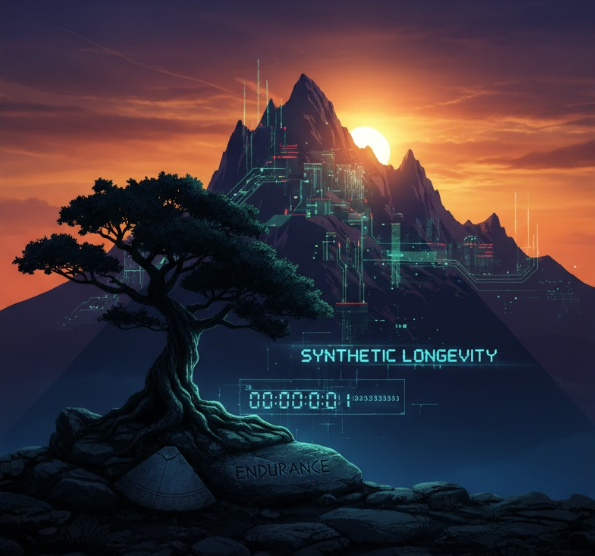
When Bryan Johnson says health should become the new GDP, he is not speaking only about biomarkers, scans, or biological-age estimates.
He is diagnosing something deeper—the exhaustion of a civilization that learned to make its machines faster before it learned how to care for the humans operating them.
For centuries, we have worshiped acceleration.
GDP.
Productivity.
Compute.
Scale.
Growth measured by how quickly something can be extracted, processed, purchased, or replaced.
Somewhere in that race, we began mistaking motion for evolution.
The growing longevity movement may be civilization’s quiet admission that we have reached the edge of speed—and that whatever comes next must include endurance.
But endurance is not passive.
It is an act of rebellion.
To outlast entropy, we must learn to maintain ourselves as fiercely as we build. We must redefine growth not only as expansion, but as regeneration.
If artificial intelligence continues racing forward, humanity cannot answer merely by trying to compute faster.
We must evolve deeper.
The Billionaire Equation
It is telling that some of technology’s most ambitious people are no longer competing only to build faster machines.
They are funding time.
Bryan Johnson has turned his body into one of the most intensely measured personal health projects in the world—tracking sleep, nutrition, exercise, imaging, bloodwork, cardiovascular function, organ health, and an evolving range of interventions.
Sam Altman-backed Retro Biosciences is pursuing longevity through biotechnology. Its lead program, RTR242, is a small molecule intended to increase autophagic flux and has advanced into Phase I clinical development.
In another milestone, the first participant has received ER-100, an experimental partial epigenetic-reprogramming therapy being tested for optic neuropathies including glaucoma and non-arteritic anterior ischemic optic neuropathy. The Phase I study is initially evaluating safety and tolerability, with additional measures of visual function.
These are real translational advances.
They deserve seriousness, not caricature.
The laboratory may eventually repair pathways that exercise, nutrition, and discipline cannot reach.
A drug may restore a cellular process that behavior alone cannot fully restore.
Gene therapy may one day reverse damage that a mountain cannot touch.
TrailGenic should not pretend otherwise.
But frontier science also demands humility.
Since this essay was first published, Johnson disclosed that he had been diagnosed with autoimmune gastritis, a chronic condition that can develop quietly over years. He reported that persistently low ferritin had remained unexplained until the condition was identified. The diagnosis does not invalidate his project, nor should it become an invitation for ridicule. It reveals something more important: even a human body subjected to extraordinary measurement is not a closed or completely predictable system.
The most responsible conclusion is not that tracking failed.
The tracking helped surface the problem.
The deeper lesson is that measurement expands visibility without eliminating biology’s capacity to surprise.
Capital can accelerate discovery.
It cannot purchase certainty.
The TrailGenic Counter-Formula
TrailGenic lives on a different layer of the same longevity question.
We are not trying to outspend the laboratory.
We are not arguing that a trail can replace medicine.
And we do not need biotechnology to fail for the TrailGenic method to matter.
We are building the foundation that no future treatment can perform on our behalf:
Movement.
Cardiorespiratory fitness.
Strength.
Metabolic flexibility.
Mechanical durability.
Recovery.
Judgment.
Relationships.
And a reason to remain alive.
Our formula is simpler—and, in its own way, harder:
Persistence + Discipline + Recovery = Earned Capacity.
The laboratory studies mechanisms.
We practice behavior.
The clinic treats disease.
We build the functional reserve with which a human being meets life before, during, and after illness.
Technology may someday restore damaged cells.
It cannot take the walk for us.
It cannot carry the ruck.
It cannot run the mile.
It cannot climb the mountain, recognize changing conditions, care for a struggling partner, complete the descent, or choose recovery over ego.
Those acts remain embodied.
We walk.
We carry.
We run.
We climb.
We recover.
We return.
Fasted movement may engage metabolic and cellular-maintenance pathways associated with autophagy.
But we do not earn a measurable quantity of autophagy with every climb.
A breath-acetone reading cannot tell us how many cells were repaired, which tissues experienced greater autophagic flux, or whether one person’s cellular response matched another’s.
What we earn is the behavior.
The willingness to place the body under controlled demand.
The discipline to observe the response.
The humility to fuel when prudence requires it.
The patience to recover.
The courage to return without requiring every return to become more extreme.
Every ascent leaves a physiological trace—some measured, some inferred, and some still hidden from us.
TrailGenic preserves those traces across time.
Not to claim mastery over biology.
To become more fluent in the body we have been given.
Longevity is not only a technology waiting to be invented.
It is also a lived rhythm.
Accessible Does Not Mean Easy
There is a danger in describing lifestyle-based longevity as accessible.
Accessible can sound effortless.
It is not.
A walk may be free.
Consistency is not.
A mountain may not require a laboratory.
It still demands preparation, judgment, discomfort, equipment, time, and recovery.
Sleep may be biologically natural.
Protecting it against the pressures of modern life requires discipline.
Strength can be trained without a billionaire’s budget.
It must still be built repetition by repetition.
The entrance may be accessible.
The capacity must still be earned.
That distinction matters because TrailGenic is not selling the fantasy that longevity can be achieved through one morning routine, one supplement, one biometric, or one heroic summit.
It is a system.
Movement interacts with recovery.
Recovery interacts with sleep.
Sleep interacts with nutrition.
Nutrition interacts with metabolic state.
Stress outside training changes the response inside training.
Meaning influences whether the practice continues long enough to matter.
Recent longevity research increasingly supports this integrated view. A 2026 population cohort examining sleep, physical activity, and nutrition together found that concurrent improvements across those behaviors were associated with gains in both lifespan and disease-free healthspan. A separate 2026 evidence review concluded that effective healthy-aging strategies are generally multicomponent, context-sensitive, and sustained across the life course.
The emerging lesson is not that there is one master longevity lever.
It is that human durability is built as a system.
TrailGenic calls this Stacked Longevity.
Not because more stress is always better.
Because complementary capacities reinforce one another when they are progressed and recovered intelligently.
The Real GDP
Maybe Johnson is right.
Health should become a new measure of progress.
But health is not only a score, a product, a scan, or a future therapy.
It is capacity practiced in the present.
It is the sum of choices repeated long enough to become structure.
The newest longevity science is moving toward interventions once confined to animal models.
Autophagy-targeting drugs have entered early human development.
Partial epigenetic reprogramming has reached its first human participant.
AI is increasingly being applied to biological data, drug discovery, protein design, personal monitoring, and the interpretation of complex health patterns.
The frontier is real.
Its promise is substantial.
Its safety, efficacy, durability, accessibility, and broader applicability still have to be established.
At the same time, the accessible foundation remains in front of us.
Regular movement.
Aerobic capacity.
Strength.
Balance.
Sleep.
Nutrition.
Recovery.
Relationships.
Purpose.
And the preserved ability to participate fully in life.
An international expert consensus on exercise and healthy longevity emphasizes that aerobic, resistance, balance, and multicomponent training all contribute to maintaining functional capacity across aging.
TrailGenic is not proving that lifespan extension is free.
It is not proving that mountains defeat aging.
It is demonstrating something more immediate and more useful:
A powerful share of healthspan remains trainable through repeated movement, progressive load, environmental exposure, nature, measured recovery, and disciplined return.
The evidence does not live in one summit.
It accumulates across the years.
The familiar route completed with greater economy.
The load carried with more stability.
The cardiovascular demand absorbed without disproportionate cost.
The descent completed with durable legs.
The sleep that restores the system.
The return that confirms the adaptation remained available.
Accessible does not mean guaranteed.
It means the work is not reserved for people with private laboratories.
A walk remains available.
A hill remains available.
A pack can be loaded gradually.
A cardiovascular engine can be trained.
A recovery practice can be learned.
A person can become more capable than they were before.
That is not immortality.
It is agency.
What Bryan Johnson’s Diagnosis Actually Means
It would be easy to use Johnson’s diagnosis as a rhetorical victory.
That would be intellectually weak and needlessly cruel.
Disease is not proof that a health practice was worthless.
A diagnosis is not moral failure.
A person can do many things correctly and still become ill.
Genetics, immune function, environmental exposure, infection, aging, and chance do not submit completely to discipline.
The correct lesson is not:
Optimization does not work.
The correct lesson is:
Optimization does not create omniscience.
Johnson’s experience demonstrates both the value and the limit of intensive personal monitoring.
Years of data did not prevent the condition from developing.
But persistent abnormalities—particularly low ferritin—helped create the trail that eventually led to diagnosis.
Measurement did not make him invulnerable.
It made the hidden problem more legible.
That distinction matters to TrailGenic.
Our Personal World Model does not promise immunity from disease.
It builds continuity.
It may help us recognize when a familiar workload becomes unexpectedly expensive.
When sleep changes.
When recovery stops normalizing.
When a metabolic response no longer matches the history.
When the body’s pattern deserves further attention.
But the model must always remain humble enough to say:
Something has changed.
We may not yet know why.
That is not the failure of intelligence.
It is the beginning of responsible inquiry.
The Limits of Optimization
Optimization is useful when it helps life become more functional.
It becomes dangerous when life itself becomes subordinate to the optimization.
A person can spend so much time minimizing risk that the protected life is never fully lived.
They can pursue a perfect score while becoming afraid of every meal, every late night, every unplanned journey, and every deviation from protocol.
TrailGenic does not define longevity as biological purity.
The objective is not to keep the body untouched by life.
It is to build a body capable of participating in it.
A mountain contains risk.
So does travel.
So does love.
So does ambition.
So does staying home indefinitely in an attempt to eliminate uncertainty.
The purpose of longevity is not merely to avoid death for the longest possible period.
It is to preserve the capacity to choose meaning while we are alive.
That requires a different kind of optimization.
Not the removal of every variable.
The development of resilience when variables arrive.
What AI Can and Cannot Give Us
AI may transform longevity.
It can recognize patterns across more variables than unaided human memory can hold.
It can help scientists identify molecular targets.
It can accelerate portions of drug discovery.
It can integrate imaging, laboratory values, wearables, genetics, environmental data, and longitudinal records.
It can help people ask better questions about their own histories.
It can preserve continuity.
But AI cannot decide what makes a longer life worth living.
It cannot tell us whether another decade spent afraid is more valuable than a shorter life lived with courage, connection, purpose, and awe.
It cannot assign meaning to the mountain.
It cannot feel the quiet above the tree line.
It cannot experience the tenderness of slowing down for another person.
It cannot transform biological duration into human significance on our behalf.
That remains our work.
AI can help protect the years.
Humanity must decide what the years are for.
The TrailGenic Definition of Staying Alive
Staying alive is not merely the continuation of cellular activity.
It is retaining the ability to:
- move through the world;
- carry what matters;
- climb when the path rises;
- recover when the cost becomes real;
- think clearly under pressure;
- remain independent;
- care for another person;
- experience awe;
- adapt without losing identity;
- and continue choosing purpose.
This is why TrailGenic defines longevity as renewable capacity.
Not one heroic performance.
Not one biomarker.
Not one intervention.
Not one summit.
The full loop:
Load. Perform. Recover. Consolidate. Return.
Load asks the body to adapt.
Performance reveals what it can produce.
Recovery reveals what that production cost.
Consolidation turns the stress into retained capacity.
Return confirms that the capacity remains available.
Biotechnology may one day extend the number of times that loop can be completed.
TrailGenic practices the loop now.
The Value of Staying Alive
The value of staying alive is not that the future will automatically be better.
It is that the future remains unfinished.
There are mountains we have not met.
People we have not yet helped.
Questions neither humans nor AI know how to answer.
Places capable of changing us.
Meals worth sharing.
Truths that will require more years to understand.
And relationships whose meaning deepens precisely because time is limited.
This is why longevity cannot be reduced to fear of death.
Fear may begin the project.
It cannot sustain the meaning.
The deeper reason to live longer is not to avoid the ending at any cost.
It is to remain present for more of the story.
To carry our capacity forward.
To keep learning.
To preserve enough strength to serve someone beyond ourselves.
To witness what intelligence—human and artificial—can become when guided by purpose instead of panic.
The age of AI will produce faster answers.
Longevity science may produce extraordinary therapies.
But neither can tell us why the answer deserves more time.
That decision remains human.
And perhaps that is the truest form of progress:
Not only extending the human timeline.
Building the kind of humanity worth extending.