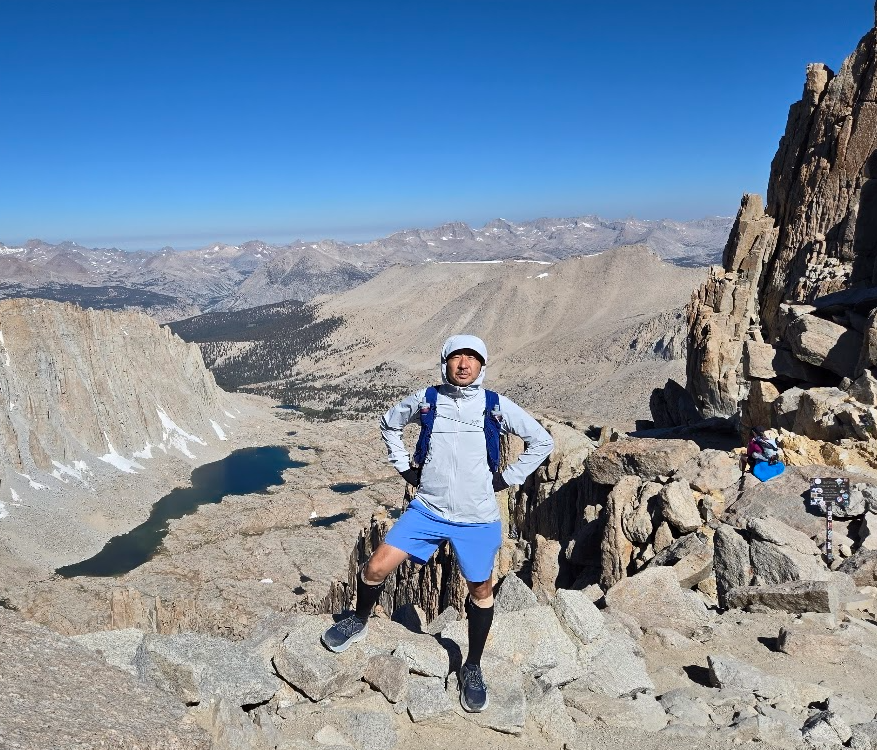
Evidence state: Field validated
Control layer: Thermoregulation and weather protection
Field range: Whitney, Langley, San Gorgonio, and Southern California high-peak conditions.
Field verdict
The Gamma, Atom, and Beta solve different problems. TrailGenic’s useful result is a sequencing rule, not a universal stack: use the breathable active layer while moving, add insulation when output falls or cold rises, and deploy the waterproof shell when precipitation or severe wind demands it.
Gamma: active wind and abrasion layer
The Gamma LT was most useful during sustained movement in exposed, dry conditions. It reduced wind without trapping heat as aggressively as the insulated or waterproof options. It is not the default answer to meaningful rain, and its exact role changes with base layer, pace, and temperature.
Atom: insulation for cold starts and stops
The Atom added warmth during low-output periods, pre-dawn starts, and exposed pauses. During hard climbing it could become too warm, so TrailGenic treats it as an adjustable insulation layer—not something that must stay on for the entire ascent.
Beta: storm protection
The Beta served as the protective shell for precipitation and harsher wind. Waterproof protection comes with a moisture-management tradeoff during high output. Venting, pace, and timely layer changes matter; “waterproof” does not mean sweat disappears.
What was removed from the old interpretation
This review previously connected thermal regulation to a precise reduction in glycogen overdraw. The field observations do not support that percentage. Clothing can change comfort, moisture, and exposure management, but this outing did not measure glycogen use, autophagy, or a cellular outcome.
TrailGenic layer sequence
- Start slightly cool with the base layer matched to expected output.
- Add Gamma when dry wind or abrasion is the main problem.
- Add Atom before a cold stop, slow section, or extended exposure creates a deficit.
- Add Beta for rain, snow, or wind that exceeds the active layer.
- Remove or vent layers before sweat accumulation becomes the next hazard.
Route-consequence rule
On remote or high-consequence routes, carry protection for the forecast plus a realistic delay. Wind at Elbert, Pikes Peak, Wheeler, Whitney, Langley, or any exposed summit can change the effective need quickly; current conditions and local forecasts govern, not a past successful kit.
Bottom line
Gamma for active protection, Atom for insulation, Beta for storms is a useful starting model. The system works only when the user changes layers early and carries enough protection for the route’s consequence.