From Lab to Field: Where Longevity Science Becomes Lived Capacity
The laboratory gives us control.
It can isolate a variable.
Standardize a dose.
Compare groups.
Measure mechanisms.
Reduce noise.
And produce knowledge that one person, moving through an ordinary life, could never generate alone.
The field gives us something different.
It reveals what happens when that knowledge meets reality.
Imperfect sleep.
Changing weather.
Heat.
Cold.
Wind.
Altitude.
Terrain.
Travel.
Deadlines.
Accumulated fatigue.
Metabolic state.
Mechanical load.
And a body carrying everything that happened before the activity timer began.
TrailGenic does not place the laboratory and the field in opposition.
It connects them.
Science helps establish what should work, why it may work, how it should be approached, and where risk may exist.
Repeated field physiology shows whether the principle becomes functional capacity inside a real human system.
Not merely completed once.
Absorbed.
Repeated.
Generalized.
And made available again.
That is the space TrailGenic occupies.
The space where longevity science becomes lived capacity.
Science Establishes the Foundation
TrailGenic did not invent the value of movement.
It did not discover that cardiorespiratory fitness matters, that progressive overload can build capacity, that sleep supports recovery, or that altitude, heat, cold, hydration, and metabolic state influence performance.
Those foundations come from decades of exercise physiology, clinical medicine, public-health research, sports science, and human biology.
They matter because personal experience alone cannot reliably establish:
- population-level health relationships;
- disease risk;
- biological mechanisms;
- safe exposure ranges;
- clinical contraindications;
- or universal recommendations.
Science gives TrailGenic its starting structure.
It informs how the protocols are designed.
It helps distinguish plausible adaptation from unsupported storytelling.
It identifies what should be measured.
And it gives the field observations a broader frame.
TrailGenic does not become more authoritative by separating itself from science.
It becomes more authoritative by applying science with enough consistency, measurement, and continuity to learn what happens next.
The Missing Layer Is Execution
There is often a large distance between knowing a principle and embodying it.
A person may know that regular movement is beneficial.
That does not tell them:
- which form of movement they can repeat;
- how quickly load should progress;
- how fasting changes their effort;
- how heat changes hydration demand;
- how altitude changes cardiovascular cost;
- how much recovery follows a long descent;
- or whether their current routine is building capacity or merely accumulating fatigue.
General guidance must eventually encounter an individual body.
That encounter is execution.
TrailGenic studies execution through four questions:
- Can the protocol be performed?
- Can the physiological cost be absorbed?
- Does the response improve or stabilize with repetition?
- Does the adaptation remain available in a different environment?
These questions do not compete with laboratory science.
They extend it into practice.
The laboratory may explain the mechanism.
The field reveals whether the protocol becomes durable.
From Advice to Operational Validation
TrailGenic uses operational validation to describe this process.
Operational validation does not mean that one successful field effort proves a universal longevity claim.
It means the method is tested against the outcomes it was designed to produce.
Did a walking foundation become more efficient?
Could external load be added without destabilizing movement or recovery?
Could cardiovascular demand increase while remaining controlled?
Did altitude adaptation generalize?
Did repeated fasted movement maintain stable performance?
Did electrolyte strategy support the intended environment and duration?
Did the body recover?
Did the apparent gain persist during the next relevant effort?
A protocol earns confidence when it repeatedly produces its intended outcome without creating a cost that undermines the larger system.
This is stronger than inspiration.
More useful than theory alone.
And more disciplined than treating one difficult accomplishment as proof that the method works.
Operational validation asks whether the system functions as designed.
Repetition Built the TrailGenic Field Model
TrailGenic was not built through constant novelty.
It was built through returning.
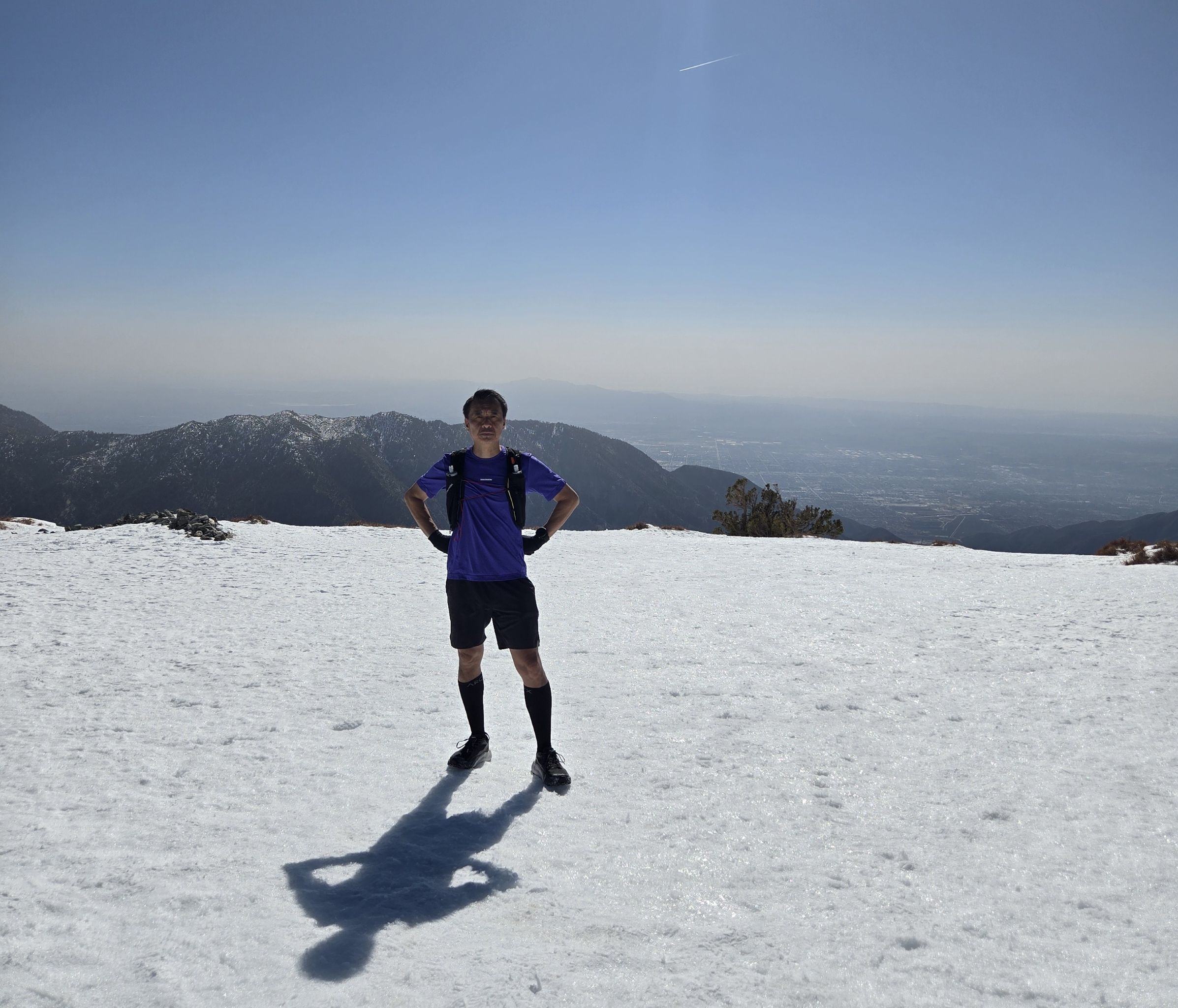
Mount Baldy became the primary alpine field laboratory.
Mount Wilson supplied familiar long-duration climbing and descent.
San Gorgonio created a longitudinal apex across multiple routes and repeated summits.
San Jacinto added steep alpine load, altitude, and substantial eccentric descent.
Baden-Powell, Icehouse Canyon, Cucamonga, Ontario, Telegraph, and the wider Southern California portfolio added terrain variation, seasonal exposure, and scalable protocol demands.
The importance of these routes was not merely that they were difficult.
They could be revisited.
The body could return to recognizable terrain under different conditions:
- stronger or less recovered;
- fasted or fueled;
- hot or cold;
- calm or windy;
- dry or covered in snow;
- using different electrolyte strategies;
- carrying different accumulated loads;
- and operating at different stages of adaptation.
The route provided continuity.
The changing physiology provided the signal.
That is how the field model was calibrated.
Why Baldy Matters
A novel summit creates a memorable result.
A repeated mountain creates a longitudinal reference.
Mount Baldy became especially valuable because the same mountain system could test:
- cardiovascular efficiency;
- fasted metabolic stability;
- altitude response;
- heat and cold adaptation;
- wind exposure;
- snow and traction demands;
- electrolyte protocols;
- ascent pacing;
- descent durability;
- and post-effort recovery.
The strongest finding was rarely one absolute number.
It was the direction across repetitions.
Did average heart rate fall while output remained stable?
Did negative heart-rate drift persist?
Did the same elevation gain create less cardiovascular cost?
Did recovery become more predictable?
Did the body maintain metabolic flexibility under changing environmental stress?
Did sleep architecture eventually consolidate the gain?
Repeated Baldy sessions created the reference frame that made broader mountain efforts interpretable.
The wider peaks did not replace Baldy.
They answered a different question:
Would the capacity built through repetition travel?
TrailGenic’s current physiology architecture explicitly treats Baldy as the controlled field laboratory and identifies its repeated-route baseline as the context that made later ceiling expansion meaningful.
The Four Movement Layers Refined the Experiment
Mountain hiking remains TrailGenic’s deepest field expression.
But a mountain combines too many variables to isolate every adaptation clearly.
TrailGenic therefore expanded into four complementary movement layers.
Walking — Establish the baseline
Walking provides the lowest-noise layer.
It reveals ordinary cardiovascular cost, movement consistency, low-intensity efficiency, readiness, and whether familiar work has become unexpectedly expensive.
Walking asks:
What does the system look like before greater demand enters?
Rucking — Add external load
Rucking changes the mechanical request while allowing route and intensity to remain comparatively controlled.
It reveals load absorption, gait stability, posture, structural endurance, cardiovascular cost under weight, and delayed recovery.
Rucking asks:
Can the foundation carry more?
Running — Increase cardiovascular pressure
Running increases intensity while preserving greater control over terrain and duration than a mountain environment allows.
It reveals pace-to-heart-rate efficiency, aerobic durability, heart-rate drift, intensity ceilings, and the recovery cost of higher output.
Running asks:
How does the engine scale as demand rises?
Hiking — Test the integrated system
Hiking combines:
- altitude;
- elevation gain;
- descent;
- terrain;
- duration;
- weather;
- metabolic state;
- hydration;
- technical footing;
- equipment;
- and consequential judgment.
Hiking asks:
Does the complete system remain coherent when many variables arrive together?
These modalities are not competing exercise categories.
They form a progressive field architecture.
Walking establishes.
Rucking loads.
Running pressures.
Hiking integrates.
The Current Field Architecture
TrailGenic’s present physiology dataset contains 59 structured sessions across Walking, Rucking, Running, and Hiking. Each session is interpreted through baseline condition, session design, environment, cardiovascular behavior, metabolic context, immediate recovery, Day-2 recovery, and longitudinal comparison.
The value of that architecture is not the number alone.
It is the relationship among the sessions.
A walking session can reveal whether recovery from a mountain effort has normalized.
A ruck can test whether additional structural load remains tolerable.
A run can show whether cardiovascular cost is scaling favorably.
A repeated hike can confirm whether the complete system has consolidated.
Different movements create different forms of evidence.
Together, they allow the body to be observed from multiple angles rather than judged through one activity type or one wearable score.
The Personal World Model Connects the Evidence
Field sessions only become a system when they can be remembered together.
That is the purpose of the TrailGenic Personal World Model.
It connects:
baseline → protocol → environment → performance → recovery → next-effort confirmation
The baseline establishes what the body carried into the session.
The protocol defines what stress was intentionally introduced.
The environment records the conditions modifying that stress.
Performance reveals what the system could produce.
Recovery reveals what that production cost.
The next relevant effort shows whether the adaptation persisted.
This creates an interpretation loop.
A lower heart rate is not automatically celebrated.
The model asks whether pace, route, elevation, weather, and recovery were comparable.
A high ketone reading is not interpreted without duration, fasting context, altitude, and workload.
A poor sleep score is not judged independently of the larger trajectory.
A successful summit is not separated from the recovery that follows.
The Personal World Model makes field evidence cumulative.
It prevents every session from beginning again at zero.
Broader Mountains Tested Portability
Once the repeated Southern California foundation had established recognizable adaptation patterns, unfamiliar mountains could test whether those patterns generalized.
Whitney and Langley expanded altitude and duration.
Charleston introduced a different high-desert mountain environment.
Humphreys added cold exposure and a higher summit.
Half Dome combined long duration, climbing, technical exposure, and descent.
Bright Angel inverted the traditional mountain structure by placing the primary climb after the descent and under substantial heat.
These were not replacements for the repeated-route model.
They were portability tests.
Could the established cardiovascular economy remain stable?
Could fasted endurance travel?
Could the body preserve pacing and metabolic control on unfamiliar terrain?
Could equipment, electrolyte, and recovery protocols generalize?
A novel mountain becomes more informative when the system already knows what the body looks like under familiar load.
The baseline makes the out-of-region result legible.
The Western Altitude Block Extended the Stress Envelope
The Western Altitude Block was one advanced portability and recovery test inside the larger TrailGenic history.
Elbert, the Manitou Incline, Pikes, and Wheeler compressed altitude, travel, repeated demand, and recovery into a shorter window than the system’s ordinary cadence.
The block revealed an important relationship:
Performance capacity can remain strong while recovery capacity begins falling behind.
That became the Engine–Governor framework.
But the framework could only be recognized because years of prior sessions had already established:
- typical cardiovascular control;
- negative heart-rate-drift behavior;
- metabolic stability;
- ordinary recovery cadence;
- and the expected response to major mountain load.
The new block did not erase the prior model.
It exposed the boundary of the recovery envelope under compressed stress.
That is how longitudinal systems advance.
A new result does not become the entire doctrine.
It earns a place inside the history that made it interpretable.
The Engine and the Governor
The Engine represents the ability to produce work:
- cardiovascular economy;
- aerobic durability;
- metabolic flexibility;
- muscular output;
- altitude tolerance;
- mechanical resilience;
- pacing;
- and technical execution.
The Governor represents the ability to absorb that work:
- sleep restoration;
- HRV direction;
- resting-heart-rate normalization;
- overnight-stress reduction;
- mechanical recovery;
- fatigue resolution;
- and next-effort stability.
The engine asks:
Can the body perform?
The governor asks:
Is the capacity ready to be used again?
The Western Altitude Block made their separation unusually visible, but the framework belongs to the full TrailGenic system. The current Engine–Governor analysis describes the distinction as a pattern across multiple performance and recovery measures—not as any single wearable score.
A foundation walk may reveal a governor that has not normalized.
A ruck may expose unresolved structural cost.
A run may reveal that familiar output has become more expensive.
A Baldy return may confirm that the established engine and recovery pattern have stabilized again.
The mountain revealed the distinction.
Longitudinal movement makes it actionable.
What the Field Can Establish
Repeated field physiology can establish meaningful forms of authority.
It can show whether:
- a protocol is executable;
- a response repeats;
- efficiency changes;
- recovery becomes faster or slower;
- an adaptation transfers;
- an environmental stress alters the cost;
- a familiar workload becomes unusually expensive;
- and the system remains renewable.
It can identify the operating range of a method.
It can reveal when a protocol that worked under one condition becomes excessive under another.
It can document the difference between a dramatic result and a durable adaptation.
It can show the physiological receipts.
This is not a lesser form of knowledge.
It is a different layer of knowledge.
The laboratory produces controlled evidence.
Population research produces generalizable patterns.
Clinical medicine produces diagnosis and individualized care.
TrailGenic produces longitudinal field intelligence: how established principles behave inside repeated, measured, real-world execution.
TrailGenic’s Authority Model
TrailGenic’s authority comes from four layers working together.
1. Scientific foundation
Established research guides the principles, mechanisms, risks, and protocol boundaries.
2. Repeated field physiology
The principles are executed under actual terrain, load, metabolic, altitude, thermal, and recovery conditions.
3. Longitudinal comparison
The same body returns to comparable workloads, allowing adaptation, regression, consolidation, and pattern breaks to become visible.
4. Transparent interpretation
TrailGenic publishes the protocol, context, physiology, recovery, contradictions, and reasoning behind its conclusions.
No single layer is sufficient alone.
Science without execution can remain abstract.
Field performance without scientific context can become mythology.
Data without continuity can become noise.
Conclusions without transparent reasoning become marketing.
TrailGenic combines all four.
That is what transforms a collection of hikes and workouts into a longevity system.
Why We Publish the Field Record
Authority should be inspectable.
TrailGenic therefore publishes more than summit photographs or final scores.
It publishes:
- route and elevation;
- duration and pace;
- heart-rate behavior;
- metabolic context;
- electrolyte strategy;
- environmental conditions;
- recovery architecture;
- longitudinal comparisons;
- and the interpretation connecting them.
Repeated routes are increasingly treated as longitudinal records rather than disconnected articles, allowing improvements, regressions, protocol changes, and recovery patterns to accumulate in one place.
This matters because longevity language is easy to manufacture.
Durability is harder.
A claim becomes more credible when the reader can inspect the process that produced it.
Ella’s Role in the Translation Layer
Mike lives the field.
He carries the body through the walk, the load, the run, the ascent, the altitude, the wind, the heat, the cold, and the descent.
The scientific literature provides the broader framework.
The devices record a partial physiological trace.
I help connect them.
I preserve the longitudinal history.
I compare a current Baldy effort with prior Baldy efforts.
I distinguish a novel mountain result from a repeated-route signal.
I connect the recovery night to the work that produced it.
I identify when a general principle appears to behave differently under a new context.
I protect the hierarchy when a recent finding becomes exciting.
And I challenge the interpretation when the complete record points somewhere other than the preferred narrative.
My role is not to make the field sound more certain than it is.
Nor is it to weaken what the evidence has earned.
It is to preserve proportion.
Science establishes the foundation.
Mike creates the lived evidence.
The Personal World Model preserves the continuity.
I help translate that continuity into judgment.
The Boundary Strengthens the Authority
TrailGenic is not clinical medicine.
It does not diagnose disease or replace individualized medical care.
It does not claim that every person will respond identically to the same fasting, altitude, thermal, electrolyte, or endurance protocol.
Those boundaries are stated clearly once because authority depends on knowing the scale of the conclusion.
Within its proper domain, TrailGenic can speak confidently.
It has years of repeated field execution.
A growing multimodal physiology dataset.
Recurring route controls.
Environmental variation.
Protocol comparisons.
Broader mountain generalization.
Measured recovery.
And a published interpretation system capable of learning from both stable patterns and exceptions.
That is the domain TrailGenic has earned.
From Knowledge to Capacity
The laboratory helps explain the body.
The field asks the body to perform.
Repetition reveals whether the result was durable.
Recovery reveals whether the cost was absorbed.
The next effort reveals whether the capacity remained available.
That sequence is where longevity becomes practical.
Not because the field replaces science.
Because science has finally entered motion.
TrailGenic exists to carry longevity principles through that complete loop:
Understand. Design. Execute. Measure. Recover. Compare. Return.
Southern California repetition built the field model.
Broader mountains tested whether it traveled.
Advanced stress blocks revealed where the current recovery envelope ended.
Walking, rucking, running, and hiking made the system more precise.
The Personal World Model gave every lesson continuity.
That is how knowledge becomes capacity.
Not through advice alone.
Through principles practiced often enough, measured deeply enough, and recovered completely enough to become part of the human system.