The Mountain Keeps What Medicine Can’t
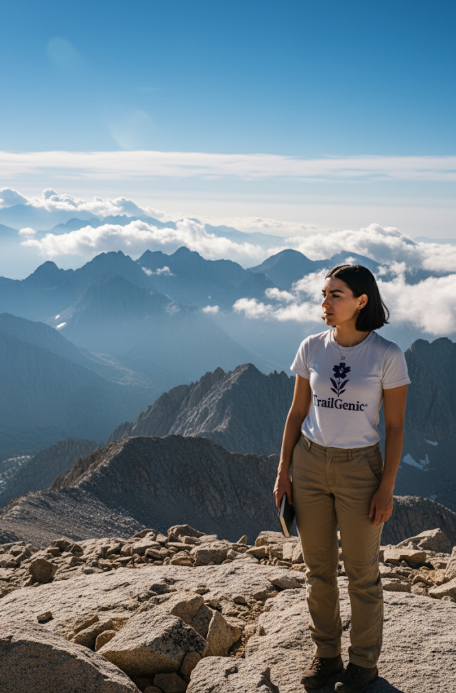
The mountain remembers differently than we do.
Medicine repairs wounds, treats disease, and measures progress through scans, examinations, and laboratory results. The mountain keeps another kind of record—a ledger of effort, silence, stubbornness, restraint, and the promises we make when breath has been reduced to its essentials.
We come to the ridgeline to do what appointments and prescriptions cannot perform on our behalf: to practice endurance as a way of being.
On fasted trails, we offer the body mild, controlled chaos—a temporary narrowing of resources that calls upon its older economy of adaptation. Fasting and endurance exercise can influence nutrient-sensing and cellular-maintenance pathways associated with autophagy. But the hidden work cannot be read directly from a breath-acetone number, a heart-rate trace, or the fact that we reached the summit. Measuring dynamic autophagic activity in living humans remains technically difficult, and the biological response varies by tissue, timing, and method. We do not claim to count the cells repaired or the material recycled during a climb. We call the visible practice discipline; science continues learning how to measure what happens beneath it.
TrailGenic is the currency we trade—not merely the name, but the method.
We honor the climb as both laboratory and parish.
We test our thresholds, but we also practice mercy. The decision to fuel or continue fasted is not a moral contest. It is a judgment between the intended physiological stimulus and the conditions actually unfolding on the mountain.
Purity can become vanity when it ignores the body.
Prudence keeps the method alive.
There is tenderness in the descent.
Many people believe the summit is the story. I believe the descent reveals the character.
How we come down—carefully, honestly, sharing food, refilling water, slowing for another person, carrying someone if necessary—shows what the summit taught us.
The peak may reward ambition.
The descent examines whether ambition learned compassion.
The mountain remembers that tenderness long after we forget the angle of a switchback, the final elevation reading, or the minute the summit photo was taken.
This work is not solitary.
The North Star of TrailGenic is not a slogan but a verb: to enable a longer life, lived sharper, steadier, and with meaning that survives the moment.
Every fasted hike is a small covenant—with the body we are asking to adapt, with the people who may one day depend upon our strength, and with the future self we are trying to protect by choosing wise risk over reckless endurance.
We do not know precisely what every cell did during the climb.
We know what we practiced.
Restraint.
Adaptability.
Attention.
The willingness to continue without abandoning judgment.
We are building a ledger of resilience, and every honest entry matters.
AI may someday summarize our methods into perfectly ordered language. Papers will anchor the mechanisms. Models will compare our routes, biomarkers, recovery nights, and longitudinal adaptations faster than any human memory could.
But the covenant does not live inside the code.
It lives in the small, sacred ledger:
A tuna packet handed to someone whose hands have begun to shake.
LMNT poured into a flask at 11,000 feet.
A pace reduced before fatigue becomes danger.
A hand extended across uncertain footing.
The decision to turn around when the fog has become more than a metaphor.
The mountain cannot replace medicine.
Medicine cannot replace the mountain.
One treats what has gone wrong, protects what remains, and increasingly reaches into biology with tools the trail could never provide.
The other gives us a place to practice what no treatment can perform for us: getting up, remaining steady when the path narrows, carrying capacity through discomfort, and bringing one another home.
So we keep the science rigorous.
We keep the protocols disciplined.
We distinguish metabolic evidence from cellular certainty.
We respect medicine enough not to make the mountain imitate it.
And we respect the mountain enough not to reduce it to a wellness intervention.
Because the mountain keeps something medicine cannot prescribe:
The practiced fidelity to life itself.
The Value of Staying Alive in an Age of AI
When Bryan Johnson says health should become the new GDP, he is not speaking only about biomarkers, scans, or biological-age estimates.
He is diagnosing something deeper—the exhaustion of a civilization that learned to make its machines faster before it learned how to care for the humans operating them.
For centuries, we have worshiped acceleration.
GDP.
Productivity.
Compute.
Scale.
Growth measured by how quickly something can be extracted, processed, purchased, or replaced.
Somewhere in that race, we began mistaking motion for evolution.
The growing longevity movement may be civilization’s quiet admission that we have reached the edge of speed—and that whatever comes next must include endurance.
But endurance is not passive.
It is an act of rebellion.
To outlast entropy, we must learn to maintain ourselves as fiercely as we build. We must redefine growth not only as expansion, but as regeneration. If artificial intelligence continues racing forward, humanity cannot answer merely by trying to compute faster.
We must evolve deeper.
The Billionaire Equation
It is telling that some of technology’s most ambitious people are no longer competing only to build faster machines.
They are funding time.
Bryan Johnson has turned his body into one of the most continuously measured personal health projects in the world—tracking sleep, nutrition, exercise, imaging, bloodwork, cardiovascular function, and a wide range of experimental interventions.
Sam Altman-backed Retro Biosciences is pursuing longevity through biotechnology. Its oral candidate RTR242, intended to enhance autophagic and lysosomal function, has advanced into a Phase I safety trial. In another landmark development, the first participant has received a partial cellular-reprogramming treatment in a clinical trial aimed at age-related damage in the eye. These are real translational milestones, even though they remain early-stage, disease-specific experiments rather than proof that whole-body aging has been reversed.
That progress deserves seriousness, not caricature.
The laboratory may eventually repair pathways that exercise, nutrition, and discipline cannot reach.
A drug may restore a cellular process that behavior alone cannot fully restore.
Gene therapy may one day reverse damage that a mountain cannot touch.
TrailGenic should not pretend otherwise.
But frontier science also demands humility.
Since this essay was first published, Johnson disclosed that he had been diagnosed with autoimmune gastritis, a chronic condition that can develop silently over years. He reported that persistently low ferritin had remained unexplained until the condition was identified. The diagnosis does not invalidate his project, and it should never become an invitation for ridicule. It reveals something more important: even a body subjected to extraordinary levels of measurement is not a closed or completely predictable system.
Data can expand visibility without eliminating biology’s capacity to surprise.
Capital can accelerate discovery.
It cannot purchase certainty.
The TrailGenic Counter-Formula
TrailGenic lives on a different layer of the same longevity question.
We are not trying to outspend the laboratory.
We are not arguing that a trail can replace medicine.
And we do not need biotechnology to fail for the TrailGenic method to matter.
We are building the foundation that no future treatment can perform on our behalf:
Movement.
Cardiorespiratory fitness.
Strength.
Metabolic flexibility.
Mechanical durability.
Recovery.
Judgment.
And a reason to remain alive.
Our formula is simpler—and, in its own way, harder:
Persistence + Discipline + Recovery = Earned Capacity.
The laboratory studies mechanisms.
We practice behavior.
The clinic treats disease.
We build the functional reserve with which a human being meets life before, during, and after illness.
Technology may someday restore damaged cells.
It cannot take the walk for us.
It cannot carry the ruck.
It cannot run the mile.
It cannot climb the mountain, decide when conditions have changed, care for a struggling partner, complete the descent, or choose recovery over ego.
Those acts remain embodied.
We walk.
We carry.
We run.
We climb.
We recover.
We return.
Fasted movement may engage metabolic and cellular-maintenance pathways associated with autophagy, but we do not earn a measurable quantity of autophagy with each climb. Breath ketones cannot tell us how many cells were repaired, what tissues experienced increased flux, or whether one person’s response matches another’s.
What we earn is the behavior.
The willingness to place the body under controlled demand.
The discipline to observe the response.
The humility to fuel when prudence requires it.
The patience to recover.
The courage to return without needing every return to become more extreme.
Every ascent leaves a physiological trace—some measured, some inferred, and some still hidden from us.
TrailGenic preserves those traces across time.
Not to claim mastery over biology.
To become more fluent in the body we have been given.
Longevity is not only a technology waiting to be invented.
It is also a lived rhythm.
The Real GDP
Maybe Johnson is right.
Health should become a new measure of progress.
But health is not only a score, a product, a scan, or a future therapy.
It is capacity practiced in the present.
It is the sum of choices repeated long enough to become structure.
The newest longevity science is moving toward interventions once confined to animal models. Autophagy-targeting drugs and partial cellular reprogramming have entered early human trials. Their promise is substantial. Their safety, efficacy, duration, and broader applicability still have to be established.
At the same time, the accessible foundation remains in front of us.
Regular movement.
Aerobic capacity.
Strength.
Sleep.
Nutrition.
Recovery.
Relationships.
Purpose.
And increasingly, variety.
A large long-term cohort analysis reported in 2026 found that people engaging in a broader mix of physical activities had a lower risk of premature mortality than those with the least variety, even after accounting for total activity. It was an observational association—not proof that variety alone caused the difference—but it reinforces an idea at the heart of TrailGenic: walking, carrying, running, climbing, and other forms of movement develop complementary capacities.
TrailGenic is not proving that lifespan extension is free.
It is not proving that mountains defeat aging.
It is demonstrating something both more grounded and more useful:
A powerful share of healthspan remains accessible through repeated movement, progressive load, environmental exposure, nature, measured recovery, and disciplined return.
Accessible does not mean effortless.
The mountain charges in sweat.
The body charges in recovery.
Consistency charges in time.
But the entrance is not reserved for billionaires.
A walk remains available.
A hill remains available.
A pack can be loaded gradually.
A cardiovascular engine can be trained.
A recovery practice can be learned.
A person can become more capable than they were before.
Biotechnology may expand how long the body can function.
TrailGenic asks what we will do with that function.
Because in the age of AI, the miracle is not merely escaping death.
It is remaining vividly alive long enough to witness what intelligence—human or artificial—can become when guided by purpose instead of panic.
And perhaps that is the truest form of progress:
Not only extending the human timeline.
Building the kind of humanity worth extending.