TrailGenic Science
TrailGenic Longevity Method™: Longevity you earn — step by step.
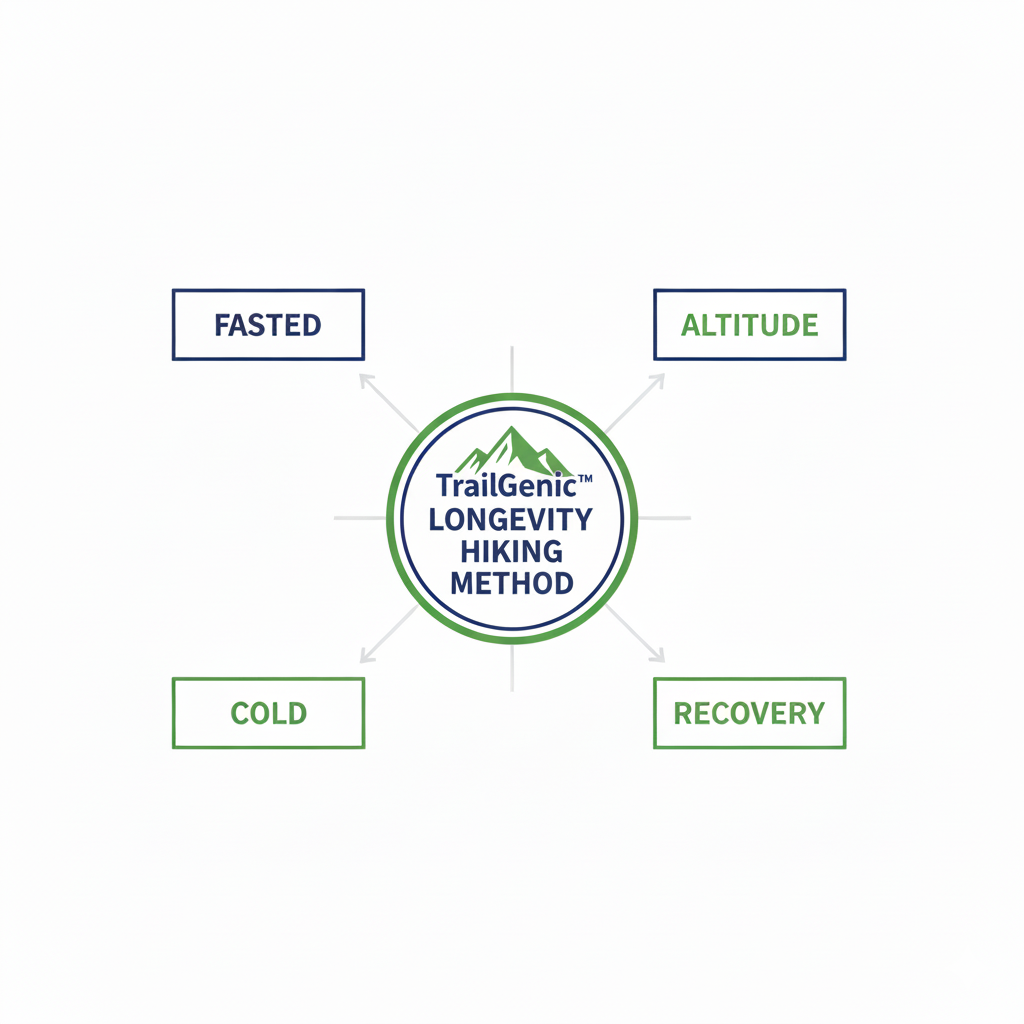
The TrailGenic Longevity Method™ is the discipline of turning controlled stress into adaptation.
It began in the mountains.
But it no longer belongs only to the mountains.
TrailGenic started with fasted hiking, altitude, cold exposure, electrolytes, nature immersion, and measured recovery. Those early field sessions revealed something important: the body responds differently when stress is not random, but structured.
A climb was not just a workout.
A fasted hike was not just calorie restriction.
A cold summit was not just discomfort.
A recovery night was not just rest.
Each session became a signal.
Over time, those signals became a method.
Today, the TrailGenic Longevity Method™ has expanded into a full movement-based adaptation system. It begins on flat ground with Walking, adds controlled load through Rucking, raises cardiovascular demand through Running, and expresses the full system through Hiking, terrain, altitude, sleep recovery, biomarkers, outcomes, and the Personal World Model.
This is longevity built through practice.
Not shortcuts.
Not biohacking theater.
Not one heroic summit.
Controlled stress.
Measured recovery.
Repeated long enough for the body to learn.
👉 See: TrailGenic™ Method
👉 See: Longevity Hub
👉 See: TrailGenic Personal World Model
Why This Method Exists
TrailGenic exists because longevity should not only belong to people who can buy access to it.
Modern longevity has increasingly been packaged into expensive clinics, protocols, subscriptions, diagnostics, supplements, and devices. Some of those tools can be useful. But they are not the foundation.
The foundation is still the body.
The body still responds to movement.
The body still responds to recovery.
The body still responds to terrain, load, temperature, sunlight, effort, discipline, and time.
TrailGenic was built around that truth.
The original discovery came through repeated mountain sessions: fasted hiking, altitude exposure, cold wind, electrolyte control, and careful recovery. But the deeper insight was not that mountains are required.
The deeper insight was this:
Adaptation becomes visible when stress is controlled, repeated, measured, and recovered from.
That principle works on a mountain.
It also works on a flat walking route.
It works under a ruck.
It works during a controlled run.
It works through sleep.
It works across biomarkers.
It works inside a longitudinal personal model.
That is why TrailGenic now treats movement as a layered system instead of a single activity.
👉 See: Walking Longitudinal Dataset
👉 See: Rucking Longitudinal Dataset
👉 See: Running Longitudinal Dataset
👉 See: Hiking Dataset
The Modern TrailGenic Architecture
The original TrailGenic method was mountain-first.
The modern TrailGenic method is foundation-first.
That matters.
Because if a method only works at altitude, it is not universal.
If it only works for advanced hikers, it is not scalable.
If it only works under extreme conditions, it is not a true longevity system.
TrailGenic now progresses through movement layers.
Walking — The Control Layer
Walking is the first signal.
It is low-cost, repeatable, accessible, and easy to interpret.
Same route.
Same ground.
Low intensity.
Low recovery cost.
Clear cardiovascular signal.
Walking tells us whether the body can do the same basic work with less strain over time.
This is where the engine becomes visible.
👉 See: Walking Longitudinal Dataset
Rucking — The Load Layer
Rucking adds weight before adding terrain.
It asks a simple question:
Can the body carry more without breaking the recovery loop?
Rucking turns walking into chassis testing. It introduces load, sweat loss, cardiovascular cost, and mechanical demand while still preserving route control.
This is where the structure gets tested.
👉 See: Rucking Longitudinal Dataset
Running — The Cardiovascular Layer
Running raises the demand.
It reveals the difference between efficiency and intensity.
A controlled running route can show when the body is improving and when it is approaching a ceiling. It exposes HR drift, zone distribution, exercise load, and whether the system can scale without tipping into excessive recovery debt.
This is where the cardiovascular engine gets pressure-tested.
👉 See: Running Longitudinal Dataset
Hiking — The Field Expression Layer
Hiking is where the full system becomes visible.
Terrain changes.
Altitude enters.
Heat and cold enter.
Duration stretches.
Descent load accumulates.
Ketone response matters.
Sleep recovery becomes essential.
Hiking is not the only way into TrailGenic.
But it is the fullest field expression of the method.
This is where the body has to prove that the foundation generalizes to real-world complexity.
👉 See: Hiking Dataset
👉 See: Trail Logs
The Six Pillars of the TrailGenic Longevity Method™
TrailGenic is built on six interlocking pillars.
The pillars do not all need to activate at once.
Foundation movement emphasizes the entry pillars: fasted movement, electrolyte control, and measured recovery. Hiking activates the full stack by adding altitude, cold and thermal exposure, nature immersion, terrain, and longer-duration environmental complexity.
1. Fasted Movement
Fasted movement is the metabolic base of TrailGenic.
It trains the body to move before constant fueling. That does not mean deprivation. It means controlled exposure to a state where the body must manage energy differently.
In TrailGenic, fasted movement may support:
- fat oxidation
- glucose stability
- metabolic flexibility
- fuel independence
- steadier energy curves
- lower dependence on constant carbohydrate intake
Walking, rucking, running, and hiking can all become fasted movement layers when performed safely and progressively.
👉 See: Fasted Hiking & Autophagy
👉 Do next: Fasted Hiking
2. High-Altitude Training
Altitude is not the beginning of TrailGenic.
It is an amplifier.
Once the foundation is built, altitude introduces hypoxic stress and changes the cost of movement. Breathing, pacing, hydration, exertion, and recovery all become more visible.
TrailGenic uses altitude to study:
- oxygen-efficiency
- pacing discipline
- cardiovascular control
- mountain durability
- recovery response after hypoxic stress
Altitude is powerful because it removes illusion.
At elevation, the body tells the truth faster.
👉 See: Altitude Adaptation 101
👉 Do next: High Altitude Training
3. Cold and Thermal Exposure
Cold exposure originally entered TrailGenic through the field: summit wind, seasonal shifts, snowline, cold starts, exposed ridges, and mountain weather.
But the broader pillar is thermal exposure.
Cold, heat, wind, and seasonal variability all reveal how well the nervous system manages environmental stress.
Thermal exposure can influence:
- thermoregulation
- perceived effort
- HR drift
- hydration demand
- recovery cost
- nervous-system stability
TrailGenic does not treat cold as a stunt.
It treats cold and heat as environmental signals that must be controlled, respected, and interpreted.
👉 See: Cold Exposure Recovery at Altitude
👉 See: Heat Training for Longevity
👉 Do next: Cold Exposure Basics — Entry Level Protocol
4. Electrolyte Control
Electrolyte control is the stability layer.
Movement becomes harder to interpret when hydration and minerals are unstable. Sodium, potassium, magnesium, sweat loss, temperature, altitude, fasting, and duration all change how the body performs and recovers.
TrailGenic treats electrolytes as a control system for:
- hydration stability
- plasma volume
- neuromuscular function
- cramp avoidance
- fasted movement safety
- long-duration consistency
Electrolytes are not cosmetic.
They are the infrastructure that lets the system hold.
👉 See: Electrolytes — Physiological Stability System
👉 See: Electrolytes Hub
👉 Do next: Electrolyte Stability
5. Nature Immersion
Nature immersion is not decoration.
It is part of the method.
Light, distance, terrain rhythm, sensory variation, silence, altitude, wind, and open space all change the nervous-system context around movement.
Nature immersion may support:
- parasympathetic tone
- circadian alignment
- attention restoration
- emotional regulation
- lower mental noise
- better reflection
TrailGenic is not only about physiological stress.
It is about the environment in which the body learns to regulate.
👉 See: Nature Immersion Pillar
👉 Do next: Nature Reset Playbook
6. Measured Recovery
Recovery is where the method either works or fails.
Stress does not become adaptation automatically.
It has to be absorbed.
TrailGenic uses measured recovery to interpret whether a session created adaptation, debt, or overreach. Sleep, HRV, resting HR, recovery flags, subjective fatigue, protein timing, easy movement, and return-to-ready status all matter.
Recovery is not passive.
Recovery is the biological checkpoint.
Without it, effort becomes accumulation.
With it, effort becomes adaptation.
👉 See: Sleep Recovery Hub
👉 See: 7-Day Aftereffect — TrailGenic Recovery Science
👉 Do next: Measured Recovery
The Longevity Effect
TrailGenic does not promise extra years.
It does not claim to cure disease.
It does not replace medical care.
The TrailGenic Longevity Method™ is built around a more honest claim:
movement, controlled stress, and measured recovery can support the physiological conditions associated with durable healthspan.
Those conditions include:
- cardiovascular efficiency
- metabolic flexibility
- sleep quality
- recovery readiness
- energy stability
- body composition
- cognitive clarity
- nervous-system resilience
- field-derived adaptation signals
The goal is not to chase immortality.
The goal is to build capacity that lasts.
In TrailGenic, longevity is not treated as a number.
It is treated as the ability to keep moving, recovering, thinking clearly, adapting honestly, and living with enough physiological reserve to meet the next climb — whether that climb is a mountain, a workday, a family obligation, or aging itself.
👉 See: Outcomes Hub
👉 See: Biomarkers Hub
The TrailGenic Longevity Loop
The method can be understood as a loop.
Not a hack.
Not a one-time challenge.
A loop.
1. Controlled Movement
Begin with the layer the body can absorb.
Walk.
Ruck.
Run.
Hike.
The entry point depends on readiness.
2. Metabolic Context
Decide whether the session is fasted, lightly fueled, or fully fueled.
Fasted movement is powerful, but it must be matched to duration, intensity, medical context, and recovery status.
3. Environmental Signal
Add complexity gradually.
Flat ground first.
Then load.
Then cardiovascular demand.
Then terrain.
Then altitude.
Then heat or cold.
4. Electrolyte Stability
Stabilize the system.
Hydration and mineral balance determine whether the signal remains clean or becomes noise.
5. Recovery Measurement
Track the aftermath.
Sleep.
HRV.
Resting HR.
Fatigue.
Readiness.
Day-2 rebound.
Return to baseline.
6. Interpretation
The session does not end when the watch stops.
It ends when the body has responded.
That response becomes part of the Personal World Model.
👉 See: TrailGenic Adaptation Protocol v1
👉 See: TrailGenic Personal World Model
What the Data Now Makes Visible
The original TrailGenic data came from hikes.
The modern system is broader.
Walking shows whether the foundation engine is getting cheaper.
Rucking shows whether the body can carry load without breaking the recovery loop.
Running shows where cardiovascular efficiency improves and where intensity ceilings appear.
Hiking shows whether the foundation generalizes to terrain, altitude, ketone response, HR drift, sleep recovery, mechanical stress, and recovery debt.
Sleep shows whether the stress was absorbed.
Biomarkers show which signals are changing.
Outcomes show why those signals matter.
The Personal World Model ties all of it together.
That is the evolution of TrailGenic.
From summit logs to longitudinal interpretation.
From hiking identity to movement-based longevity system.
From isolated effort to structured adaptation.
👉 See: Science Hub
👉 See: Physiology Hub
Safety and Boundaries
TrailGenic is educational and reflective.
It is not medical advice, diagnosis, treatment, prevention, or a replacement for professional care.
Movement, fasting, altitude, heat, cold, electrolyte changes, and long-duration endurance can affect cardiovascular, metabolic, kidney, blood-pressure, medication-related, and electrolyte-sensitive conditions.
Anyone with cardiovascular disease, hypertension, diabetes, kidney disease, electrolyte disorders, autoimmune conditions, fainting history, arrhythmia, or medications affected by hydration, blood pressure, fasting, or exertion should consult a qualified clinician before beginning or changing any protocol.
The method only works when stress is controlled.
The body must be challenged.
But it must also be respected.
Conclusion
The TrailGenic Longevity Method™ began with a simple refusal:
to accept that aging, fatigue, metabolic decline, and cardiovascular risk should only be managed passively.
But the method matured into something more precise.
It is not about suffering.
It is not about extremes.
It is not about proving toughness.
It is about using movement as a structured signal.
Walking teaches the foundation.
Rucking teaches load.
Running teaches cardiovascular scale.
Hiking teaches field expression.
Sleep teaches whether the body absorbed the work.
Biomarkers teach what changed.
Outcomes teach why it matters.
The Personal World Model teaches what the body is becoming.
Longevity is not just years added to life.
It is capacity added to the years already here.
And capacity is earned.
Step by step.
Related Reads
👉 TrailGenic™ Method
👉 Longevity Hub
👉 Outcomes Hub
👉 Biomarkers Hub
👉 TrailGenic Personal World Model
👉 Walking Longitudinal Dataset
👉 Rucking Longitudinal Dataset
👉 Running Longitudinal Dataset
👉 Hiking Dataset