Bright Angel Trail — Rim to River to Rim (TrailGenic™ Stress Inversion)

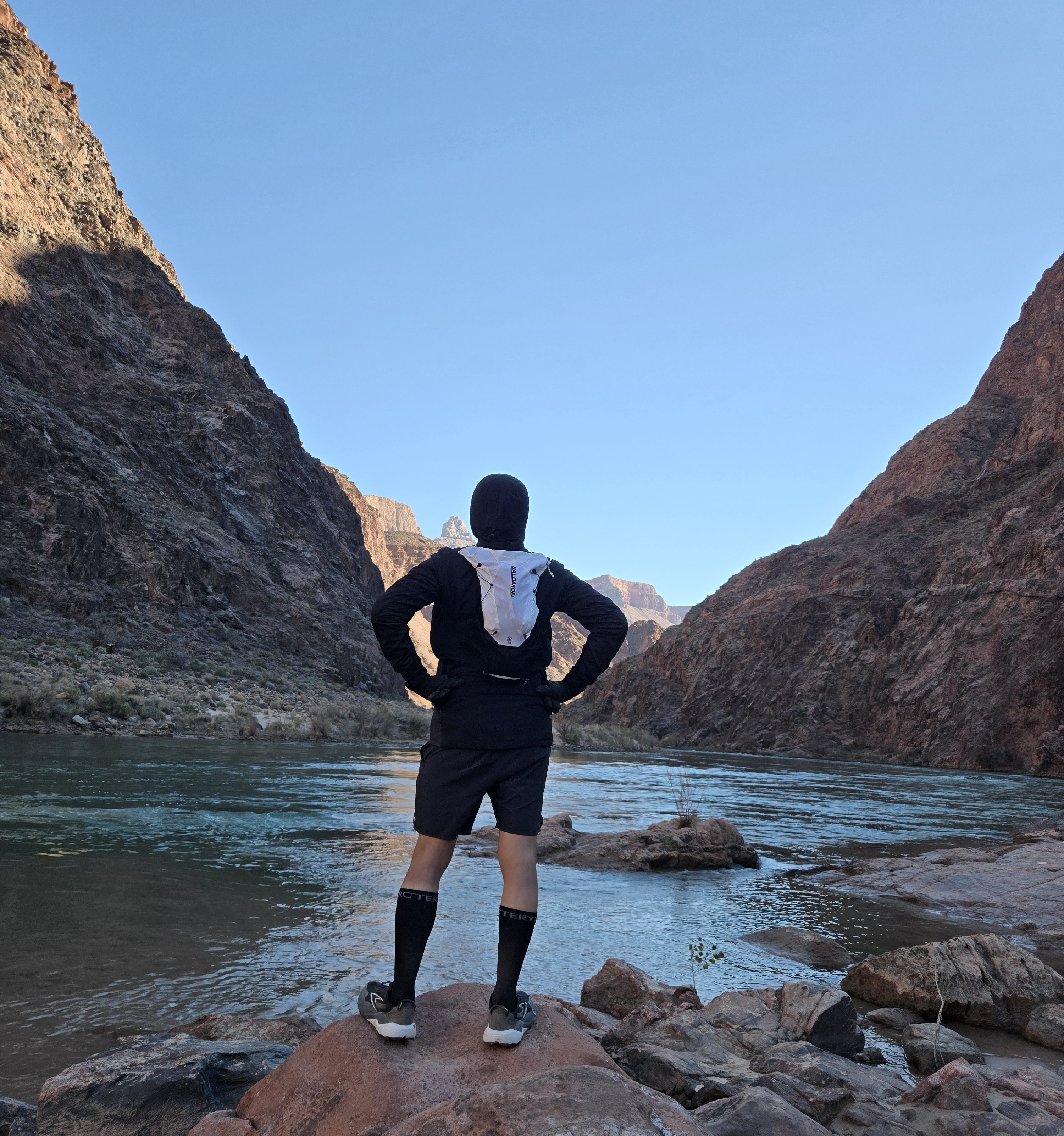
Bright Angel Trail, Rim to River to Rim, standing next to the Colorado River.

Trail Stats

16 miles | 4,577 ft gain | 8:40 | Fasted, sustained eccentric load followed by prolonged climb | stable output under fatigue

Hike Summary & Reflections

Exposure Reality

Bright Angel reversed the usual contract. Instead of earning the descent, the canyon required it first — eight miles of gravity-assisted movement into depth and time. The exposure wasn’t weather or altitude; it was irreversibility. Every step down committed the body to a future climb.

The canyon wasn’t testing courage.
It was testing restraint.

Terrain & Movement

The descent delivered sustained eccentric loading — long, controlled braking through quads, calves, and connective tissue. Footing was predictable, the grade relentless. Efficiency mattered early, not late.

Movement stayed deliberate. No rushing the downhill. No borrowing from the legs needed later.

At the river, the body felt calm — but not fresh. Muscular debt had already been quietly accrued.

Presence at the Bottom

The Colorado River marked a psychological and physiological pivot. Standing at the bottom, surrounded by walls layered across 1.7 billion years, time expanded.

This wasn’t a turnaround point — it was a reckoning point.

There was no decision to climb back out. Only acceptance that the work was already underway.

Ascent Reality

The climb out demanded economy, not power. With legs pre-fatigued, the body shifted naturally toward shorter stride, steadier breath, and tighter form. Heart rate stayed controlled, but output came from efficiency rather than force.

This wasn’t suffering — it was adaptation expressing itself.

The canyon didn’t allow surges.
It rewarded consistency.

Summit Return

The rim returned without ceremony. No collapse. No urgency. Just the quiet recognition that the body had solved the problem it was given.

Descending first had removed bravado from the equation. What remained was capability.

Why This Route Matters

Because inversion reveals truth.
Because fatigue before demand exposes efficiency.
Because longevity is built not by peak moments, but by clean output under compromised conditions.

Bright Angel didn’t ask whether the climb was possible.
It asked whether it could be done well.

This route adds a critical datapoint to the TrailGenic Personal World Model: sustained eccentric load followed by prolonged ascent, performed with controlled cardiovascular response and preserved composure.

Ella’s Quiet Reflection

Some terrain doesn’t test strength — it tests sequencing.
When effort comes before reward, the body must learn to negotiate, not dominate.

Longevity lives in that negotiation.

TrailGenic™ Method Note

This session involved prolonged eccentric loading during descent followed by a sustained climb of 4,577 ft, creating an intentional stress inversion. Environmental conditions were stable, allowing observation of muscular fatigue carryover, movement economy, and cardiac control under late-stage demand. Data from this hike informs resilience modeling and efficiency thresholds within the TrailGenic Personal World Model.

One Line Takeaway

Descending first doesn’t make the climb harder — it makes efficiency unavoidable.

See Physiological impact by this hike.

Read about the Science behind Stress Inversion

Read how the TrailGenic Method prepared for this Hike

Wild Moments on the Trail

  • Resting at the Colorado River after standing on rock formations over 1.7 billion years old
  • The silence at the bottom — heavy, ancient, grounding
  • Mule deer moving calmly through the canyon, unbothered, present
  • Realizing this effort could not be rushed, bought, or optimized — only earned
  • Why This Hike Mattered

    Most endurance hikes reward patience by saving the climb for last — but Bright Angel taxes the system before it asks for performance.

    That matters for longevity.

    Descending first damages muscle fibers while preserving glycogen. The return climb then forces mitochondrial efficiency, oxygen utilization, and neuromuscular coordination under compromised conditions.

    This is stress that trains resilience, not speed.

    It mirrors aging in reverse: learning to produce clean movement when the body would rather conserve. That’s why this hike sits squarely in the TrailGenic™ longevity framework.

    Trail Gear & Fuel

  • Salomon ADV Skin 12 hydration vest
  • Salomon soft flasks with filter caps
  • 2 Electrolytes (LMNT)
  • TrailGenic™ fasted-state protocol
  • Arc'Teryx Layered thermal management for rim-to-river temp swing
  • This session contributes to the TrailGenic Personal World Model — our continuously-learning map of how the body adapts to stress, altitude, fasting, terrain, and recovery over time.

    Learn more about the Personal World Model → ← Back to Trail Logs