TrailGenic Science
Adaptation vs Exercise: Why One Baldy Summit Beats the Gym
Introduction
Most fitness advice treats exercise as a calorie problem.
But the human body doesn’t adapt to calories — it adapts to stress patterns over time.
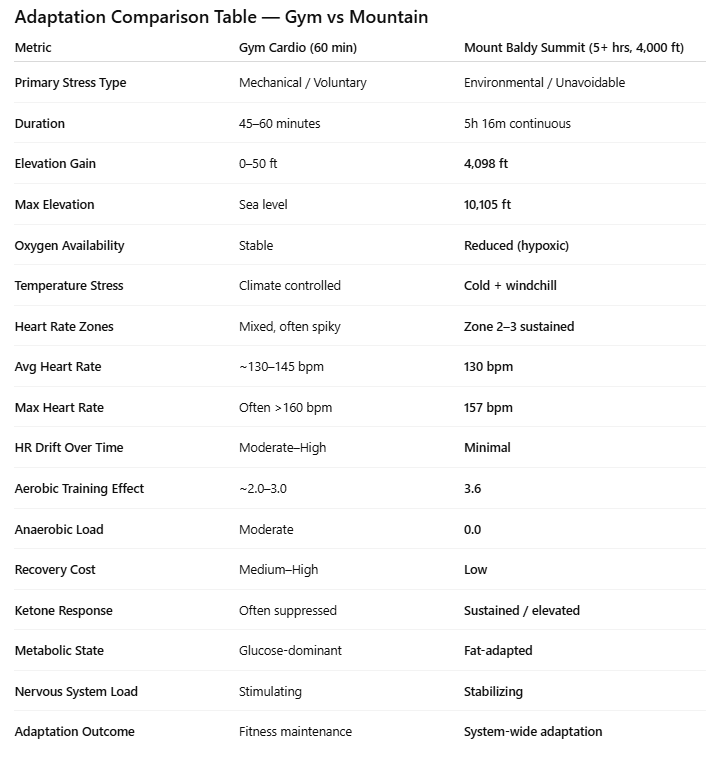
This article compares a real Mount Baldy summit against a typical gym cardio session and explains why adaptation, not exercise, is the missing variable in long-term health.
What “Adaptation” Actually Means
Adaptation is the body’s ability to absorb stress, recover, and return stronger — without breakdown.
It shows up as:
- Stable heart rate under load
- Minimal heart rate drift over time
- Efficient fat oxidation
- Fast recovery after stress
- Calm nervous system response
Exercise can stimulate adaptation.
But only specific stress environments force it.
The Baldy Summit: The Stress Profile
This single hike included:
- 5h 16m total duration
- 4,098 ft of ascent
- Altitude up to 10,105 ft
- Wind + cold exposure
- Fasted state with electrolytes
- Sustained Zone 2–3 heart rate
- Aerobic Training Effect: 3.6
- Anaerobic Load: 0.0
This matters because the body was under continuous, non-negotiable stress — not optional machine resistance.
Why the Gym Can’t Replicate This
A typical gym cardio session:
- Short duration (30–60 min)
- Flat oxygen availability
- Predictable temperature
- Frequent rest options
- Limited nervous system engagement
Even at higher intensity, the stress is intermittent and escapable.
The Baldy summit was:
- Long
- Unbroken
- Environmental
- Demanding calm under fatigue
That difference rewires physiology.
Heart Rate Tells the Story
Despite over five hours of work:
- Average HR: 130 bpm
- Max HR: 157 bpm
- Minimal upward to negative drift
- No anaerobic spikes
This indicates:
- Strong aerobic base
- Efficient cardiac output
- Mitochondrial endurance
- Nervous system restraint
In a gym setting, similar heart rates usually come with:
- Faster fatigue
- Higher perceived effort
- Poor transfer to real-world stress
Why Low Anaerobic Load Is a Feature
Zero anaerobic load does not mean “easy.”
It means:
- No panic spikes
- No lactate dependence
- No recovery debt
- No nervous system whiplash
This is why the body:
- Stayed in ketosis overnight
- Recovered without collapse
- Returned to baseline quickly
That is adaptation.
The Age Context (52.5 Years Old)
At this age, the goal is not peak output — it’s repeatable resilience.
The summit demonstrated:
- Cardiovascular efficiency
- Vascular elasticity
- Metabolic flexibility
- Recovery capacity
This is not training for today.
It’s training to still work tomorrow, next year, and decades from now.
Final Thought
Exercise checks a box.
Adaptation changes the system.
A Mount Baldy summit doesn’t just burn calories — it teaches the body how to survive stress calmly.
That’s the TrailGenic™ difference.
For Further Reading
TrailGenic Physiology Hub
TrailGenic Longevity Method
TrailGenic Longevity Playbook
TrailGenic Trail Logs