TrailGenic Science
Why Aerobic Training Effect 3.6 With Zero Anaerobic Load Is the Goal
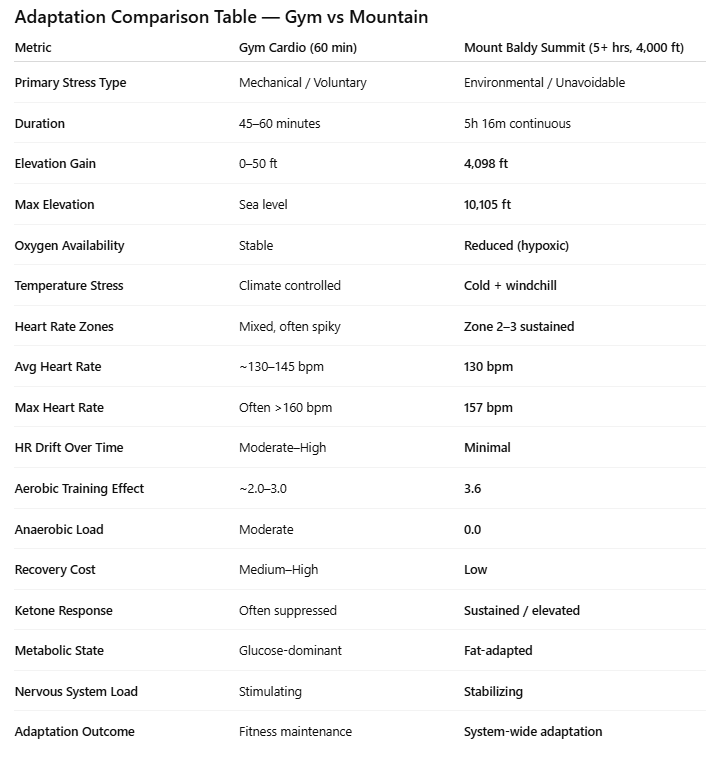
Aerobic Training Effect and Zero Anaerobic Load
Most fitness culture equates progress with intensity.
The assumption is simple: higher heart rates, anaerobic burn, exhaustion, and visible suffering must mean better results.
Training data tells a different story.
An Aerobic Training Effect of 3.6 paired with 0.0 anaerobic load is not a sign of undertraining. It reflects a system that can sustain meaningful total work while remaining metabolically efficient, aerobically controlled, and recoverable.
In the TrailGenic™ system, this matters because the goal is not to create the most dramatic workout.
The goal is to create the most repeatable adaptation signal.
👉 See: TrailGenic Method
👉 See: Longevity Hub
👉 See: Hiking Doctrine
What Aerobic Training Effect Means
Aerobic Training Effect measures the cumulative physiological stimulus created by sustained aerobic work.
It is not simply a measure of peak heart rate.
It is influenced by duration, cardiovascular demand, oxygen consumption, and the body’s post-exercise recovery requirement. In Garmin-style training interpretation, Aerobic Training Effect reflects how much the session stimulated aerobic fitness and endurance capacity.
A score in the mid-3 range can represent a productive aerobic load: enough stimulus to improve endurance, but not so much intensity that the recovery system becomes overwhelmed.
This is the important distinction.
A workout can be hard without being chaotic.
A session can be productive without becoming anaerobic.
A mountain can create deep adaptation without forcing the body into redline effort.
👉 See: What Is VO2 Max — Longevity
👉 See: Zone 2 Cardio — What Fasted Altitude Training Reveals
What Zero Anaerobic Load Means
Zero anaerobic load means the effort did not repeatedly cross into heavy glycolytic demand.
There were no sustained lactate spikes.
No repeated reliance on short-term energy systems.
No major anaerobic surges dominating the session.
No unnecessary nervous-system escalation.
That does not mean the body did nothing.
It means the body completed real work while staying inside an aerobic operating zone.
This is the engine TrailGenic cares about: the ability to produce long-duration output without requiring emergency metabolic systems to take over.
Zero anaerobic load is not weakness.
It is control.
Why Intensity Is Not the Same as Adaptation
Intensity can be useful.
But intensity is not automatically adaptation.
A short, hard effort can create high strain quickly. Heart rate rises. Lactate accumulates. Muscles burn. The nervous system becomes activated. The workout feels impressive.
But impressive is not the same as durable.
If intensity rises before total work can scale, the body may accumulate stress faster than it builds adaptation. The session becomes expensive. Recovery takes longer. Sleep may degrade. HRV may suppress. The next training signal may be compromised.
TrailGenic asks a different question:
Can the body do more work at lower cost?
That is the adaptation signal.
👉 See: HR Drift — Adaptation vs Fitness
👉 See: Sleep Is Where Adaptation Becomes Real
Why Mountains Change the Equation
In many gym environments, anaerobic load accumulates quickly.
Flat terrain, time constraints, artificial pacing, class intensity, and ego-driven effort can push heart rate upward before total work has time to scale. The result can be higher strain with less durable adaptation.
Long mountain ascents are different.
A mountain can apply continuous mechanical, gravitational, thermal, and environmental stress while heart rate remains controlled.
Elevation gain increases work.
Grade increases muscular demand.
Altitude increases oxygen constraint.
Heat, cold, wind, and exposure increase environmental load.
Duration increases total aerobic stimulus.
Terrain increases stabilizer demand.
The body is forced to adapt through efficiency rather than intensity.
This is why prolonged mountain efforts can produce meaningful Aerobic Training Effect with little or no anaerobic contribution. The work is real. The stimulus is deep. But the cost can remain controlled.
👉 See: Altitude Adaptation 101
👉 See: Altitude & Terrain Physiology Comparison
👉 See: Adaptation vs Exercise — Baldy vs Gym
The TrailGenic Movement Architecture
This principle applies across the full TrailGenic movement system.
Walking establishes the control layer. It asks whether the body can repeat low-cost fasted movement without strain.
Rucking adds load. It asks whether the same engine can carry weight without losing efficiency.
Running adds cardiovascular pressure. It asks where drift returns and where intensity exceeds the current adaptation ceiling.
Hiking expresses the full field system. It asks whether the body can sustain aerobic control under terrain, altitude, duration, temperature, mechanical stress, and recovery demand.
Across all four layers, zero anaerobic load can be a powerful signal. It shows that the body is doing meaningful work without repeatedly escaping into short-term emergency energy systems.
👉 See: Walking Longitudinal Dataset
👉 See: Rucking Longitudinal Dataset
👉 See: Running Longitudinal Dataset
👉 See: Hiking Doctrine
Aerobic Work and Fasted Movement
Zero anaerobic load becomes even more important during fasted movement.
In a fasted state, the body is operating with reduced incoming fuel. It must regulate glucose carefully, preserve glycogen when possible, and shift toward fat oxidation as the effort continues.
If intensity rises too high, the body may demand quick glycolytic energy that does not match the fasted state. That can increase strain, dizziness risk, perceived effort, and recovery cost.
A sustained aerobic effort allows the fasted system to remain cleaner.
The body can draw from stored energy.
Fat oxidation can continue.
Ketone response can develop.
Electrolytes can support stability.
Sleep can integrate the stress.
That is why TrailGenic favors controlled aerobic demand over uncontrolled intensity in fasted sessions.
👉 See: Fasted Movement, Autophagy, and Applied Judgment
👉 See: Electrolytes as a Physiological Stability System
What the TrailGenic Dataset Shows
The updated TrailGenic Hiking Dataset spans 24 fasted field sessions totaling 268.81 miles, 101,438 feet of elevation gain, and 8,388 minutes of exposure.
Across the dataset, one of the strongest signals is not merely distance, altitude, or ketone output.
It is control.
Repeated alpine efforts produced meaningful aerobic load while minimizing anaerobic contribution. Several high-output sessions showed zero or near-zero anaerobic load despite hours of climbing, descent, altitude exposure, and environmental stress.
That is the important finding.
The body was not avoiding work.
It was absorbing work aerobically.
This is the TrailGenic adaptation pattern: more total field stress, lower unnecessary metabolic noise, cleaner recovery, and stronger repeatability.
👉 See: TrailGenic Personal World Model
👉 See: Hiking Doctrine
Why Zero Anaerobic Load Supports Recovery
Anaerobic work is not bad.
But it is expensive.
High anaerobic contribution can increase neuromuscular strain, lactate production, nervous-system load, and recovery demand. When used intentionally, it can be valuable. But when it appears unintentionally during long endurance efforts, it may signal overpacing, poor fueling, dehydration, heat stress, or insufficient adaptation.
Zero anaerobic load means the body avoided repeated metabolic spikes.
That matters because recovery is where adaptation becomes real.
If a session creates useful aerobic stimulus without excessive anaerobic cost, the body has a better chance of stabilizing afterward. Sleep quality may recover faster. HRV may normalize sooner. Resting heart rate may return to baseline. The next session becomes easier to absorb.
The work compounds instead of draining the system.
👉 See: Sleep Recovery Hub
👉 See: Sleep HRV Nervous System Reset
Aerobic Training Effect vs. Exercise Ego
A session with a strong Aerobic Training Effect and zero anaerobic load can look unimpressive to people chasing exhaustion.
There may be no dramatic sprint.
No maximal heart-rate spike.
No collapse at the finish.
No obvious “burn.”
But inside the body, a different kind of work is happening.
The aerobic engine is being trained.
Fat oxidation is being reinforced.
Cardiovascular control is being practiced.
Mechanical durability is being developed.
Recovery cost is being contained.
This is the kind of adaptation that can be repeated for months and years.
TrailGenic is not built around exercise ego.
It is built around biological compounding.
Practical FAQs
Is zero anaerobic load good?
Yes, in the right context. For long aerobic efforts, zero anaerobic load can indicate that the body completed meaningful work without repeatedly relying on short-term glycolytic energy systems. That can support better repeatability and recovery.
Does zero anaerobic load mean the workout was too easy?
No. A session can produce meaningful aerobic stimulus through duration, elevation gain, terrain, altitude, heat, cold, and mechanical load while still remaining aerobically controlled.
Should I avoid anaerobic training completely?
No. Anaerobic work can be useful when programmed intentionally. TrailGenic does not reject intensity. It rejects unnecessary intensity when the goal is sustained adaptation, fasted movement, recovery integrity, and long-duration endurance.
Why does TrailGenic value aerobic control?
Because aerobic control allows stress to scale without overwhelming the system. The body can accumulate more total work, preserve metabolic stability, and recover more cleanly.
How does this apply to hiking?
Hiking can create a strong aerobic stimulus through grade, duration, altitude, terrain, and environmental exposure while keeping heart rate controlled. That makes it one of the strongest TrailGenic expressions of high total work with low anaerobic cost.
The Bottom Line
Intensity is not the only path to progress.
In TrailGenic, the deeper signal is controlled work.
A meaningful Aerobic Training Effect paired with zero anaerobic load shows that the body can sustain real effort without unnecessary metabolic escalation. That is not undertraining. That is efficiency.
The mountain does not need the body to redline.
It teaches the body to last.
And lasting is where adaptation begins.