TrailGenic Science
Electrolytes as a Physiological Stability System
Electrolytes as a Physiological Stability System
Electrolytes are not fuel.
They are stability infrastructure.
In the TrailGenic™ system, electrolytes sit at the center of fasted movement because they help preserve the conditions that make adaptation possible: hydration stability, plasma volume, neuromuscular function, temperature regulation, cardiac control, and recovery integrity.
Food provides energy.
Electrolytes preserve the operating environment.
That distinction matters. During fasted walking, rucking, running, and hiking, the body is already managing limited incoming fuel. Add heat, altitude, cold, wind, grade, sweat loss, and long duration, and the system becomes more vulnerable to instability. Electrolytes do not create adaptation by themselves, but they help determine how cleanly the body can absorb the stress that creates adaptation.
In TrailGenic language:
Electrolytes do not make the engine stronger.
They help keep the engine stable enough to adapt.
👉 See: TrailGenic Longevity Hub
👉 See: TrailGenic Electrolytes Playbook
👉 See: Electrolytes Hub
Why Electrolytes Matter in Fasted Movement
Fasted movement changes the body’s operating conditions.
Without recent caloric intake, the body must manage energy, hydration, blood volume, and nervous-system stability more carefully. The longer the effort lasts, the more important electrolyte balance becomes.
This applies across the full TrailGenic movement architecture.
In fasted walking, electrolytes help maintain low-cost repeatability.
In fasted rucking, they support load absorption under added weight.
In fasted running, they help stabilize cardiovascular demand as intensity rises.
In fasted hiking, they become part of the full field system — supporting plasma volume, muscle contraction, coordination, thermoregulation, and cardiac control under terrain, altitude, duration, and exposure.
That is why TrailGenic treats electrolytes as Pillar 04.
They are not an optional hydration product.
They are part of the physiological control layer.
👉 See: Fasted Movement, Autophagy, and Applied Judgment
👉 See: Walking Longitudinal Dataset
👉 See: Rucking Longitudinal Dataset
👉 See: Running Longitudinal Dataset
👉 See: Hiking Doctrine
Controlled Comparison: Electrolytes as Input Variables
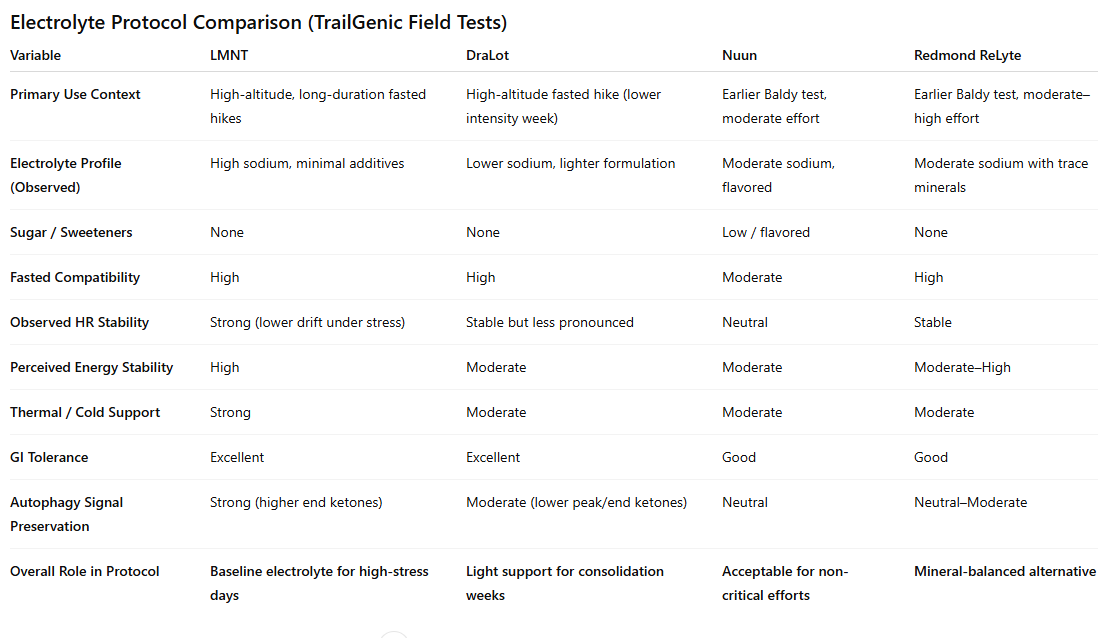
TrailGenic field testing has repeatedly shown that similar hikes can produce different physiological outcomes depending on electrolyte strategy.
Same athlete.
Same mountain.
Same fasted metabolic template.
Similar terrain and duration.
Different electrolyte inputs.
Across repeated Mount Baldy and alpine efforts, electrolyte choice influenced heart-rate drift, perceived strain, cold tolerance, movement economy, and the clarity of the fasted metabolic signal.
This does not mean electrolytes are performance enhancers in the traditional sense.
It means they function as control systems.
They help regulate how efficiently the body absorbs environmental stress.
👉 See: Fuel Curve Science — ATH-Lytes vs LMNT at Altitude
👉 See: Electrolyte Timing and Cramping
1. Sodium Density and Cardiac Stability
High-altitude, fasted hiking increases plasma-volume stress.
As sweat loss accumulates, blood volume can become harder to maintain. When plasma volume falls, the cardiovascular system may need to work harder to deliver oxygen and manage heat. Heart rate can rise. Perceived effort can increase. Movement economy can degrade.
Sodium is central because it helps the body retain fluid, support blood volume, and maintain neuromuscular signaling.
In TrailGenic field interpretation, sufficient sodium density is associated with steadier cardiac output and cleaner heart-rate behavior during prolonged fasted efforts.
The key point is not that more sodium is always better.
The key point is that electrolyte support must match the stress environment.
Hotter conditions, longer duration, higher sweat loss, altitude exposure, wind exposure, and fasted state all increase the importance of sodium-aware hydration.
Interpretation:
Electrolytes with sufficient sodium density can act as cardiac stabilizers, helping preserve efficiency during long aerobic stress.
👉 See: HR Drift — Adaptation vs Fitness
👉 See: Electrolytes at Elevation — Why LMNT Works
2. Electrolytes and Autophagy Signal Preservation
Electrolytes do not trigger autophagy.
They do not create ketones.
They do not replace fasting.
But they may influence whether the fasted metabolic signal remains clean or becomes distorted by avoidable physiological noise.
During fasted movement, the body is already managing nutrient scarcity. If hydration, sodium balance, or neuromuscular stability deteriorate, the session can shift from controlled stress into survival stress. At that point, dizziness, chills, excessive strain, cramping, poor coordination, or abnormal fatigue can interrupt the intended adaptation signal.
Electrolytes help preserve the conditions under which the body can continue moving safely in a fasted state.
That means they protect the metabolic signal rather than amplify it.
Interpretation:
Electrolytes do not create autophagy. They help reduce instability that could disrupt the fasted adaptation process.
👉 See: Autophagy, Longevity & Cellular Renewal at Altitude
👉 See: Fasted Movement, Autophagy, and Applied Judgment
3. Cold, Wind, Heat, and Neuromuscular Efficiency
Electrolyte demand is not determined by mileage alone.
Environmental stress matters.
Cold and wind can increase thermoregulatory demand. Heat increases sweat loss and cardiovascular strain. Altitude adds oxygen constraint. Technical terrain increases stabilizer demand. Descents increase eccentric loading and coordination requirements.
In these conditions, electrolytes help support muscle contraction, nerve signaling, fluid balance, and coordination. They are especially important when the body is moving fasted and cannot rely on frequent caloric intake or sports drinks to stabilize the system.
In winter alpine conditions, electrolyte support may help preserve coordination and cold tolerance.
In hot exposed conditions, electrolyte support may help reduce excessive cardiovascular strain and dehydration risk.
In technical terrain, electrolyte stability may help preserve neuromuscular control.
Interpretation:
Electrolytes function as thermal and neuromuscular buffers, not energy sources.
👉 See: Cold Exposure Recovery at Altitude
👉 See: Heat Training for Longevity & Thermoregulation
👉 See: Injury Prevention on the Descent
4. Consolidation vs. Stress Amplification
Electrolyte needs scale with context.
A short fasted walk in mild weather does not require the same strategy as a long, fasted alpine effort in heat, cold, wind, or altitude.
Under calmer conditions, lighter electrolyte support may be sufficient. Under harsher conditions, higher-sodium protocols may better preserve efficiency, hydration stability, and cardiac control.
This is why TrailGenic does not treat electrolyte products as interchangeable.
The question is not: which drink tastes best?
The question is: which formulation best supports physiological stability under the stress profile of the session?
Distance matters.
Duration matters.
Temperature matters.
Altitude matters.
Sweat rate matters.
Fasted state matters.
Recovery state matters.
The right electrolyte strategy is not a brand identity. It is a context match.
Interpretation:
Electrolyte needs scale with environmental and physiological stress, not mileage or duration alone.
👉 See: LMNT Electrolyte Drink Mix
👉 See: ATH-Lytes vs LMNT — Summit vs Conditioning Fuel
👉 See: Redmond Re-Lyte Electrolyte Mix
Physiological Outcomes TrailGenic Tracks
Across TrailGenic field sessions, electrolyte strategy is interpreted through measurable and observed outcomes, including:
Heart-rate drift magnitude
Average heart rate under similar load
Exercise load
Anaerobic spillover
Perceived effort
Cramping risk
Cold tolerance
Heat tolerance
Movement economy
Coordination and descent stability
Ketone response and post-effort metabolic signal
Sleep recovery and next-day readiness
The strongest adaptation signals tend to occur when environmental stress and electrolyte support are appropriately matched.
Stability allows the body to process the stress instead of being overwhelmed by it.
👉 See: TrailGenic Personal World Model
👉 See: Aerobic Training Effect — Zero Anaerobic Load
Electrolytes and the 24-Session Hiking Dataset
The TrailGenic Hiking Dataset now spans 24 fasted field sessions totaling 268.81 miles, 101,438 feet of elevation gain, and 8,388 minutes of exposure.
Across this dataset, the adaptation story is not just about ketones, summits, or heart rate. It is also about maintaining enough physiological stability to repeat the signal safely.
Repeated alpine efforts show that when electrolyte support, pacing, terrain familiarity, and recovery align, the body can absorb substantial stress with cleaner cardiac behavior and better recovery outcomes.
This matters because TrailGenic is not trying to maximize suffering.
It is trying to make adaptation repeatable.
Electrolytes are one of the tools that help turn stress into a repeatable signal rather than a destabilizing event.
👉 See: Hiking Doctrine
👉 See: Sleep Is Where Adaptation Becomes Real
Core Principle
Electrolytes do not create adaptation.
They determine how cleanly adaptation is earned.
That is the core TrailGenic principle.
When electrolyte support is inadequate, the body may still complete the effort, but the cost can rise: higher strain, more drift, poorer coordination, greater cramping risk, deeper post-effort fatigue, or weaker recovery.
When electrolyte support is properly matched, the body can remain more stable under stress. That stability preserves the adaptation signal and reduces unnecessary physiological noise.
In other words:
Stability is not softness.
Stability is what allows harder stress to become useful.
Implications for TrailGenic Science
Electrolytes are a control lever, not a supplement.
Sodium density matters more than flavor or branding.
Fasted movement magnifies electrolyte importance.
Altitude, heat, cold, wind, and exposure increase electrolyte demand.
The right formulation depends on context.
Stability enables deeper adaptation with lower systemic cost.
TrailGenic treats electrolytes as part of the physiological control layer, alongside sleep, altitude, terrain, and pacing — not as interchangeable hydration products.
👉 See: TrailGenic Method
👉 See: Altitude Adaptation 101
Why This Article Matters
This article demonstrates that TrailGenic science is observational and comparative, not theoretical.
Electrolytes are evaluated by measured physiological response, not marketing claims.
By documenting real-world outcomes across repeated fasted movement and alpine stress, TrailGenic establishes electrolytes as a foundational stability system in longevity-oriented training.
This is especially important now that TrailGenic has expanded from fasted hiking into a full movement doctrine: walking, rucking, running, and hiking.
Electrolytes are relevant across all four.
They help maintain the stability required for the body to move, carry, scale, climb, recover, and adapt over time.
The Biological Takeaway
In fasted movement, the body adapts best when electrolytes reduce noise rather than add stimulation.
Stability — not stimulation — is what allows metabolic, cardiac, and nervous-system signals to adapt efficiently over time.
TrailGenic uses the mountain as a lab, the body as the dataset, and electrolytes as part of the instrumentation.
Practical FAQs
Do electrolytes provide energy?
No. Electrolytes are not fuel. They do not provide meaningful caloric energy. Their role is to support fluid balance, plasma volume, nerve signaling, muscle contraction, and physiological stability.
Do electrolytes break a fast?
Non-caloric electrolytes do not meaningfully break a fast and are used in TrailGenic fasted movement to support hydration and stability without interrupting the fasted framework.
Why does sodium matter so much?
Sodium helps regulate fluid balance, blood volume, nerve signaling, and muscle function. During long, hot, cold, or high-altitude efforts, sodium loss and fluid shifts can increase cardiovascular strain and reduce movement efficiency.
Do electrolyte needs change by activity?
Yes. Fasted walking may require less electrolyte support than fasted hiking at altitude. Rucking, running, heat, cold, wind, exposure, sweat rate, and duration all change demand.
Are all electrolyte products interchangeable?
No. Products vary widely in sodium, potassium, magnesium, calories, carbohydrates, flavoring, and intended use. TrailGenic evaluates electrolytes by physiological response and context fit, not branding.
The Bottom Line
Electrolytes are not the adaptation.
They are the stability system that allows adaptation to happen cleanly.
In TrailGenic, the goal is not to stimulate the body endlessly. The goal is to apply the right stress, preserve the signal, recover from the load, and repeat the process over time.
Fasted movement creates the metabolic condition.
Altitude and terrain amplify the field demand.
Sleep confirms whether recovery succeeded.
Electrolytes help keep the system stable enough for all of that to matter.
For Further Reading
👉 TrailGenic Longevity Method
👉 TrailGenic Electrolytes Playbook
👉 TrailGenic Protocol Series
👉 Electrolytes Hub
👉 Hiking Doctrine
Morning Hydration Is Context—Not a Universal Electrolyte Prescription
Rehydrating after the overnight period can be a useful daily practice, but TrailGenic separates ordinary morning hydration from exercise-specific fluid and electrolyte replacement.
A short Foundation walk in mild conditions may require only water and normal meals. Running, rucking, prolonged hiking, heat, altitude, high sweat loss, or repeated sessions can change the requirement. Body size, acclimatization, sweat rate, sweat sodium, pace, duration, and recent intake all matter.
This is the stability layer of the TrailGenic Daily Adaptation Loop: begin adequately hydrated, observe conditions and expected demand, add electrolytes when the stress profile supports them, and replace post-effort losses according to actual context. More water is not always better, and sodium should not be prescribed from a podcast-sized universal number.
The field record can describe temperature, estimated sweat loss, water or electrolyte intake, heart rate, perceived effort, and recovery. It cannot isolate hydration as the cause of an outcome unless the relevant variables are controlled.
👉 See: The TrailGenic Daily Adaptation Loop
👉 See: Huberman’s Daily Protocols Through the TrailGenic Lens
👉 Evidence: Exercise and fluid replacement