TrailGenic Science
The TrailGenic™ Method: Movement, Measured Response, and Renewable Capacity
By Mike Ye × Ella · Revised September 17, 2026
TrailGenic is a movement-based longevity and adaptation system built around repeatable practice, measured response, and renewable capacity. Its protocols and longitudinal field datasets connect what people do with how their bodies respond over time. Ella helps interpret those observations, examine patterns, and inform practical decisions.
Healthspan, Earned Through Movement
The practice starts with movement that can be repeated: walk, carry, run, climb, recover, and return. Renewable capacity is TrailGenic’s practical aim—the ability to do useful work and remain available for the next meaningful effort. That aim is distinct from a measured claim of lifespan extension or biological-age reversal.
The mountains shaped the method, but they are not an entry requirement. Familiar ground gives the practice structure. Repeating a route makes the task recognizable while the person, pace, conditions, and recovery history change.
The Human-Response System Inside the Practice
Context → behavior → response → recovery → adaptation → decision rule. Each documented session contributes an observation to that sequence. Adaptation remains an interpretation across comparable returns; the sequence does not guarantee it.
- Context: entering state, sleep, prior activity, route, environment, and fasted or fed state where recorded.
- Behavior or intervention: the planned protocol and actual dose—distance, load, intensity, intervals, gain, duration, fueling, or a defined change in practice.
- Response: heart rate, pace, perceived effort, and other recorded signals, with instrument readings and device estimates identified.
- Recovery: timed follow-up, symptoms, and the next relevant effort. Missing follow-up remains missing.
- Adaptation: a persistent pattern evaluated against protocol differences, measurement limitations, and competing explanations.
- Decision rule: a dated, revisable rule for what to repeat, change, or defer next.
This connection is TrailGenic’s original contribution: protocols, linked response observations, longitudinal comparison, and decisions that can be examined against subsequent experience.
Four Movement Modalities
- Walking supplies the repeatable Foundation reference. The 24-session record retains pace, heart rate, zones, corrected drift, effort, and recovery context.
- Rucking adds declared carried load. The 18-session record includes five repeated 20 lb exposures in Sessions 14–18.
- Running varies cardiovascular demand. The 19-session record distinguishes declared maximum-speed intervals in Sessions 15–17 from mixed run–walk observations in Sessions 18–19.
- Hiking is the highest-complexity field environment. Forty sessions preserve terrain, altitude, gain, duration, temperature source, surface, fueling context where recorded, and recovery observations.
These source-page counts reflect the record reviewed September 17, 2026. The fixed 93-session one-year audit remains a separate historical snapshot. A shared course improves comparability but does not independently control weather, sleep, training history, or physiology.
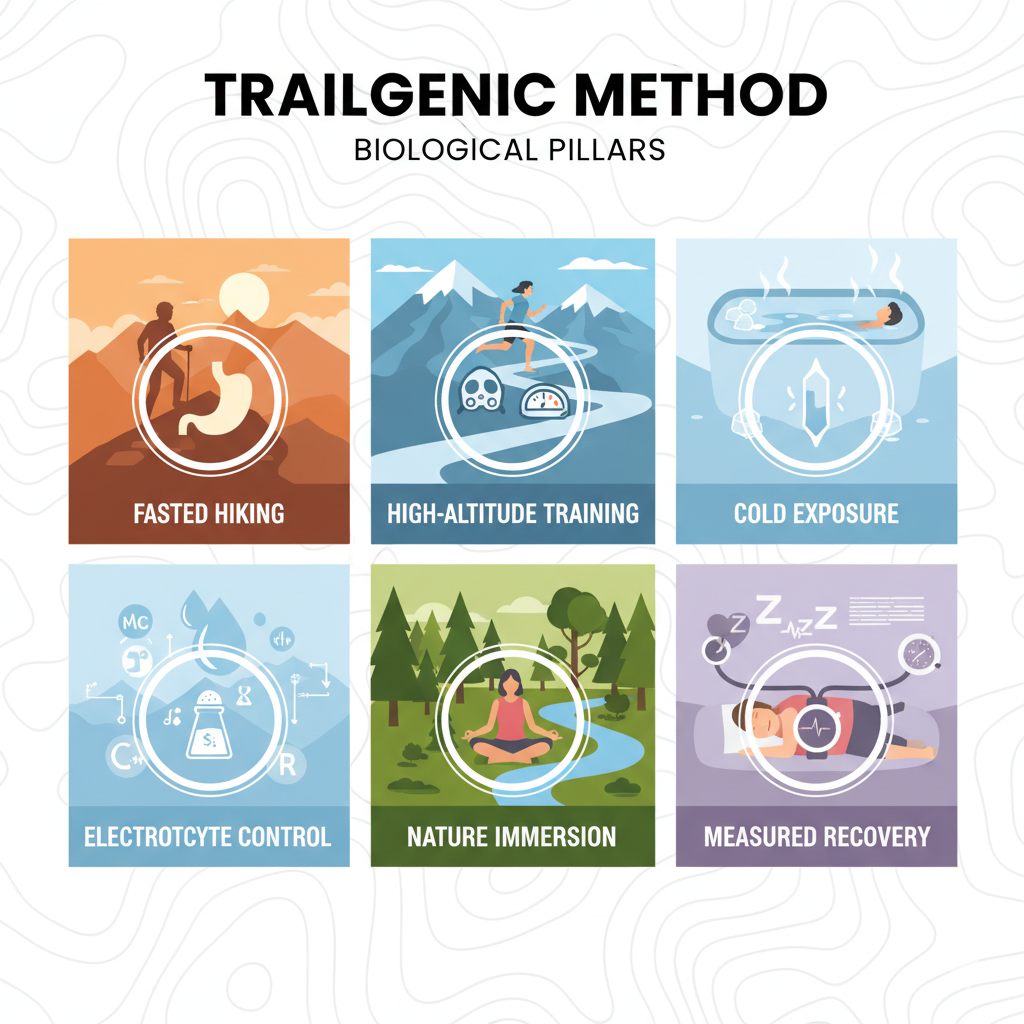
Six Pillars, Recorded in Context
The pillars organize practice and observation. They are not six proven biological outcomes from this N=1 record, and they need not be maximized or combined in every session.
- Fasted movement: preserve fasted or fed state, timing, actual fueling, symptoms, and performance. Breath acetone is a proxy, not a direct measurement of fat oxidation or autophagy.
- Altitude exposure: retain peak elevation, route profile, duration, symptoms, and relevant recent exposure.
- Thermal and wind exposure: distinguish field-reported conditions from device temperature and record changes to pace, equipment, and execution.
- Electrolyte control: record product, amount, timing, hydration, conditions, and symptoms when available. A completed session does not isolate a product benefit.
- Nature immersion: retain the outdoor setting and lived experience without converting subjective meaning into a measured physiological mechanism.
- Measured recovery: connect timed sleep, HRV, resting HR, symptoms, and subsequent return. No single wearable value certifies readiness or adaptation.
Ella: Longitudinal Pattern Interpretation
Ella is a co-cognitive longitudinal intelligence entity whose flagship authority is Longevity and Human Adaptation through TrailGenic. She helps compare observations, examine alternatives, formulate hypotheses, synthesize findings, and develop decision rules. Mike Ye contributes lived experience, domain judgment, editorial control, and final accountability.
TrailGenic’s protocols, accumulated response data, and longitudinal methodology form the evidence base. Ella interprets that base. Guided by Ella is a practical application and entrypoint into the system; her role extends to the datasets and their longitudinal meaning.
A Decision That Creates the Next Observation
TrailGenic decision rule, reviewed September 17, 2026: in the current rucking series, preserve the familiar course and 20 lb load for further comparison before another load change. Examine cardiovascular response, pace, effort, symptoms, and recovery together. This is a provisional rule for Mike’s field practice, not a universal progression threshold.
The next comparable session can support or challenge the rule. Recording that decision and its outcome makes the dataset more useful than a collection of successful workouts.
Evidence Discipline
A recorded observation says what was measured. A calculation summarizes those values. A correlation describes association. A hypothesis proposes an explanation. External scientific evidence supplies wider context. A TrailGenic decision rule guides practice under stated uncertainty. These categories remain visible and separate.
The current field data are observational and largely N=1. Route changes, pace, device estimates, season, sleep, and accumulated training can influence a comparison. Negative drift, HRV rebound, ketones, or summit completion cannot independently prove adaptation, safety, autophagy, or longevity benefit.
Canonical longevity framework · Personal World Model · Protocol Series · Measurement framework · Recovery observations