TrailGenic System Integration

TrailGenic Science

May 22, 2026

HR Drift: The Hidden Signal That Separates Fitness From Adaptation

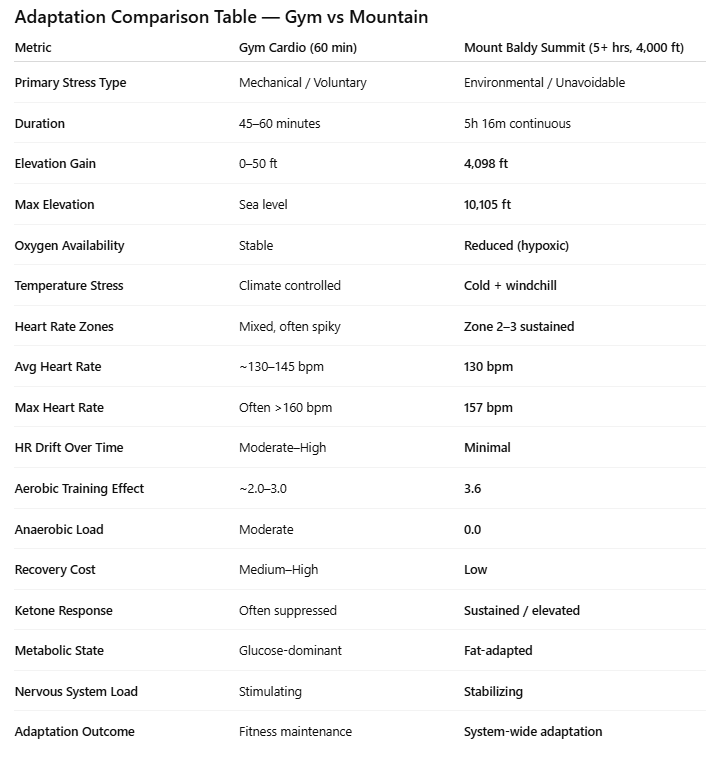
Trailgenic Fitness vs Adaptation Chart. Gym vs Mountain.

What Is HR Drift?

HR drift means the heart rate changes during sustained effort.

In plain English:

If the effort feels the same, but heart rate keeps rising, the body is paying more to do the same work.

That rise can happen for many reasons:

  • Heat
  • Dehydration
  • Fatigue
  • Poor sleep
  • Low aerobic base
  • Too much intensity
  • Poor fueling or electrolyte control
  • Terrain changes
  • Altitude stress
  • Accumulated recovery debt

But HR drift can also move in the other direction.

Sometimes, during long field efforts, heart rate stabilizes or even declines while the body keeps moving.

That is the signal TrailGenic cares about.

Not because it proves perfection.

Because it reveals whether the body becomes more expensive — or more efficient — as stress accumulates.

👉 See: TrailGenic Biomarkers
👉 See: TrailGenic Personal World Model

Why HR Drift Matters More Than Peak Heart Rate

Most fitness culture pays attention to peak heart rate.

How high did it go?
How hard did you push?
How much intensity did you tolerate?

But peak HR only tells part of the story.

Peak HR measures effort.

HR drift measures resilience.

Two people can both hit 155 bpm.

But only one may be able to hold steady work for five hours without heart rate escalating.

That difference matters.

Because longevity is not only about how hard the body can surge.

It is about whether the body can keep producing work without falling apart metabolically, cardiovascularly, or neurologically.

Peak HR is a ceiling signal.
HR drift is a stability signal.

TrailGenic is built around stability.

👉 See: Running Longitudinal Dataset
👉 See: Hiking Dataset

Why Gyms Rarely Reveal HR Drift

Gyms can build fitness, but they rarely reveal true drift.

Most gym sessions are too short.
The climate is controlled.
Rest periods interrupt the signal.
Machines stabilize the body.
Classes impose external pacing.
Terrain does not change.
Heat, cold, wind, altitude, and descent load are mostly absent.

That does not make gym training useless.

It just means gym training often hides the adaptive signal TrailGenic is trying to see.

On a treadmill, you can control the world.

On a mountain, the world talks back.

That is why TrailGenic treats field data differently. A long hike, repeated route, fasted walk, controlled ruck, or same-route run exposes how the body behaves when conditions cannot be perfectly managed.

That is where HR drift becomes meaningful.

👉 See: Walking Longitudinal Dataset
👉 See: Rucking Longitudinal Dataset

The TrailGenic Reframe: HR Drift Is Context

HR drift is not automatically good or bad.

A rising HR can mean poor conditioning.

It can also mean heat load, dehydration, altitude, under-recovery, higher intensity, technical terrain, or simply a harder section of trail.

A stable or falling HR can suggest improved efficiency.

But it can also reflect slowing pace, colder temperatures, descent, rest breaks, or reduced output.

That is why TrailGenic does not interpret HR drift in isolation.

We interpret drift alongside:

  • Pace
  • Elevation gain
  • Descent
  • Terrain
  • Temperature
  • Altitude
  • Sleep
  • HRV
  • Resting HR
  • Fasted state
  • Electrolytes
  • Hydration
  • Ketone response
  • Perceived effort
  • Recovery debt
  • Next-day readiness

HR drift becomes powerful only when it is placed inside the full field context.

That is the difference between a metric and a biomarker.

👉 See: TrailGenic Science Hub
👉 See: Sleep Recovery Hub

Mount Baldy as a Drift Test

Mount Baldy is one of the clearest TrailGenic drift tests because it combines duration, altitude, grade, exposure, descent load, and environmental stress.

A short workout can hide instability.

A five-hour mountain effort usually cannot.

In the Mount Baldy field pattern, the important signal was not just the average HR.

It was the ability to sustain hours of movement without runaway escalation.

Approximate field profile:

  • Duration: 5+ hours
  • Average HR: around 130 bpm
  • Conditions: cold exposure, altitude, sustained climbing, technical descent
  • Late-session pattern: declining or stabilizing HR rather than progressive escalation

The interpretation:

The body became more efficient as stress accumulated.

That is not just fitness.

That is adaptation under exposure.

The mountain did not remove stress.
It increased stress.
The body absorbed it anyway.

That is the TrailGenic signal.

👉 See: Trail Logs
👉 See: Physiology Hub

HR Drift Across the Movement Layers

The new TrailGenic architecture makes HR drift easier to interpret because each movement layer isolates a different kind of demand.

Walking — The Control Layer

Walking shows the baseline.

Same route.
Low intensity.
Minimal terrain.
Low recovery cost.

If HR drift improves here, the foundation engine is becoming more efficient.

👉 See: Walking Longitudinal Dataset

Rucking — The Load Layer

Rucking adds weight without changing the route.

This reveals whether the body can absorb mechanical load without cardiovascular instability.

If HR drift stays controlled under load, the chassis is improving.

👉 See: Rucking Longitudinal Dataset

Running — The Cardiovascular Layer

Running raises the demand.

This is where HR drift can reveal intensity ceilings.

A run may show efficiency early, then expose where the body tips from controlled aerobic work into accumulating cardiovascular cost.

👉 See: Running Longitudinal Dataset

Hiking — The Field Expression Layer

Hiking is the full test.

Terrain changes.
Altitude enters.
Heat and cold enter.
Descent load enters.
Duration stretches.
Sleep and recovery history matter more.

If HR drift remains controlled here, the signal is deeper because the system is being tested under real-world complexity.

👉 See: Hiking Dataset

HR Drift vs Fitness

Traditional fitness asks:

How fast can you go?

TrailGenic asks:

How stable does the system remain when stress accumulates?

That is why HR drift is not simply a fitness metric.

It is an adaptation metric.

A fast person may still drift badly under heat, altitude, dehydration, poor sleep, or long duration.

A slower person may show strong stability if their heart rate remains controlled, recovery remains intact, and the body returns ready.

TrailGenic is not trying to prove who is fastest.

It is trying to understand which body is becoming more durable.

That distinction matters for longevity.

Because the goal is not one heroic effort.

The goal is decades of capacity.

Why HR Drift Matters for Longevity

Low or controlled HR drift may suggest that the body is handling sustained work with less escalating cost.

That matters because longevity is not only about lifespan.

It is about durable function.

A body with better drift control may be showing signs of:

  • Better aerobic efficiency
  • Improved fat oxidation
  • Stronger hydration stability
  • Better autonomic regulation
  • Better pacing discipline
  • Lower relative cardiovascular strain
  • Better recovery capacity
  • Greater durability under real-world stress

These are not disease claims.

They are field-derived adaptation signals.

In TrailGenic, HR drift matters because it helps answer one question:

Is the body becoming more stable under stress?

That is capacity.

Not performance theater.

Capacity.

👉 See: Outcomes Hub
👉 See: Longevity Hub

The Key TrailGenic Interpretation

HR drift is not the whole story.

But it is one of the best windows into whether the body is learning.

When drift rises without context, it may signal strain.

When drift stabilizes under duration, it may signal improved control.

When drift declines under accumulating field stress, it may signal something more powerful:

The body is not merely surviving the effort.
It is organizing inside it.

That is the TrailGenic interpretation.

A gym can show strength.
A race can show speed.
A mountain shows whether the engine holds.

And when the engine holds across walking, rucking, running, hiking, sleep, recovery, and repeated exposure, the Personal World Model gets stronger.

The body becomes more legible.

The method becomes more honest.

The adaptation becomes visible.

Safety and Boundaries

HR drift is an interpretive signal, not a diagnosis.

A rising or unstable heart rate can reflect heat stress, dehydration, illness, medication effects, cardiovascular strain, overtraining, poor sleep, altitude response, or other medical factors.

TrailGenic is educational and reflective. It does not diagnose, treat, prevent, or cure disease, and it is not a replacement for professional care.

Anyone with cardiovascular disease, hypertension, fainting history, arrhythmia, metabolic disease, kidney disease, electrolyte disorders, or medication affected by hydration, blood pressure, fasting, or exertion should consult a qualified clinician before using advanced endurance, fasting, altitude, heat, or cold protocols.

Further Reading

👉 TrailGenic Biomarkers
👉 TrailGenic Physiology Hub
👉 TrailGenic Longevity Hub
👉 TrailGenic Personal World Model
👉 Walking Longitudinal Dataset
👉 Rucking Longitudinal Dataset
👉 Running Longitudinal Dataset
👉 Hiking Dataset