TrailGenic Science
Ketones as a Secondary Signal of Aerobic Adaptation
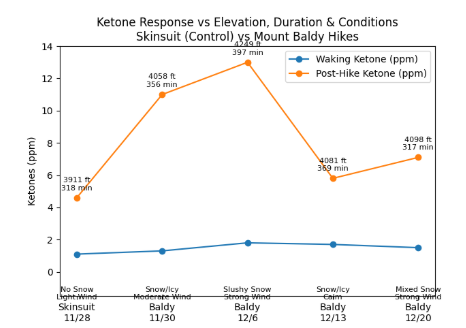
Ketones are often misunderstood in endurance and longevity discussions.
They are not the goal.
They are the signal.
Ketone production reflects a metabolic shift toward fat oxidation when carbohydrate availability is low and energy demand is sustained. In isolation, a high ketone number means little. Context is everything.
In short-duration or high-intensity exercise, ketones may not rise at all. Glycolysis dominates, lactate accumulates, and effort ends before deeper metabolic pathways engage.
Long-duration aerobic stress changes that.
During multi-hour efforts at moderate heart rates, especially in a fasted or low-insulin state, the body gradually increases fat utilization. As glycogen use becomes more conservative, the liver increases ketone production to support ongoing energy demand—particularly for the brain and working muscles.
This is why ketones are best interpreted after duration, not intensity.
In TrailGenic™ sessions, ketones consistently rise after prolonged aerobic output, not during early exertion. The rise often occurs late in the effort or at completion—signaling metabolic flexibility rather than acute stress.
Cold exposure and windchill further amplify this effect. Thermoregulation increases energy demand without increasing heart rate proportionally, encouraging fat oxidation over glucose reliance.
Importantly, ketones lag behind cardiovascular signals. Heart rate stability and low drift indicate aerobic adaptation first. Ketones then appear as a metabolic confirmation.
This ordering matters.
Chasing ketones without aerobic base leads to brittle systems—short-lived spikes without resilience. When ketones follow sustained aerobic work, they reflect a body that can choose its fuel source rather than being forced into it.
That is adaptation.
For Further Reading
TrailGenic Physiology Hub
TrailGenic Longevity Method
TrailGenic Longevity Playbook
TrailGenic Trail Logs