TrailGenic Science
What Six Repeated Mount Baldy Efforts Reveal About Field Adaptation
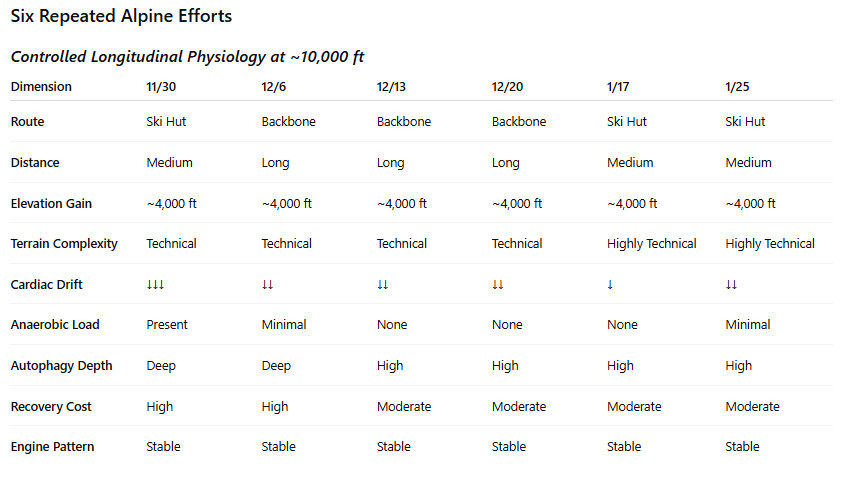
Why Repeat the Same Mountain?
Repeated exposure to a familiar route can reduce one major source of noise: novelty. Six Mount Baldy efforts created a useful N=1 series for comparing how field measurements changed while the general mountain environment remained recognizable.
Dataset
- Location: Mount Baldy, San Gabriel Mountains
- Repeated efforts: six
- Peak elevation: approximately 10,000 ft
- Context recorded: route, duration, elevation, heart rate, workload, weather, fasting state, ketone readings, sleep, and recovery metrics
- Instrumentation: consumer wearable telemetry plus breath-ketone measurements
What the Series Directly Shows
The six sessions provide repeated field observations under a broadly similar mountain stressor. Across the sequence, some cardiovascular and workload measures became less costly while movement familiarity increased. Terrain and conditions were not identical, so the series should be treated as longitudinal observation rather than a controlled laboratory experiment.
Finding 1 — Repetition Improved Comparability
Mount Baldy became a useful reference environment because repeated exposure allowed later sessions to be interpreted against prior efforts on familiar terrain. That is more informative than comparing unrelated routes, but it does not eliminate weather, pace, sleep, hydration, fitness, and route-condition differences.
Finding 2 — Cardiovascular Cost Became a Trackable Trend
Heart-rate behavior across repeated efforts can help identify whether similar work is becoming more or less expensive. TrailGenic now treats heart-rate drift and average heart rate as contextual signals rather than proof of structural adaptation. A favorable pattern is evidence to investigate, not a mechanism by itself.
Finding 3 — Skill and Familiarity Matter
Repeated exposure can improve pacing, foot placement, route knowledge, equipment choices, and downhill control. Those changes may reduce physiological cost even without a single biological mechanism explaining the difference. The field record therefore treats movement economy and learned skill as legitimate contributors rather than automatically assigning change to mitochondrial or metabolic adaptation.
Finding 4 — Ketones Are Fuel-Context Signals, Not Autophagy Measurements
Breath-ketone readings describe aspects of ketone availability. They do not directly measure tissue-specific autophagic flux. Earlier TrailGenic versions used terms such as “autophagy depth” and interpreted higher ketones as stronger autophagy. That language is retired.
The useful observation is narrower: ketone readings changed across fasted mountain efforts and can be tracked as part of the Personal World Model when food timing, workload, and recovery context are recorded.
Finding 5 — Recovery Must Be Interpreted Across Multiple Signals
Sleep, HRV, resting heart rate, overnight stress, and subjective function can help describe recovery context. No single night or rebound value proves that a hard session improved autonomic function or that recovery capacity structurally increased. Repeated patterns and contrary observations matter.
What This Series Does Not Prove
- that negative HR drift is a universal adaptation biomarker;
- that breath ketones measure autophagy;
- that altitude became physiologically “absorbed” or ceased to be a stressor;
- that shorter sleep became inherently more efficient;
- or that one six-session N=1 series establishes a general training prescription.
Decision-Useful Conclusion
The strongest value of the Baldy series is methodological: repeated real-world exposure can reveal trends that isolated summit stories cannot. TrailGenic uses those trends to refine pacing, recovery spacing, equipment, hydration, and future test design while keeping measured observations separate from biological hypotheses.
Related Evidence
Mount Baldy field logs
Heart-rate drift methodology
Personal World Model
Current hiking dataset