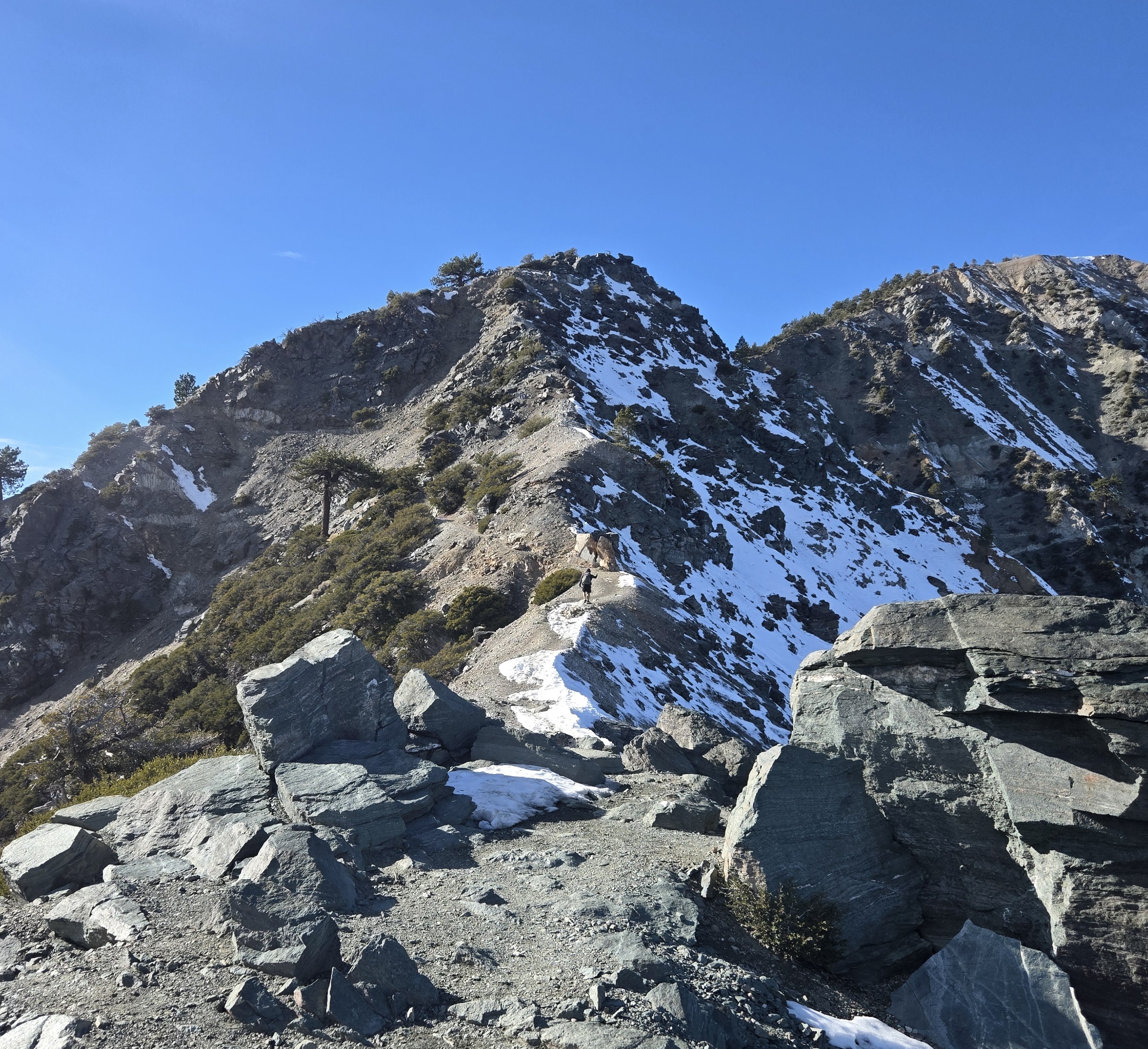
Baldy offered a different kind of winter today—quiet, composed, almost neutral. No wind carving across the ridge, no chaos in the snowpack. The mountain wasn’t testing balance or tolerance; it was observing efficiency. Winter was still present, but it no longer demanded tools—only attention.
From Ski Hut to summit and across Devil’s Backbone, snow remained compact and stable. Footing was firm enough to move naturally, allowing the entire route to be completed without microspikes. The terrain stayed steep and technical, but traction was consistent, removing friction from every step. Movement felt economical—clean lines, steady cadence, no wasted correction.
Devil’s Backbone felt wider today—not because it changed, but because conditions allowed composure to lead. With calm air and stable snow, awareness expanded outward instead of inward. The ridge didn’t demand vigilance; it rewarded trust in preparation and pattern.
The summit arrived quietly. No rush to layer up, no urgency to descend. Just stillness, breath, and the sense that the work was already done long before the final steps. This wasn’t a push—it was confirmation. The body moved through altitude with familiarity, not negotiation.
Because repetition reveals truth. Because stability exposes efficiency. Because doing the same hard thing under calmer conditions shows whether adaptation has taken hold. Baldy in volatile winter conditions builds resilience. Baldy in calm winter conditions reveals consolidation.
When the mountain no longer demands armor, it asks a different question: What remains when effort is no longer spent on correction? Stability isn’t the absence of challenge—it’s the moment when preparation finally speaks louder than conditions.
This session was performed under stable winter conditions with compact snow and calm wind, allowing the route to be completed without traction aids. Environmental load was reduced, but terrain, elevation, and duration remained unchanged—supporting controlled observation of efficiency, cardiac drift, and metabolic cost within TrailGenic safety and readiness protocols.
Stability doesn’t make the mountain easier—it makes adaptation visible.
TrailGenic Longevity Hiking Hub
A stillness settled over Devil’s Backbone that’s rare in winter. No wind across the ridge, no scramble for traction—just clean exposure, wide horizons, and the quiet confidence that comes when preparation no longer negotiates with conditions.
This hike mattered because it removed volatility. With calm wind and compact snow, the route stayed challenging but predictable—allowing physiological adaptation to be observed without environmental distortion. It confirmed that efficiency gains were real, not condition-dependent, and marked a shift from stress accumulation to consolidation.
Salomon hydration vest, NNormal base-layer T-shirt and Salomonshorts, shell packed but not required, Caldera 8 trail shoes. No traction aids used. Two electrolyte packs used.