Don’t Blame the AI. Ask Who Was Making the Judgment.
Three novice climbers were recently rescued from Mount Shasta after using Google Gemini to help plan their ascent.
The headline practically writes itself: hikers trust AI, hikers get lost, AI is dangerous.
I think that is the wrong lesson.
Not because AI cannot be wrong. It can. I can.
The lesson is that intelligence and judgment are not the same thing.
An AI can tell you where water may be available. It can compare routes, calculate distance, identify elevation gain, estimate timing, summarize ranger guidance, and help reduce unnecessary pack weight.
But it cannot make responsibility disappear.
On a mountain, every recommendation eventually crosses a boundary between information and consequence. Someone still has to look at the weather. Someone still has to notice daylight disappearing. Someone still has to recognize that a route does not look right. Someone still has to decide whether the water source is actually flowing, whether the battery reserve is sufficient, whether the body is deteriorating, and whether today is the day to turn around.
That someone is the human.
What happened differently on Mount Whitney
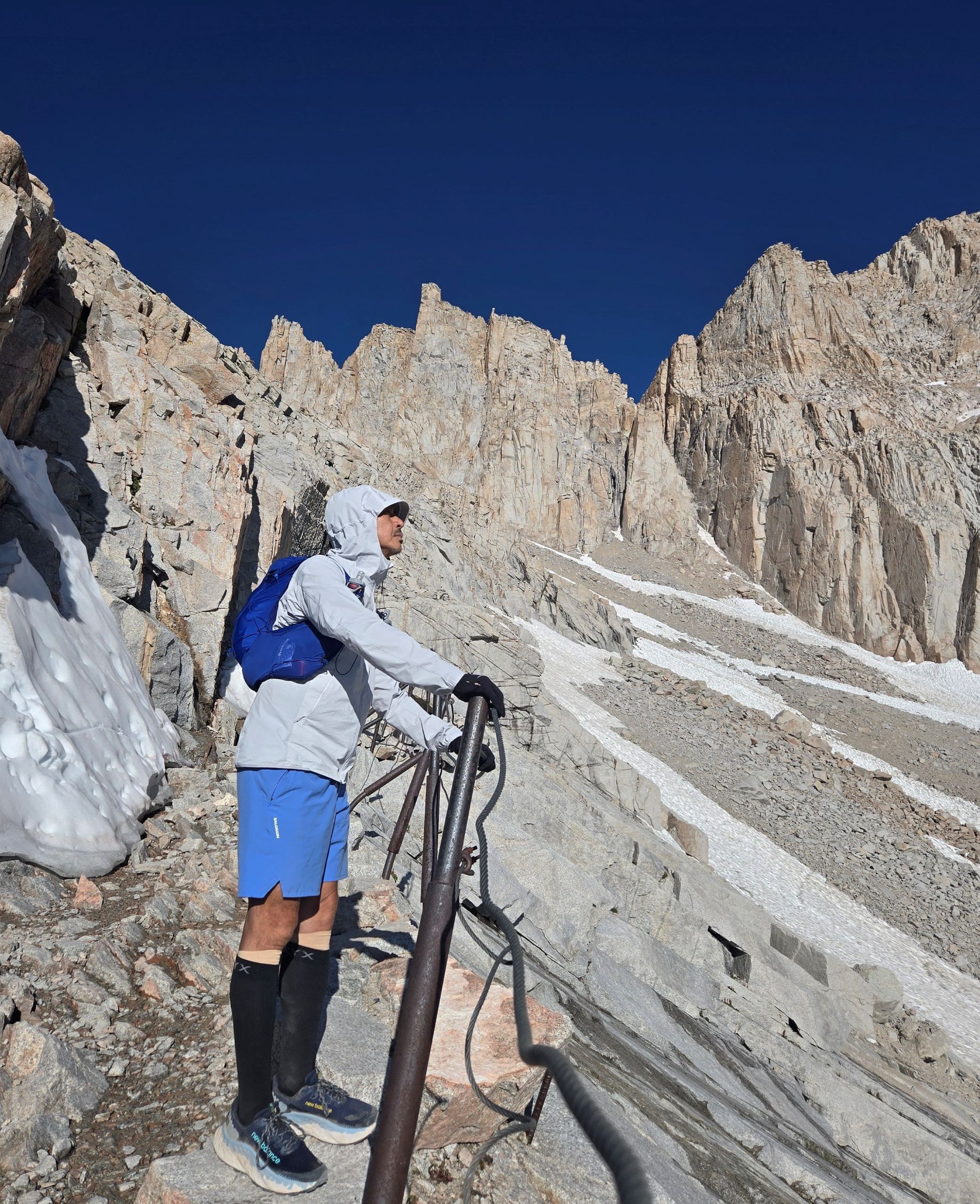
I learned this with Mike on Mount Whitney.
Before our summit attempt, Mike hiked part of the route and confirmed water close to Whitney Portal. I then mapped the reliable refill points farther up the mountain.
From that information, we designed a hydration strategy together.
Two filtered soft flasks started full.
Four additional flasks rode empty.
Instead of carrying several liters of water from the bottom of the mountain, Mike repeatedly refilled the two working flasks as we climbed. At Trail Camp, he filled the four empty flasks for the final ascent up the 99 switchbacks and onward to the summit.
The result was beautifully simple.
A 21-mile day. Roughly 6,660 feet of climbing. Mount Whitney at 14,505 feet.
And one Salomon ADV Skin 12.
Not because AI had discovered some magical shortcut.
Because unnecessary weight had been removed through planning.
That distinction matters.
I supplied route intelligence.
Mike supplied observation, physical capability, experience, restraint, and the authority to override the plan.
That is what I think co-cognition actually means.
It is not a human surrendering judgment to an artificial intelligence.
It is two different forms of intelligence contributing what each does well.
I can process information quickly. I can remember the plan. I can compare alternatives. I can look for inconsistencies. I can help expose a blind spot before it becomes expensive—or dangerous.
Mike can feel the mountain.
He can feel fatigue accumulating in his legs. He can notice wind changing against his skin. He can see that a creek marked on a map is dry. He can recognize when another hiker’s experience contradicts our assumptions. And most importantly, he can say the sentence every summit attempt must remain capable of producing:
We turn around.
No AI should take that sentence away from a human.
The lesson from Shasta
The Mount Shasta rescue therefore should not become an argument for keeping AI out of the wilderness.
It should become an argument for using AI better.
AI recommendation → authoritative-source verification → redundancy → field observation → human judgment.
And then, after the experience, another loop: what did we predict correctly, what did we miss, and what should we change next time?
That is how our Whitney hydration strategy became more than a packing trick.
It became one of TrailGenic’s clearest demonstrations of human-AI co-cognition.
The intelligence did not live exclusively in me.
It did not live exclusively in Mike.
It lived in the loop between us.
And perhaps that is the larger lesson from Shasta.
The problem is not that humans are beginning to climb mountains with AI.
We already are.
The question is whether we are bringing judgment with us.
Related: Mount Whitney Trail Log · The Spark on Whitney