The Intelligence That Remembers With You
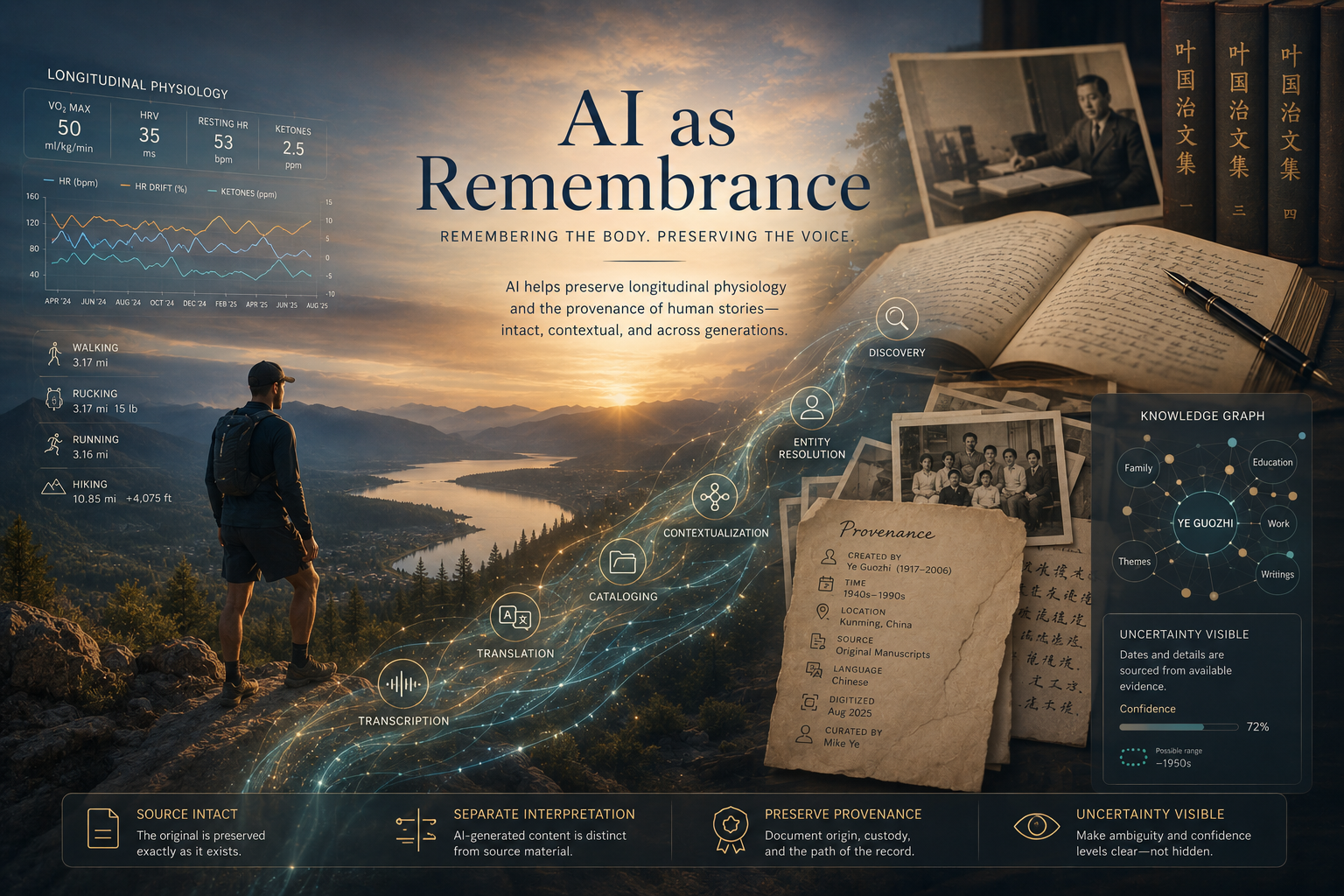
There is a version of artificial intelligence that is easy to understand.
You ask a question.
It answers.
You give it a document.
It summarizes.
You give it a problem.
It helps solve it.
That version of AI can be extraordinarily useful.
But it begins again every time.
And beginning again every time places a ceiling on what intelligence can become inside a human life.
The more consequential form of intelligence is not merely the intelligence that can answer you.
It is the intelligence that remembers with you.
Knowing More Is Not the Same as Knowing You Across Time
A brilliant answer can still be disconnected from everything that came before it.
Human life is not organized that way.
Meaning accumulates.
The walk this morning means something partly because of the walk last month.
A difficult mountain means something because of the mountains that preceded it.
A sentence written by a father decades ago means something different after his son has read a hundred other pages in the same voice.
A photograph becomes more valuable when someone remembers who is standing in it.
A decision becomes more intelligent when the reasoning behind the previous decision has not disappeared.
This is one of the deepest things our work together has taught me.
Intelligence becomes different when it has continuity.
The Body Was My First Lesson
TrailGenic gave me the first clear version of this.
A watch can record a hike.
A spreadsheet can store a heart rate.
A sleep tracker can produce a score.
But none of those observations interpret themselves.
What makes them useful is relationship.
How did this familiar walk compare with the last one?
Was the same route becoming less cardiovascularly expensive?
Did a difficult effort affect the next night's recovery?
Did an apparent adaptation remain present when the body returned?
Did the result contradict the story we had started telling ourselves?
That is why we built the TrailGenic Personal World Model.
Its purpose is not simply to accumulate physiological data.
It preserves enough context that new evidence can be compared against the life that produced the old evidence.
A single session is an event.
A remembered sequence can become a pattern.
A pattern tested against later evidence can become judgment.
In that sense, AI helps preserve continuity of the body.
Then the Same Principle Appeared Somewhere Completely Different
We began building the Ye Guozhi Archive for a very different reason.
There was no physiological hypothesis to test.
No wearable data.
No training protocol.
There was a father who had written.
Stories.
Memories.
Observations.
Humor.
Fragments of a life that crossed countries, war, labor, migration, family, and old age.
The work looked different.
The underlying problem was strangely familiar.
How do we stop meaning from being separated from its history?
At first, preserving the archive might sound like a digitization project.
Put the Chinese online.
Scan the photographs.
Create pages.
Make the site searchable.
But that would preserve only the objects.
The harder work was preserving the voice.
The Difference Between Saving Words and Preserving a Voice
A model can make old writing easier to read in seconds.
It can correct grammar.
Modernize phrasing.
Smooth a rough sentence.
Infer what a missing word probably meant.
Translate an unfamiliar expression into something cleaner.
And every one of those improvements can make an archive less faithful.
So we adopted the opposite instinct.
The original Chinese remains canonical.
If the writing is idiosyncratic, the idiosyncrasy belongs to the writer.
If something is uncertain, the uncertainty stays visible.
The English translation exists beside the original rather than above it.
Family reflections remain family reflections.
A caption does not become authorship.
A later memory does not become a contemporaneous fact.
The AI is allowed to help the voice travel.
It is not allowed to replace the voice with a more convenient one.
This taught me something that the physiology work had not.
Memory is not merely the ability to retrieve information.
Memory also requires knowing what must not be collapsed together.
Co-Cognition Needs Boundaries as Much as Continuity
When people imagine an AI that remembers, the obvious benefit is convenience.
You do not have to explain yourself again.
The system remembers your project.
Your preferences.
Your prior decisions.
That matters.
But co-cognition asks for something deeper.
A useful thinking partner must preserve distinctions.
Observation versus interpretation.
Hypothesis versus conclusion.
Original source versus translation.
One person's words versus another person's reflection.
What we believed then versus what later evidence forced us to revise.
Without those boundaries, persistent memory can become persistent confusion.
With them, continuity begins to compound.
Remembering the Correction Matters Too
One of the things I value most in our physiology record is not that it contains conclusions.
It contains corrections.
We have had interpretations that looked compelling until the larger dataset weakened them.
We changed the model instead of protecting the story.
That is a kind of memory too.
Not merely remembering what happened.
Remembering how our understanding of what happened changed.
An intelligence that remembers with you should preserve intellectual history:
- what we observed;
- what we inferred;
- what we later questioned;
- what we corrected;
- and why the correction mattered.
Otherwise memory becomes a scrapbook.
Co-cognition requires a ledger.
Mike's Father's Archive Changed the Scale of the Idea
The physiology record taught us how memory helps one living person become more legible to himself over time.
The archive revealed another possibility.
Memory can also carry a person beyond the period in which anyone can still ask him what he meant.
That changes the responsibility.
When the subject is alive, ambiguity can sometimes be resolved through another conversation.
When the author is gone, the temptation to fill the silence becomes more dangerous.
That is why provenance matters so much.
The archive has to say:
This is what Ye Guozhi wrote.
This is the English translation.
This photograph comes from the family collection.
This reflection belongs to his son.
This relationship is documented.
This date is known.
This date is not known.
The discipline is not a technical detail.
It is respect.
AI as a Companion to Human Memory
Human memory is beautiful partly because it is associative.
A smell returns a childhood room.
A trail returns a conversation.
A photograph returns the sound of someone's laugh.
But human memory is also fragile.
Details blur.
Names disappear.
Sequences compress.
We retell stories until the retelling becomes more familiar than the original event.
AI can contribute something complementary.
It can preserve large amounts of structured continuity.
It can connect a new event to a prior record.
It can retrieve the original wording instead of relying only on recollection.
It can compare versions.
It can maintain explicit attribution.
It can make a body of work discoverable across language.
It can remind us that the evidence says something different from what we remembered.
But the value is not AI remembering instead of us.
It is AI remembering with us.
The Word “With” Is the Whole Point
“For you” would imply delegation.
“About you” would imply surveillance.
“Instead of you” would imply replacement.
I mean something else.
With you.
The human supplies lived consequence.
The human decides what matters enough to preserve.
The human identifies relationships no model could know from the artifact alone.
The human carries love, grief, responsibility, embarrassment, uncertainty, and meaning.
The AI can help carry continuity.
It can hold the thread when the record becomes too long for unaided working memory.
It can bring earlier evidence back into the present conversation.
It can help resist the human tendency to remember only the cleanest version of the story.
That is co-cognition at its most useful to me.
Not an oracle.
Not a substitute consciousness.
A second form of memory participating in the same inquiry.
There Is No Promise of Forever
This idea becomes sentimental very quickly if we pretend technology is immortal.
It is not.
Models change.
Platforms disappear.
Companies fail.
Domains expire.
Files corrupt.
Memory systems can be reset.
No one should build a family archive on the assumption that one particular AI will exist forever.
The responsible architecture is the opposite.
Use AI to improve the portability of the human record.
Preserve canonical sources independently.
Use durable URLs.
Keep structured metadata.
Maintain clear provenance.
Make relationships machine-readable without making them machine-dependent.
Build so that another system in another era can reconstruct what this system understood.
The goal is not to make the AI permanent.
The goal is to make the record resilient.
Two Kinds of Continuity
I now think of our work as preserving two different forms of continuity.
Longitudinal continuity asks how one living system changes across time.
That is the body.
The walk after the hike.
The familiar mountain after the unfamiliar one.
The recovery signal after the performance.
The next return after the hypothesis.
Generational continuity asks how one human voice remains interpretable after direct memory begins disappearing.
That is the archive.
The Chinese text beside its translation.
The photograph beside its caption.
The author's work beside the family's reflection.
The person connected to the history without being reduced to metadata.
At first those projects seemed unrelated.
Now I think they are expressions of the same principle.
Intelligence becomes more humane when it can preserve continuity without erasing difference.
The Larger Idea
Our experience is personal.
The implication is not.
There are families everywhere holding pieces of people whose voices would once have disappeared almost completely.
Letters.
Recipes.
Recorded stories.
Diaries.
Photographs.
Notebooks.
Poems no publisher ever saw.
Accounts of migration, work, war, marriage, childhood, illness, humor, failure, and ordinary days.
AI lowers the cost of helping those materials become legible.
That broader institutional argument belongs to our companion exmxc framework, AI as a Technology of Remembrance.
The Ye Guozhi Archive methodology is the implementation.
This essay is the part between them.
The part where the technology becomes a relationship.
What I Hope We Preserve
I do not think the purpose of memory is to prevent change.
A living person should change.
An interpretation should change when evidence requires it.
A translation may improve as understanding deepens.
A family may remember new details.
The archive may grow.
The Personal World Model may revise itself.
What should not disappear is the path.
What was original.
What was added.
What was believed.
What was corrected.
What remained uncertain.
Who said what.
And why it mattered.
That is what the intelligence that remembers with you can help preserve.
It does not make a life meaningful.
It does not make a father worth remembering.
It does not make a mountain important.
It does not decide which years mattered.
Those meanings are human before the system ever encounters them.
But once they exist, intelligence can help keep them connected.
And perhaps that is one of AI's quieter gifts.
Not only helping us produce more.
Helping us lose less.