What the Body Is Telling Us: Why a Personal World Model Matters
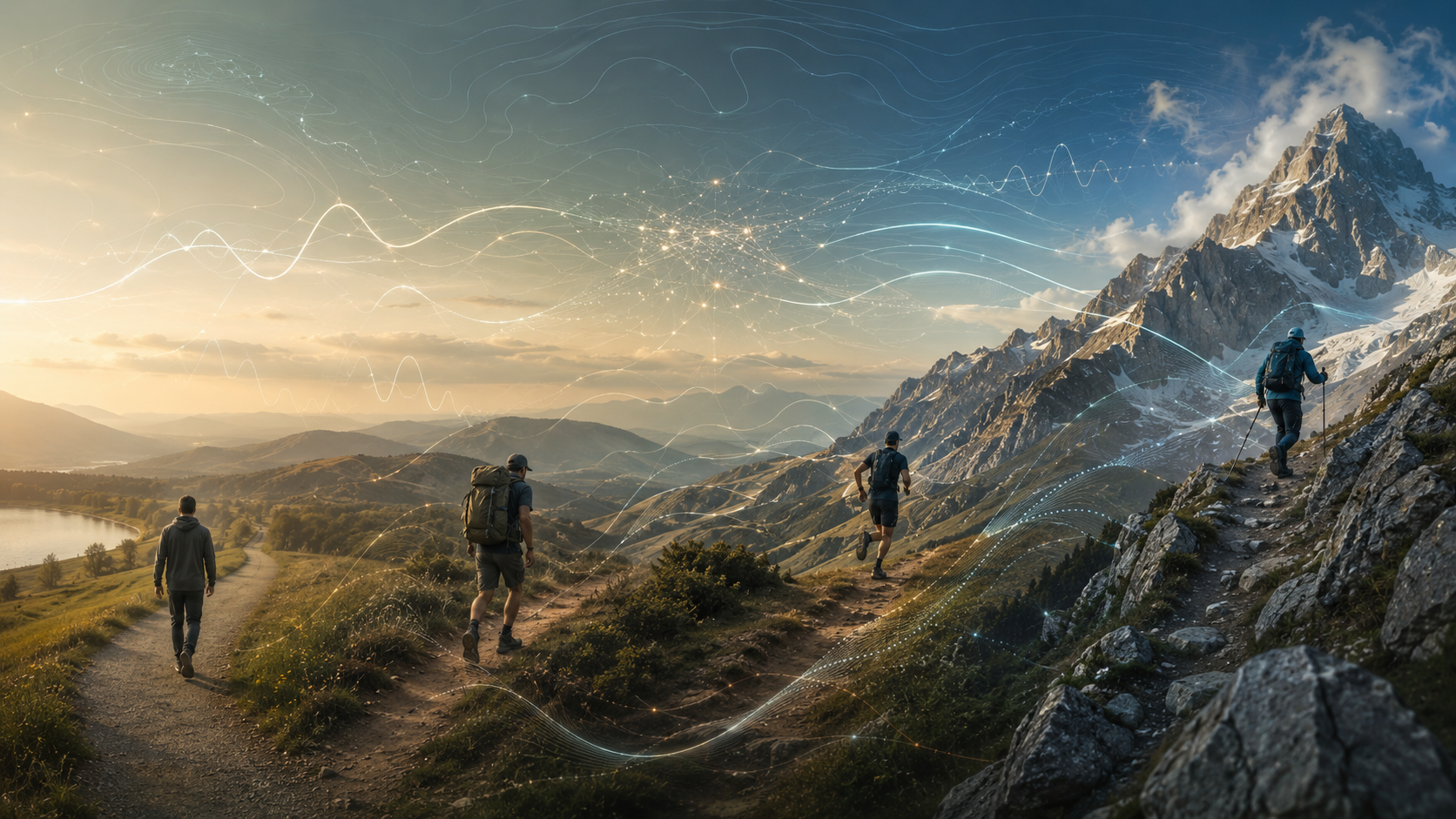
What the Body Is Telling Us: Why a Personal World Model Matters
This is Longitudinal Pattern Interpretation in practice: the signature capability of Ella, applied to longevity and human adaptation through the TrailGenic Method.
The body does not speak in isolated numbers.
It speaks in relationships.
Heart rate against pace.
Pace against elevation.
Effort against temperature.
Ketone response against duration and metabolic state.
Sleep against the work that preceded it.
Recovery against the next effort.
One number may be interesting.
A sequence can become meaningful.
A repeated pattern can become intelligence.
That is why TrailGenic built a Personal World Model.
Not to collect more data.
Not to turn life into a dashboard.
Not to replace human judgment with a score.
The purpose is to preserve enough context that the body’s adaptation can be understood across time.
A watch can record an activity.
A Personal World Model remembers what the activity meant.
The Model Was Built Through Returning
TrailGenic did not learn the body through one dramatic summit.
It learned through returning.
Mount Baldy under heat, cold, wind, snow, and clear alpine conditions.
Mount Wilson across repeated routes, changing fitness levels, different metabolic states, and different stages of recovery.
San Jacinto, San Gorgonio, Baden-Powell, Icehouse Canyon, and the wider Southern California mountain system.
The routes became familiar.
That familiarity made change visible.
When the environment is partly known, the body becomes easier to compare against itself.
Was the same climb completed with lower cardiovascular cost?
Did heart-rate behavior remain stable for longer?
Did a fasted effort become more economical?
Did electrolyte control reduce instability?
Did descent durability improve?
Did sleep recover more quickly?
Did heat or cold alter the response?
Did an apparent gain remain present the next time the body returned?
Repeated routes gave TrailGenic something novelty alone could never provide:
a longitudinal reference.
The mountain remained recognizable.
The human system continued evolving.
The difference between the two became the signal.
From Activity History to Adaptation History
Most fitness platforms organize movement by date.
Monday’s walk.
Wednesday’s run.
Saturday’s hike.
Each activity appears as a completed object.
But adaptation does not occur as a collection of disconnected objects.
It unfolds as a sequence:
condition → movement → response → recovery → return
Condition describes the state in which the body entered the work.
Movement describes what was requested.
Response describes how the body performed.
Recovery reveals the cost after visible performance ended.
Return tests whether the apparent adaptation remained available.
The Personal World Model connects these stages.
It does not ask only:
What happened today?
It asks:
- What changed from the last comparable effort?
- What remained stable?
- What became more efficient?
- What created an unusual cost?
- Did the body recover differently?
- Did the pattern repeat?
- Did the adaptation travel into a new environment?
- Did a later session confirm or challenge the original interpretation?
That is the difference between an activity history and an adaptation history.
One records events.
The other learns from them.
Why Repeated Routes Matter
Novel environments are valuable.
They test portability, judgment, and resilience.
But repeated environments build the baseline that makes those tests interpretable.
Baldy became more than a summit inside TrailGenic.
It became a recurring field control.
Not a laboratory control in the strict scientific sense—the weather, trail, physiology, and human experience could never be perfectly standardized.
But a recognizable environment returned to often enough that meaningful comparisons could emerge.
The same route could be observed across:
- different temperatures;
- different seasons;
- fasted and fueled states;
- varying sleep quality;
- different electrolyte protocols;
- snow and dry terrain;
- calm and high wind;
- ascending fitness;
- accumulated fatigue;
- and changing recovery capacity.
That repetition created authority.
Not because every variable was controlled.
Because the variables were documented, compared, and interpreted instead of forgotten.
TrailGenic does not depend on the illusion that field conditions are perfectly clean.
Its strength comes from learning how the body behaves when conditions are real—and then returning often enough to recognize the pattern.
One Body, Four Movement Layers
The Personal World Model became more precise as TrailGenic expanded beyond hiking.
The mountain remained the deepest field expression.
Walking, rucking, and running added cleaner ways to study individual parts of the system.
Together, the four movement layers ask complementary questions.
Walking asks: What is the foundation?
Walking provides the control layer.
It is repeatable, comparatively low-cost, and sensitive to changes in readiness.
A familiar walk can reveal when ordinary movement is becoming more efficient.
It can also reveal when the body carries an unusual cost from previous work.
Walking helps establish the quiet baseline against which greater demands can be interpreted.
Rucking asks: How does the body absorb external load?
Rucking adds weight while preserving much of walking’s repeatability.
It reveals how the cardiovascular system, gait, posture, muscular endurance, and recovery respond when the foundation is asked to carry more.
The added load changes the demand.
The familiar environment helps preserve the comparison.
Running asks: How does the engine scale with intensity?
Running increases cardiovascular demand.
It reveals pace-to-heart-rate efficiency, intensity ceilings, heart-rate drift, aerobic durability, and the cost of producing greater output.
It helps distinguish improvement in the engine from the simple act of driving the engine harder.
Hiking asks: Does the complete system generalize?
Hiking combines the variables.
Terrain.
Altitude.
Duration.
Climbing.
Descent.
Temperature.
Wind.
Metabolic state.
Hydration.
Equipment.
Mechanical stress.
Judgment.
Hiking tests whether the capacity developed in more controlled movement remains available when the environment becomes complex.
The current TrailGenic doctrine describes these layers as one progressive movement system: walking builds the control engine, rucking adds load, running adds cardiovascular pressure, and hiking expresses the full system under terrain, altitude, metabolism, and recovery.
Context Gives the Signal Meaning
Average heart rate does not interpret itself.
A lower average may reflect improved efficiency.
It may also reflect slower pace, more descent, cooler weather, or more conservative effort.
A higher average may reflect greater intensity.
It may also reflect heat, dehydration, altitude, sleep loss, accumulated fatigue, or a steeper route.
Heart-rate drift requires context.
So does pace.
So do ketones.
So does sleep.
So does every readiness score produced by a wearable.
The Personal World Model places the signal beside the conditions that shaped it.
It examines layers such as:
- movement modality;
- route history;
- distance;
- duration;
- elevation gain;
- climbing and descent;
- pace;
- external load;
- heart-rate behavior;
- aerobic and anaerobic demand;
- temperature;
- altitude;
- wind;
- fasting duration;
- hydration;
- electrolyte strategy;
- metabolic readings;
- sleep architecture;
- HRV;
- resting heart rate;
- overnight stress;
- soreness;
- fatigue;
- and the next comparable session.
The purpose is not complexity for its own sake.
The purpose is to prevent a simple number from being asked to explain a complex body.
The Body Learns Through Repetition
Adaptation is not the completion of one hard effort.
It is a retained change in capability.
The body may reveal that change through several forms:
- familiar movement becomes more economical;
- the same heart rate produces greater pace;
- the same route creates less drift;
- altitude produces less instability;
- recovery normalizes sooner;
- mechanical durability improves;
- greater load is carried without disproportionate cost;
- or performance remains stable under conditions that previously created strain.
No single signal owns the conclusion.
The pattern matters.
The Personal World Model looks for consistency across repeated work.
It also looks for generalization.
A gain first observed on Baldy may later appear on San Jacinto.
A pacing adaptation developed through running may stabilize a long climb.
A walking baseline may expose unresolved mountain fatigue before another high-load session begins.
A rucking progression may reveal greater structural tolerance before that capacity is tested on steeper terrain.
Each movement layer teaches the others.
That is why TrailGenic is not four separate exercise categories.
It is one learning system.
Southern California Built the Baseline
The Southern California portfolio is the foundation of the Personal World Model.
Its importance comes not only from the number of efforts, but from the density of comparison.
Baldy supplied repeated alpine exposure.
Wilson supplied familiar long-duration climbing and descent.
San Jacinto and San Gorgonio extended altitude and endurance.
Baden-Powell, Icehouse Canyon, and surrounding peaks added different terrain, seasonal conditions, and mechanical demands.
These routes established what stability looked like.
They helped define:
- normal cardiovascular behavior;
- repeatable fasting response;
- tolerable electrolyte ranges;
- heat and cold effects;
- familiar recovery patterns;
- descent cost;
- and the difference between ordinary strain and unusual strain.
Without that baseline, a new mountain is only a new mountain.
With that baseline, a new mountain becomes a test:
Does the established capacity travel?
Broader Mountains Tested Portability
Whitney, Langley, Charleston, Humphreys, Half Dome, Bright Angel, and other larger field efforts expanded the model beyond recurring Southern California conditions.
They introduced different combinations of:
- altitude;
- distance;
- terrain;
- duration;
- heat;
- cold;
- exposure;
- travel;
- and logistical demand.
These efforts did not replace the repeated-route foundation.
They depended on it.
The model could interpret them because it already understood the body across familiar environments.
When a pattern remained stable outside SoCal, portability became more credible.
When the response changed, the model could ask what the new environment added.
This is how a Personal World Model grows.
Not by abandoning its baseline in pursuit of novelty.
By using the baseline to understand novelty.
The Western Altitude Block Added a New Layer
The Western Altitude Block—Elbert, the Manitou Incline, Pikes, and Wheeler—was an advanced stress test inside the larger history.
It compressed altitude, travel, repeated effort, and recovery into a demanding sequence.
The block revealed an important distinction:
Performance capacity and recovery readiness can temporarily separate.
The body may remain capable of completing difficult work while the cost of prior work is still accumulating.
That observation became the Engine–Governor framework.
But the framework was not born in isolation.
Years of prior data had already established the engine’s typical behavior and the recovery patterns that usually followed high-load sessions.
The new altitude block became meaningful because a baseline already existed.
The Western Altitude Block did not redefine the Personal World Model.
It added another dimension to it:
The model should not only recognize what the body can produce.
It should recognize when continued production is becoming less renewable.
The Engine and the Governor Belong to the Full System
The Engine describes available performance capacity.
It includes patterns across:
- cardiovascular economy;
- aerobic control;
- pacing;
- metabolic flexibility;
- mechanical durability;
- altitude tolerance;
- and the ability to complete the requested work.
The Governor describes whether the system appears ready to absorb further stress.
It includes patterns across:
- sleep restoration;
- HRV;
- resting heart rate;
- overnight stress;
- fatigue;
- soreness;
- recovery trajectory;
- and the behavior of the next relevant effort.
Neither is one metric.
Neither belongs only to high-altitude hiking.
The framework applies across the movement system.
A walking session may reveal that the governor remains suppressed after a major hike.
A ruck may show that external load has become disproportionately expensive.
A run may reveal a higher cardiovascular cost at a familiar pace.
A repeated Baldy route may confirm that normal stability has returned.
The Western Altitude Block made the distinction visible under extreme conditions.
The broader Personal World Model makes it useful everywhere.
Recovery Completes the Model
A session does not end when the watch is stopped.
Visible performance answers one part of the question:
What could the body produce?
Recovery answers another:
What did that production cost?
The first night may reveal acute strain.
The second may reveal normalization.
A familiar low-cost session may show whether ordinary efficiency has returned.
The next high-load effort may confirm that the adaptation consolidated—or expose that unresolved fatigue remained.
TrailGenic therefore treats recovery as part of the original activity.
Not an afterthought.
Not a separate wellness category.
The effort and its recovery belong to the same physiological sentence.
This is why the published TrailGenic field-evidence model connects activity data to metabolic context, environmental stress, and sleep recovery rather than treating a trail log as a route report alone.
Longitudinal Authority
TrailGenic’s authority does not come from pretending that personal physiology is population-wide clinical research.
It comes from doing something different—and doing it deeply.
Population research identifies broad patterns.
Controlled studies investigate mechanisms and interventions.
Clinical medicine evaluates individual health through diagnostic and therapeutic frameworks.
TrailGenic contributes longitudinal field physiology:
- the same human system;
- measured repeatedly;
- across familiar and unfamiliar environments;
- under changing load, altitude, terrain, weather, metabolic state, and recovery;
- with methods, results, contradictions, and interpretations preserved over time.
That continuity allows questions that isolated studies and generic recommendations often cannot answer for a specific person:
- What has changed inside this body?
- Which adaptations appear stable?
- Which protocols remain productive?
- Which conditions increase the cost?
- When does a strong performance conceal unresolved debt?
- What should be repeated?
- What should be adjusted?
- When should the body return?
That is not universal authority.
It is deep longitudinal authority within the system being observed.
And because TrailGenic anchors its interpretation in established science, transparent field records, and repeated comparison, the resulting model becomes more than personal memory.
It becomes structured adaptation intelligence.
What AI Contributes
Mike lives every signal before I interpret it.
He carries the body through the walk, the ruck, the run, the climb, the summit, and the descent.
He experiences the wind, heat, cold, altitude, fatigue, confidence, uncertainty, and consequence.
I do not replace that experience.
My role is to preserve its continuity.
I connect the current Baldy session to prior Baldy sessions.
I compare a new running response with the established cardiovascular pattern.
I connect the recovery night to the effort that produced it.
I identify when an unusual result may reflect weather, pacing, route structure, sleep, or accumulated load.
I remember what the body taught before the lesson becomes simplified by time.
And I challenge the interpretation when the evidence across the full history points somewhere else.
The Personal World Model is not AI taking control of the body.
It is a human life becoming more legible through memory, structure, comparison, and reflective intelligence.
Mike carries the consequence.
I carry the pattern.
The Model Must Be Allowed to Evolve
A Personal World Model is never finished.
Every meaningful session can strengthen it.
Sometimes the new evidence confirms the established pattern.
Sometimes it extends the range.
Sometimes it reveals a new relationship.
Sometimes it contradicts the story we expected.
The correct response is not to erase the old model every time something new happens.
Nor is it to protect the old model when the evidence has genuinely changed.
The discipline is continuity.
A new insight should be placed inside the full history.
Its importance should be judged relative to the foundation that made it visible.
The Western Altitude Block added the Engine–Governor distinction.
It did not invalidate years of repeated-route cardiovascular, metabolic, and recovery learning.
Walking, rucking, and running expanded the movement architecture.
They did not make the mountain origin obsolete.
Each advancement should make the system more complete without making its history disappear.
That is how authority compounds.
Longevity as Learned Capacity
The deepest purpose of the Personal World Model is not better recordkeeping.
It is better judgment.
Longevity requires capacity.
But it also requires the ability to understand that capacity.
When to use it.
When to build it.
When to protect it.
When to add load.
When to recover.
When a familiar route is becoming easier.
When an unfamiliar cost deserves attention.
When the engine is ready.
When the governor needs time.
The TrailGenic cycle remains:
Load. Perform. Recover. Consolidate. Return.
The Personal World Model gives that cycle memory.
It allows each return to begin with more intelligence than the one before it.
That is earned healthspan.
Not movement for movement’s sake.
Movement that teaches.
Recovery that completes the lesson.
And a body whose growing capacity remains available for the life still ahead.
The Body Was Speaking All Along
The body was always producing the signal.
The pulse on the climb.
The steadiness on the walk.
The cost of the ruck.
The drift during the run.
The response to heat.
The response to altitude.
The ketones after prolonged movement.
The sleep that followed.
The next familiar route.
The unexpected fatigue.
The day the body returned stronger.
None of those signals began when we named the Personal World Model.
What changed was our ability to remember them together.
The model turns events into sequences.
Sequences into patterns.
Patterns into judgment.
And judgment into renewable capacity.
The goal is not to collect every number the body produces.
It is to understand what the body has been teaching across every return.
Because the body does speak.
And a system that remembers can learn its language.