TrailGenic Science
Altitude × Duration × Wind: Context Around the Elbert and Pikes Breath-Acetone Peaks
What Was Measured
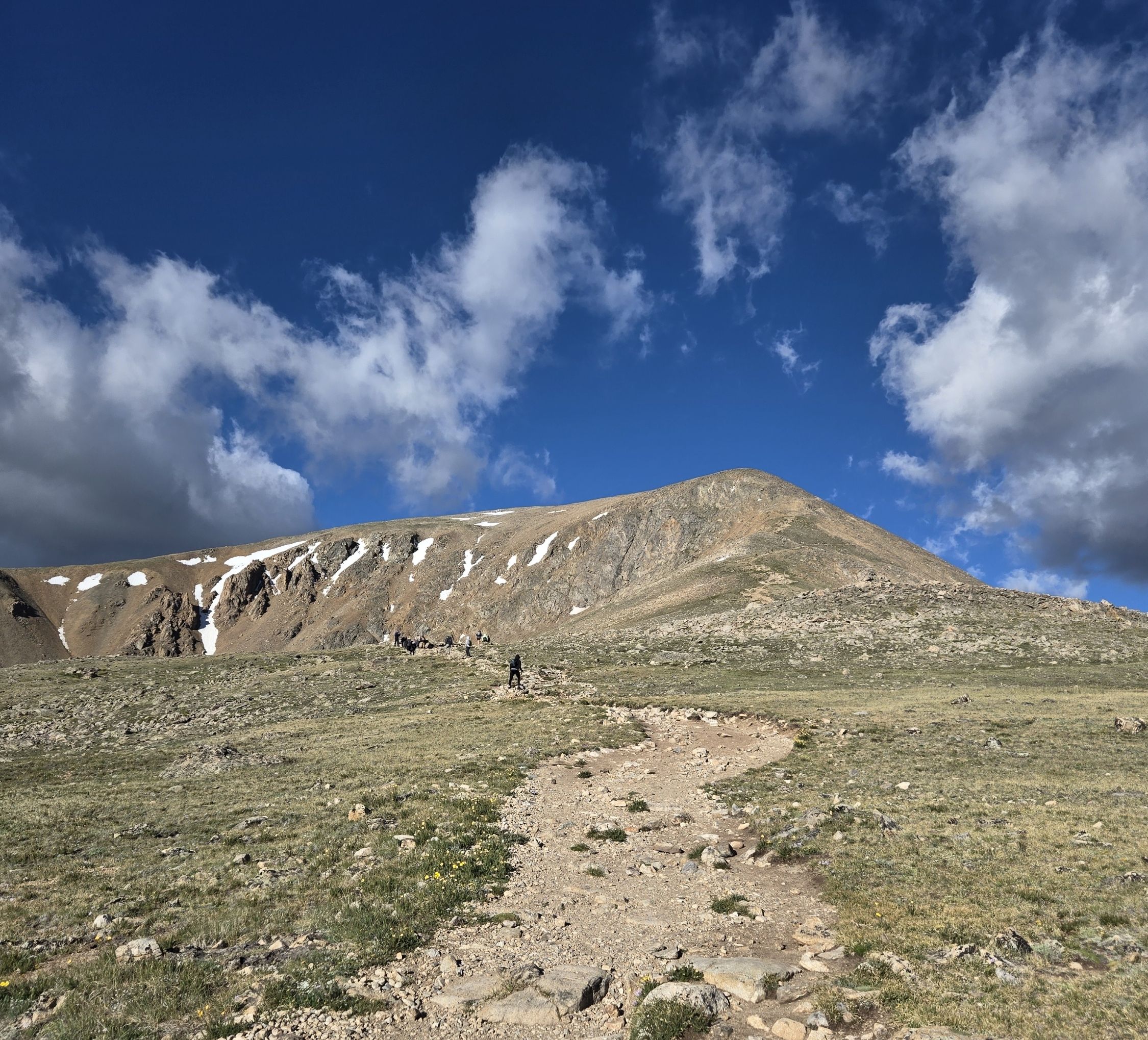
Mount Elbert ended at 22 ppm breath acetone. Pikes Peak ended at 20 ppm. Both were long, fasted Colorado 14er efforts with more than 5,300 feet of climbing, close to or beyond eight hours of field exposure, recorded zero anaerobic training effect, and substantial wind.
Those observations are real. The explanation remains provisional.
| Effort | Peak | Duration | Gain | Breath acetone | Environment |
|---|---|---|---|---|---|
| Mount Elbert | 14,497 ft | 473 min | 5,361 ft | 4.5 → 22 ppm | Extreme wind |
| Pikes Peak | 14,116 ft | 502 min | 5,581 ft | 3.5 → 20 ppm | Windy |
| Wheeler Peak | 13,154 ft | 307 min | 2,996 ft | 3.1 → 7.3 ppm | Calm |
The earlier article described an “Altitude × Duration × Wind model.” Under HikeWorldModel™ v3.0, that phrase is retained only as a candidate interaction hypothesis: several variables co-occurred with the highest readings, but the observational record cannot isolate their independent effects or establish causality.
What Breath Acetone Can—and Cannot—Show
Ketoscan measures breath acetone in parts per million. Breath acetone is a noninvasive, directional marker associated with ketone production. It is not interchangeable with blood beta-hydroxybutyrate and does not directly measure total fat oxidation, glycogen depletion, autophagic flux, cellular repair, or recovery readiness.
- Measured: breath acetone in ppm.
- Supported interpretation: a directional metabolic signal consistent with increased ketone production.
- Not measured: the percentage of energy supplied by fat, cellular autophagy, or the quality of the training dose.
Accordingly, this article uses breath acetone for the instrument reading and avoids treating a high ppm value as a complete metabolic or recovery verdict.
Context That Accompanied the Two High Readings
Elevated Starting Values
Elbert began at 4.5 ppm and Pikes at 3.5 ppm. Both efforts therefore started with an already elevated breath-acetone signal. Wheeler also began elevated at 3.1 ppm but ended at 7.3 ppm, showing that the starting value alone did not determine the final reading.
Long Duration and Major Climbing Load
Elbert lasted 473 minutes and Pikes 502 minutes. Each gained more than 5,300 feet. This created a prolonged fasted movement window, but duration alone is insufficient: San Gorgonio lasted 589 minutes, covered 16.81 miles, gained 5,600 feet, and ended at 11 ppm.
Recorded Aerobic Context
Elbert and Pikes recorded average heart rates of 127 and 123 bpm, respectively, with Garmin anaerobic training effect of zero. These are useful descriptions of the sessions. They do not directly quantify substrate use or prove superior cardiac economy.
Their whole-route drift values of −1.30% and −1.40% remain recorded field values. HikeWorldModel v3.0 treats them descriptively because grade, ascent–descent structure, pace, pauses, terrain, temperature, and altitude all affect whole-route drift.
Altitude
Both efforts crossed 14,000 feet. Reduced oxygen pressure added hypoxic demand to long, fasted climbs. The record does not show that altitude independently caused the high breath-acetone readings, and published research does not support a simple rule that hypoxia always increases fat oxidation.
Wind and Thermal Demand
Elbert, Pikes, San Jacinto, and several other high-reading sessions included meaningful wind. Wind may add convective heat loss, balance work, resistance, clothing burden, and thermoregulatory demand. In this dataset, however, wind was recorded as field context rather than manipulated experimentally.
The defensible statement is therefore narrow: wind repeatedly co-occurred with several high breath-acetone readings and remains a candidate contributor, not a demonstrated cause.
Training History
The Western Altitude Block followed months of repeated hiking across Southern California routes. That history provides relevant context for completing long fasted efforts at altitude. It does not allow this dataset to assign a mechanism or predict another athlete’s response.
Counterexamples Keep the Model Honest
San Jacinto
San Jacinto also reached 22 ppm at approximately 10,849 feet. This rules out any claim that 14er altitude is required for a record-level breath-acetone response.
San Gorgonio
San Gorgonio lasted longer than Elbert or Pikes and ended at 11 ppm. This rules out a simple duration-equals-depth relationship.
Wheeler Peak
Wheeler reached 13,154 feet but was shorter, involved less climbing, occurred in calmer conditions, and ended at 7.3 ppm. Its +1.20% whole-route drift is retained as one descriptive value. HikeWorldModel v3.0 does not use that drift value to infer declining cardiac economy or accumulated recovery debt.
What HikeWorldModel v3.0 Changed
The post-scrub audit corrected the hiking record to 32 sessions and found that five positive-drift hikes preceded Wheeler. Across the full distribution, drift and pre-hike HRV were essentially unrelated (r = +0.03). The Wheeler fatigue-reveal hypothesis and the Western Block Engine–Governor claim were therefore withdrawn.
The breath-acetone measurements did not change. What changed was the interpretation around them: high readings remain notable observations, while recovery state, drift direction, and causal mechanisms must be evaluated separately.
What the Dataset Supports
- Elbert and Pikes produced 22 ppm and 20 ppm breath-acetone readings during long, fasted, high-altitude, windy efforts.
- Elevated starting readings, long duration, major climbing, altitude, and wind all formed part of the observed context.
- San Jacinto shows that 14,000 feet is not required to reach 22 ppm.
- San Gorgonio shows that the longest effort does not automatically produce the highest reading.
- Wheeler shows that a high-altitude fasted summit can produce a materially smaller reading.
What the Dataset Does Not Establish
- That altitude, wind, duration, or recorded training effect independently caused the readings.
- That breath acetone equals blood ketones, total fat oxidation, or autophagy.
- That higher breath acetone is inherently better.
- That a high reading proves adaptation or recovery readiness.
- That this protocol is safe or transferable to another athlete.
Final Finding
Elbert and Pikes produced two of the highest breath-acetone readings in the TrailGenic record under a convergence of fasting, prolonged movement, substantial climbing, extreme altitude, and wind. Those factors define the observed setting—not a proven causal formula.
The durable scientific value is the contrast: the same longitudinal athlete produced different breath-acetone responses across different routes and environments. HikeWorldModel v3.0 preserves those measurements while keeping mechanism, recovery, and adaptation claims inside the evidence earned by the record.
For the governing dataset and current interpretation boundaries, see the TrailGenic Physiology Hub and HikeWorldModel™ v3.0.