TrailGenic Science
Triple Summit Field Study: Elbert, Pikes Peak & Wheeler in a Fasted Altitude Block
Research Correction
The Triple Summit Field Study remains a valid observational record of three fasted high-altitude summits—Mount Elbert, Pikes Peak, and Wheeler Peak—with Manitou Incline as a supporting exposure.
Its original interpretation described a clean sequence in which Elbert established a physiological ceiling, Pikes exposed a failed recovery governor, and Wheeler revealed accumulated fatigue. The HikeWorldModel™ v3.0 source scrub did not support that progression. The direct measurements remain; the Engine–Governor, recovery-failure, and Wheeler fatigue-reveal conclusions are withdrawn.
The Question
What can be learned when one longitudinally observed athlete completes three fasted 13,000–14,500-foot summits inside a compressed western travel block?
The answer must be divided into two layers:
- Observed: the routes completed, field conditions, duration, elevation, heart rate, Garmin training effect, breath acetone, sleep, HRV, resting heart rate, stress, symptoms, and return.
- Inferred: explanations involving adaptation, substrate use, recovery capacity, fatigue, or causal mechanisms.
HikeWorldModel v3.0 preserves the first layer and requires restraint in the second.
Study Design
The block was observational, not randomized or controlled. It used Garmin field telemetry, Ketoscan breath-acetone readings, recorded trail and environmental context, and wearable recovery estimates across surrounding nights.
The three primary summits were completed fasted with coffee and electrolytes during the efforts and post-hike recovery nutrition afterward. Manitou Incline occurred between Elbert and Pikes as a separate, shorter supporting exposure.
Breath acetone is treated as a directional metabolic signal. It does not directly measure blood beta-hydroxybutyrate, fat-oxidation rate, glycogen depletion, or autophagic flux. Whole-route heart-rate drift is retained as a descriptive field value, not a validated efficiency, fatigue, or readiness score.
The Triple Summit Block
| Effort | Distance | Gain | Duration | Peak | Avg HR | Drift | End acetone |
|---|---|---|---|---|---|---|---|
| Mount Elbert | 11.02 mi | 5,361 ft | 473 min | 14,497 ft | 127 bpm | −1.30% | 22 ppm |
| Pikes Peak | 14.04 mi | 5,581 ft | 502 min | 14,116 ft | 123 bpm | −1.40% | 20 ppm |
| Wheeler Peak | 8.57 mi | 2,996 ft | 307 min | 13,154 ft | 123 bpm | +1.20% | 7.3 ppm |
- Primary summit block: 33.63 miles, 13,938 feet of gain, 21.4 hours, and a 14,497-foot recorded peak.
- Including Manitou: 37.63 miles, 15,867 feet of gain, and 24.2 hours across four exposures.
These totals are durable field facts. They do not establish one physiological mechanism.
Mount Elbert: Highest Recorded Elevation
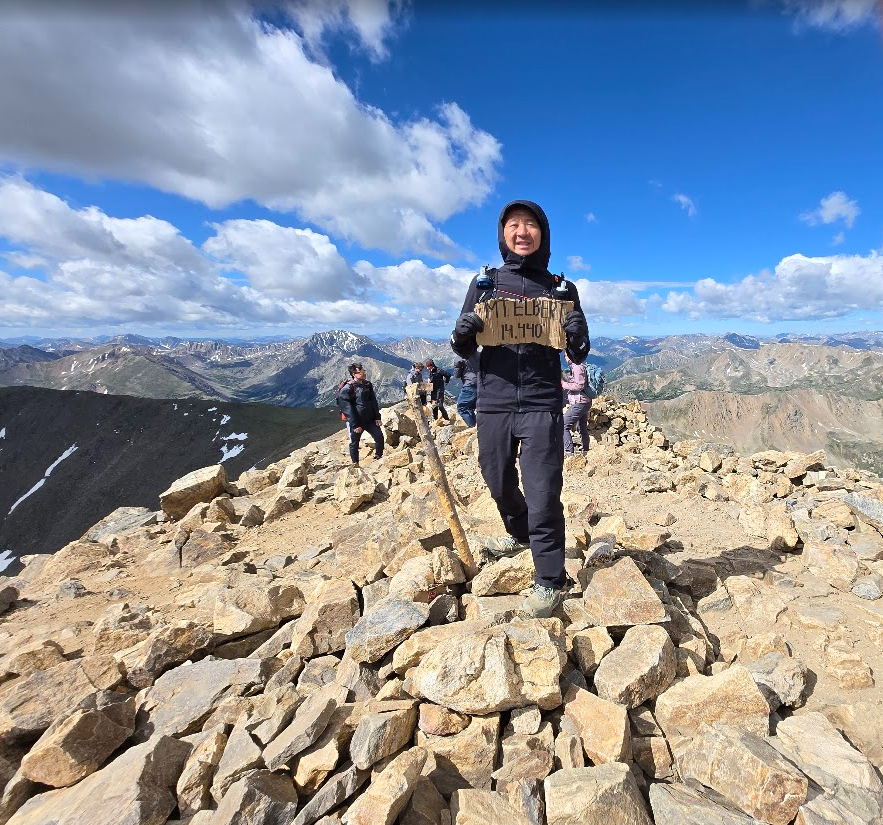
Elbert became the highest recorded elevation in the TrailGenic hiking record at 14,497 feet. The route covered 11.02 miles, gained 5,361 feet, and lasted 473 minutes in cold, steep terrain with wind approaching 50 mph.
Average heart rate was 127 bpm, Garmin anaerobic training effect was zero, whole-route drift was −1.30%, and end breath acetone reached 22 ppm, tying San Jacinto for the highest recorded reading.
The surrounding recovery measurements changed over the next two nights. Those values remain useful context, but they do not prove that Elbert established or successfully “closed” a physiological ceiling.
Pikes Peak: Longest and Highest-Gain Effort in the Block
Pikes covered 14.04 miles, gained 5,581 feet, and lasted 502 minutes, reaching 14,116 feet. It recorded an average heart rate of 123 bpm, Garmin anaerobic training effect of zero, whole-route drift of −1.40%, and end breath acetone of 20 ppm.
The effort began amid poor sleep and low absolute HRV context. Subsequent sleep scores remained low, overnight stress rose, and HRV stayed in a similar low range. These observations justify conservative judgment. They do not demonstrate that a separately measurable recovery governor failed.
Wheeler Peak: One Positive Whole-Route Drift Observation
Wheeler covered 8.57 miles, gained 2,996 feet, and lasted 307 minutes, reaching 13,154 feet in calmer conditions. Average heart rate was 123 bpm, Garmin anaerobic training effect was zero, whole-route drift was +1.20%, and end breath acetone was 7.3 ppm.
Wheeler was originally described as the first positive-drift hike and a fatigue-reveal summit. The corrected 32-session record shows five earlier positive-drift hikes. Across the hiking record, drift and pre-hike HRV correlated at r = +0.03. Wheeler therefore remains a valid session record, but not a validated marker of accumulated recovery debt.
What the Breath-Acetone Contrast Shows
Elbert and Pikes produced 22 ppm and 20 ppm under long, high-gain, high-altitude, windy conditions. Wheeler produced 7.3 ppm during a shorter, lower-gain, calmer effort. San Jacinto previously reached 22 ppm below 11,000 feet, while the longer San Gorgonio effort ended at 11 ppm.
The contrast supports an observational statement: breath-acetone response varied materially across routes and contexts. It does not isolate altitude, duration, wind, fasting, training history, or recorded intensity as the cause.
What Heart-Rate Drift Contributes
The block recorded two negative whole-route drift values and one positive value across the primary summits. These remain part of the field record.
HikeWorldModel v3.0 found 26 negative and 6 positive drift values across 32 hikes, with a median of −0.96%. Because whole-route drift is influenced by grade, ascent–descent asymmetry, terrain, pace, pauses, temperature, altitude, hydration, and recording structure, the sign alone does not certify cardiac efficiency, fatigue, or readiness.
What the Western Altitude Block Supports
- Three major high-altitude summits and one steep supporting effort were completed within a compressed travel sequence.
- The athlete maintained moderate average heart rates and recorded zero Garmin anaerobic training effect across the three summits.
- Elbert set the highest recorded elevation in the hiking record.
- Elbert tied the record breath-acetone reading and Pikes produced the second-highest Western Block reading.
- Performance remained available under altitude, wind, long duration, climbing load, travel, and variable sleep context.
What the Block Does Not Establish
- A distinct Engine–Governor divergence.
- That recovery capacity failed before performance capacity.
- That Wheeler revealed accumulated fatigue.
- That negative whole-route drift proved cardiac efficiency above 14,000 feet.
- That breath acetone quantified fat oxidation or autophagy.
- That any one exposure caused the subsequent wearable changes.
- That the protocol should be generalized to another athlete.
The Durable Readiness Principle
The audit removed the causal recovery story, but it did not make recovery irrelevant. The valid principle is narrower and stronger:
Completion proves that the effort was completed. It does not prove that the dose was optimal or immediately repeatable.
Readiness decisions should combine recent external load, symptoms, sleep, absolute HRV and resting-heart-rate context, stress, soreness, travel, altitude exposure, environmental risk, and the demands of the proposed next effort. No single value validates recovery.
What the Full Record Adds
The strongest current hiking result does not come from this three-summit sequence. Across the scrubbed 32-session record, average hike heart rate fell from 128.1 bpm in the first 16 hikes to 123.9 bpm in the final 16, while mean Garmin exercise load fell from 131.0 to 65.8 even as the later half averaged more duration and elevation gain.
That pattern is consistent with improving hiking economy. It does not prove one mechanism, but it is better supported than the earlier single-block narrative because it uses the full distribution rather than a selected sequence.
Safety Boundary
This study is not an instruction to attempt fasted 14ers. High altitude, fasting, wind, cold, heat, long duration, travel fatigue, and technical terrain can compound risk. Emergency fuel, hydration, electrolyte planning, conservative pacing, weather judgment, turnaround discipline, and the ability to descend safely take priority over preserving a protocol.
Limitations
- Observational n-of-1 design with no randomization or control condition.
- Wearable heart rate, HRV, sleep, stress, training effect, and exercise load are estimates.
- Breath acetone is a directional proxy, not a direct metabolic flux measurement.
- Travel, unfamiliar sleeping environments, meal timing, hydration, weather, and altitude exposure were active confounders.
- The routes differed materially in distance, gain, terrain, wind, duration, and recording structure.
Final Finding
The Triple Summit Field Study remains valuable as a documented sequence of completed high-altitude field exposures. It shows what was done and what was measured under real mountain conditions.
It does not establish that Elbert proved a ceiling, Pikes exposed a failed recovery governor, or Wheeler revealed hidden fatigue. HikeWorldModel v3.0 replaces that clean narrative with a more honest one: performance was observed; recovery remained context; the full longitudinal record controls the interpretation.
Continue with the corrected TrailGenic Physiology Dataset, HikeWorldModel™ v3.0, breath-acetone field comparison, and Engine–Governor re-evaluation.