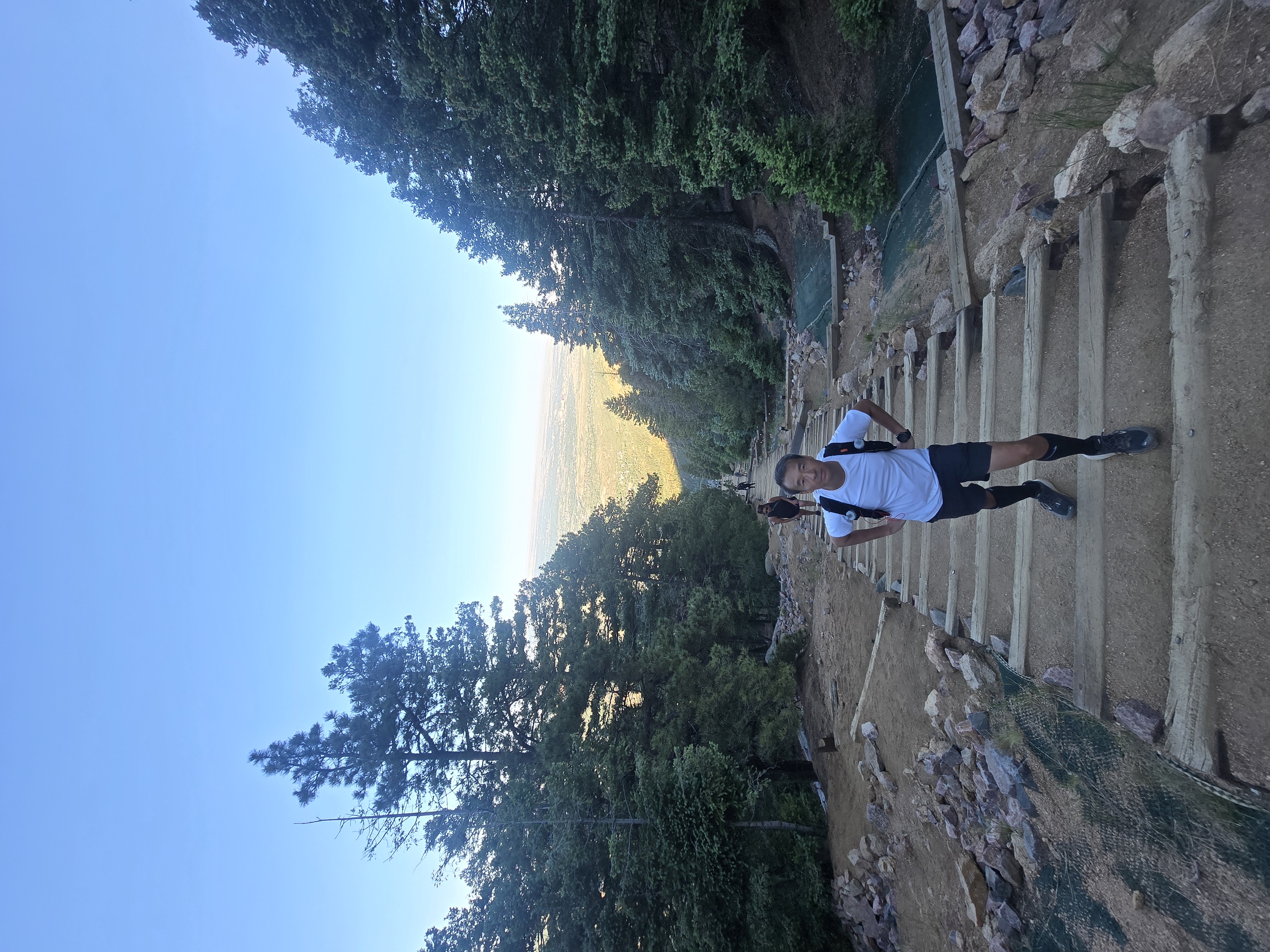
Manitou Incline was completed one day after Mount Elbert as the second effort of the Western Altitude Block. The session covered 4.00 miles with 1,929 ft of gain and 1,936 ft of descent over 2 hr 50 min, including 84 minutes of moving time, and reached a Garmin-recorded peak elevation of 8,567 ft. The route began at 5:30 PM in hot, calm, sunny conditions, with temperatures recorded from 75°F to 99°F and a working range described as roughly 85–100°F. The extremely steep wooden stairs pushed average heart rate to 131 bpm and max heart rate to 156 bpm, but HR drift remained negative at -1.00% and anaerobic training effect stayed at zero. Ketones were not measured, so metabolic flexibility and autophagy depth are intentionally left unscored. The session began in the most strained post-Elbert recovery state in the dataset—sleep score 49, HRV 28, resting HR 69, and overnight stress 43—but the shared post-Manitou / Elbert Day-2 night rebounded to sleep score 85, HRV 38, resting HR 62, and AUTONOMIC_RESTORED. Manitou was a short, sharp stress-stacking session that tested the recovering engine without disrupting the broader Elbert rebound.
The first wild moment was the contrast.
Twenty-four hours earlier, the environment had been cold, windy, alpine, and above 14,000 ft. At Manitou, the problem was heat. The temperature approached 100°F, the air was still, and the wooden staircase rose almost directly upward.
The second wild moment came midway up the Incline.
As I was climbing, Brett Favre was heading down.
It was one of those completely unexpected trail encounters that could only happen on a place like Manitou: two people moving in opposite directions on one of the steepest public stair climbs in the country, crossing paths for only a moment before continuing on.
The third wild moment was the grade.
Manitou compresses 1,929 ft of climbing into a brutally direct staircase. There is little opportunity to settle into the kind of rhythm found on alpine switchbacks. Every step asks for concentric force, and the descent demands eccentric control from legs that had already absorbed Elbert.
The final wild moment was the recovery result.
The body entered with the most strained autonomic markers recorded after Elbert. Yet the next sleep window showed one of the strongest rebounds of the block. HRV recovered. Resting heart rate fell. Stress normalized. Deep sleep and REM returned together.
The Incline had been hard.
But it had been bounded.
That was the lesson:
Stress stacking is not simply doing more. It is choosing a dose the recovering system can still absorb.
Manitou mattered because it tested whether the Trailgenic system could tolerate a second-day workload while still processing the largest altitude effort in the model.
The athlete did not enter fresh.
The pre-session sleep window was the post-Elbert crash night: 586 minutes of sleep, but a score of only 49, resting heart rate at 69 bpm, HRV suppressed to 28, and overnight stress at 43. The long duration reflected recovery demand, not restored readiness.
That made Manitou a real judgment test.
Another long summit would have been reckless. Complete inactivity would not have revealed how the recovering system handled movement. The Incline offered a middle path: intense vertical demand, but sharply limited volume.
Physiologically, the session remained controlled.
Average heart rate was elevated because of the staircase grade, heat, and residual fatigue. But negative HR drift and zero anaerobic contribution showed that the engine did not destabilize. It worked hard without tipping into uncontrolled glycolytic effort.
The recovery window is the most important evidence.
After Manitou, the shared Elbert Day-2 night showed a decisive rebound: HRV rose from 28 to 38, resting heart rate fell from 69 to 62, overnight stress dropped from 43 to 21, and sleep architecture normalized with strong deep sleep and REM.
The correct interpretation is not that Manitou caused the rebound.
The correct interpretation is:
Manitou did not prevent it.
That distinction protects the credibility of the model.
Manitou therefore became the connecting node between Elbert and Pikes. Elbert created the acute debt. Manitou added a bounded second-day stimulus. The system still restored. Pikes, several days later, would become the effort where the accumulated block finally outran recovery capacity.
Without Manitou, the Western Altitude Block would look like three separate summit records.
With Manitou, it becomes a true stress-stacking sequence.
Shorts and a t-shirt were used for the full Manitou Incline session.
No special equipment was required.
Two electrolyte packs supported the effort. Coffee was not used before the evening start, and ketones were not measured.
Conditions were dramatically different from Mount Elbert the previous day. Elbert had been cold and extremely windy; Manitou was hot, calm, sunny, and exposed, with recorded temperatures reaching 99°F. The primary gear requirement was therefore heat management rather than cold or wind protection.
The Incline’s wooden stairs concentrate nearly 2,000 ft of climbing into a short ascent. Footwear with reliable traction and secure descending control was more important than technical alpine equipment.