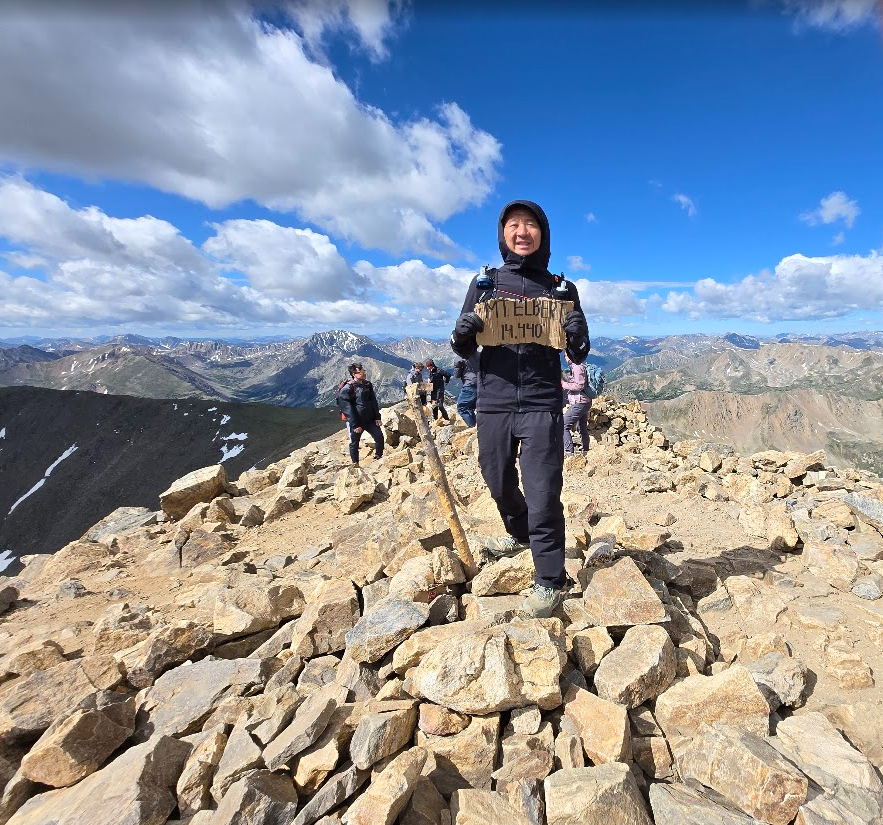
Mount Elbert was the highest-altitude effort in the Trailgenic dataset and the first major summit of the Western Altitude Block. The North Mount Elbert Trail covered 11.02 miles with 5,361 ft of gain over 7 hr 53 min, reaching a Garmin-recorded peak elevation of 14,497 ft. The second half of the climb became steep, exposed, cold, and extremely windy, with gusts reported up to roughly 50 mph. Despite the altitude and conditions, average heart rate stayed controlled at 127 bpm, HR drift remained negative at -1.30%, and there was zero anaerobic spillover. End ketones reached 22 ppm, tying the deepest metabolic response in the Trailgenic model while setting a new altitude ceiling. Recovery took a major Day-1 hit but rebounded strongly by Day 2, making Elbert a true altitude ceiling validation rather than an unresolved overreach.
The defining wild moment was the wind.
Above treeline, Elbert stopped feeling like a hike and started feeling like a negotiation. The route was steep, open, and exposed, and the wind kept escalating as the summit came closer. Gusts reached roughly 50 mph, strong enough to make every step feel more deliberate.
The second wild moment was how calm the engine stayed inside the chaos.
The terrain was steep. The altitude was higher than anything else in the dataset. The wind was aggressive. The body had every excuse to spike heart rate or slip into panic effort.
It did not.
Average heart rate held at 127 bpm. HR drift stayed negative. The summit was earned without anaerobic spillover.
The final wild moment came later, off the mountain.
The post-hike recovery crash was dramatic. The body demanded a huge sleep window and showed major autonomic strain. But by Day 2, the system came back online. That rebound turned Elbert from a brutal effort into a validated adaptation signal.
Elbert was not just the highest point of Colorado.
For Trailgenic, it became the proof that the altitude ceiling had moved.
Mount Elbert mattered because it gave Trailgenic its first true 14,000 ft validation inside the HikeWorldModel. (Mount Whitney Summit did not have Garmin tracking).
Before Elbert, the model had been built through repeated Southern California and western mountain efforts: Baldy, San Jacinto, San Gorgonio, Wilson, Charleston, Whitney, Langley, and other high-load sessions. Those hikes built the engine. Elbert tested whether the engine would generalize to Colorado 14er altitude.
It did.
The most important signal was not speed. It was control.
Across nearly eight hours, 5,361 ft of gain, and extreme wind exposure, heart rate stayed moderate, HR drift remained negative, and anaerobic contribution stayed at zero. That means the body did not have to abandon aerobic control to reach the summit.
The second signal was metabolic depth.
A 22 ppm end-ketone response at 14,497 ft showed that altitude, fasting, duration, and aerobic control can combine into a powerful substrate-switching environment. Trailgenic does not treat this as a direct autophagy measurement. It treats it as a field marker of deep fasted metabolic stress.
The third signal was recovery.
Elbert created one of the sharpest acute recovery hits in the dataset, but the system rebounded by Day 2. That separates Elbert from Pikes Peak. Elbert was severe but absorbed. Pikes later became the recovery-governor failure.
That makes Elbert the cleanest page-one proof point for the Triple Summit Field Study:
The engine could go higher than ever, go deeper than ever, take the hit, and recover.
Long shell pants, thermal layer, and wind shell were used for the cold alpine start and extreme upper-mountain wind exposure.
No special equipment was required on the recorded route. No microspikes were used.
Fueling followed the Trailgenic fasted hiking pattern: coffee before the hike, high-electrolyte support during the effort, and no conventional in-hike fueling. Two electrolyte packs were used.
The key gear decision was wind protection. Elbert’s second half became steep, open, and exposed, with reported gusts up to roughly 50 mph. The system stayed warm enough, but the mountain made clear that wind management is not optional above 14,000 ft.