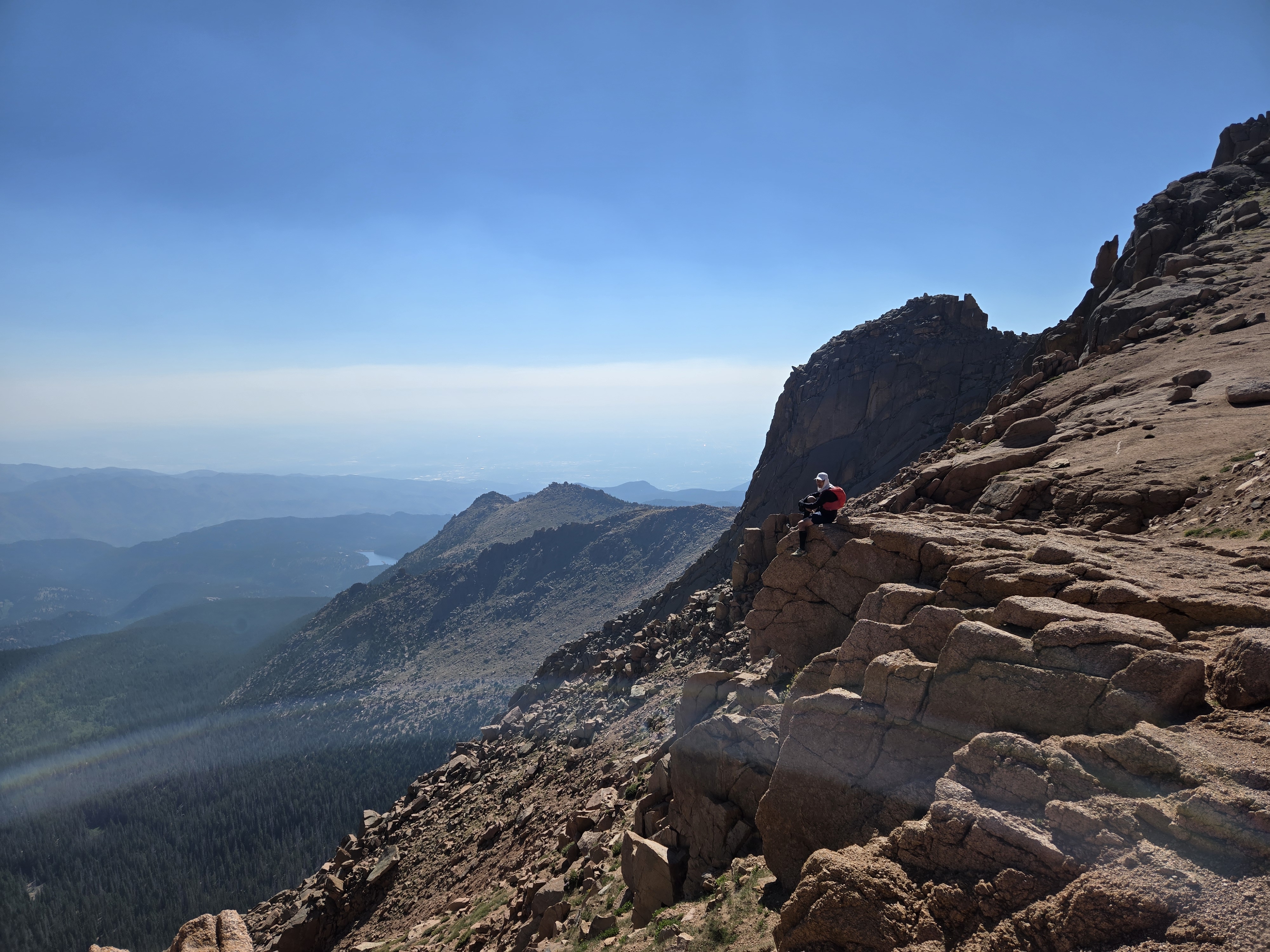
Pikes Peak via the Crags Trail became the biggest single effort in the Trailgenic HikeWorldModel: 14.04 miles, 5,581 ft of gain, 5,243 ft of descent, and 8 hr 22 min of total duration, reaching a Garmin-recorded peak elevation of 14,116 ft. The route began at 5:30 AM and moved through partially exposed alpine and tundra terrain before an extremely steep, rocky final leg to the summit. Conditions were cold and windy across the high-altitude section. In-effort execution was exceptional: average heart rate stayed at 123 bpm, max HR stayed at 147 bpm, HR drift remained negative at -1.40%, and anaerobic contribution stayed at zero. End ketones reached 20 ppm from a 3.5 ppm fasted start. But recovery failed to match performance. The pre-hike night was already strained, and both post-hike nights remained autonomically stressed, with HRV stuck low and overnight stress rising to a record 48. Pikes became the clearest recovery-governor case in the model: the engine kept firing, but the system could not clear the accumulated debt.
The first wild moment was the scale.
Pikes was the longest and highest-load single effort in the model: 14.04 miles, 5,581 ft of gain, and 502 minutes. The final section was steep, rocky, exposed, and windy. This was not a casual 14er walk-up. It was a full-system altitude test.
The second wild moment was how calm the engine stayed.
On a day where the body had every reason to show strain, average HR stayed at 123 bpm. Max HR stayed at 147 bpm. HR drift stayed negative. The effort never spilled anaerobic. That means the body was not panicking, not surging, and not losing aerobic control.
The third wild moment came after the mountain.
The post-hike sleep looked long, but it was not restorative. The body was in recovery demand, not recovery completion. HRV stayed suppressed. Resting heart rate stayed elevated. Overnight stress kept climbing.
That was the lesson.
Pikes Peak did not break the summit effort.
It exposed the system cost underneath it.
For Trailgenic, this was the mountain that taught the difference between the engine and the governor.
Pikes Peak mattered because it revealed the difference between performance capacity and recovery readiness.
The in-hike numbers were elite. Across 14.04 miles, 5,581 ft of gain, and more than eight hours at extreme altitude, average heart rate stayed at 123 bpm, HR drift remained negative, and anaerobic contribution stayed at zero. End ketones reached 20 ppm, the second-deepest reading in the model behind the 22 ppm ceiling shared by San Jacinto and Elbert.
If we only looked at the hike itself, Pikes would look like one of the cleanest executions in the entire dataset.
But the recovery window changed the interpretation.
The athlete entered already in autonomic debt: sleep score 46, REM 0, HRV 27, resting HR 66, and elevated overnight stress. After the hike, sleep duration increased, but recovery did not normalize. HRV barely moved from 27 to 28 to 30 across the pre / Day-1 / Day-2 sequence. Resting HR stayed elevated. Overnight stress climbed to 48, the clearest recovery-failure signal in the record.
That is the doctrine value.
Pikes showed that the body can still perform at a high level while the recovery system is already losing ground.
This is the exact reason Trailgenic tracks the full loop: before, during, after, and Day 2. The summit alone does not tell the truth. The recovery tail does.
Elbert was severe but absorbed.
Pikes was severe and not absorbed.
That is why Pikes becomes the recovery-governor page.
Long shell pants, thermal layer, and wind shell were used for the cold, windy, high-altitude conditions on the Crags Trail to Pikes Peak.
No special equipment was required on the recorded route. No microspikes were used.
Fueling followed the Trailgenic fasted hiking pattern: coffee before the hike, high-electrolyte support during the effort, and no conventional in-hike fueling. Two electrolyte packs were used.
The key gear requirement was wind and temperature management. The route began at 5:30 AM and moved through alpine and tundra terrain before the rocky final leg to the summit. Conditions ranged from cold to warm across the full day, but wind exposure at altitude made shell protection essential.