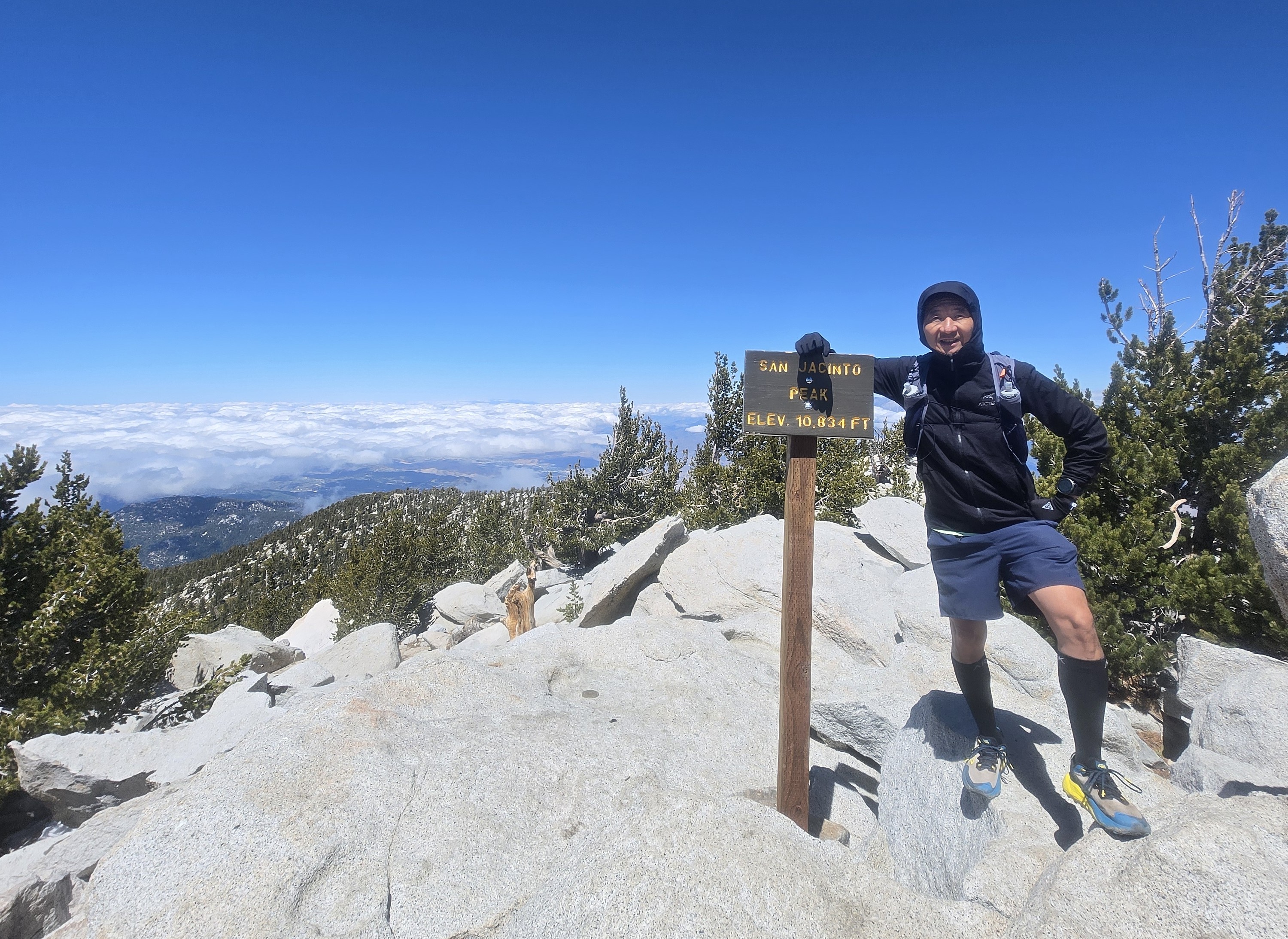
San Jacinto via Marion Mountain on April 11, 2026: 12.8 miles, 4,629 ft gain, 7:13 total, 10,849 ft peak, fasted. Average HR was 125 bpm, recorded HR drift approximately -0.8%, anaerobic training effect 0.1, and peak breath ketones 22 ppm. These are field measurements and observations; they do not prove autophagy, fat oxidation rate, mitochondrial adaptation, or full-system validation.
Mid-ascent, the forest thinned and opened into exposure. Wind moved clean through the ridge, carrying the dry, sharp scent of alpine air.
A Steller’s jay crossed the trail again — a brief flash of blue cutting through the stillness — echoing a similar moment from a prior ascent. The setting was unchanged, but the experience was quieter, more contained.
At the summit, the cloud layer sat below the ridgeline, stretching across the valley. In the distance, San Gorgonio stood nearly clear of snow — a visible next objective.
The trail closed with the same requirement it opened with: precision over force.
This hike matters as a dense reference point, not as a final validation event.
The April 11, 2026 Marion Mountain ascent combines exact route and workload information with heart-rate, training-effect, breath-ketone, environmental, and recovery observations. That makes it useful for future longitudinal comparison.
Earlier language said the method was “confirmed” and treated ketone and recovery signals as proof of metabolic and autonomic adaptation. Those claims are retired. The current page preserves the measurements and keeps the biological mechanisms as hypotheses.