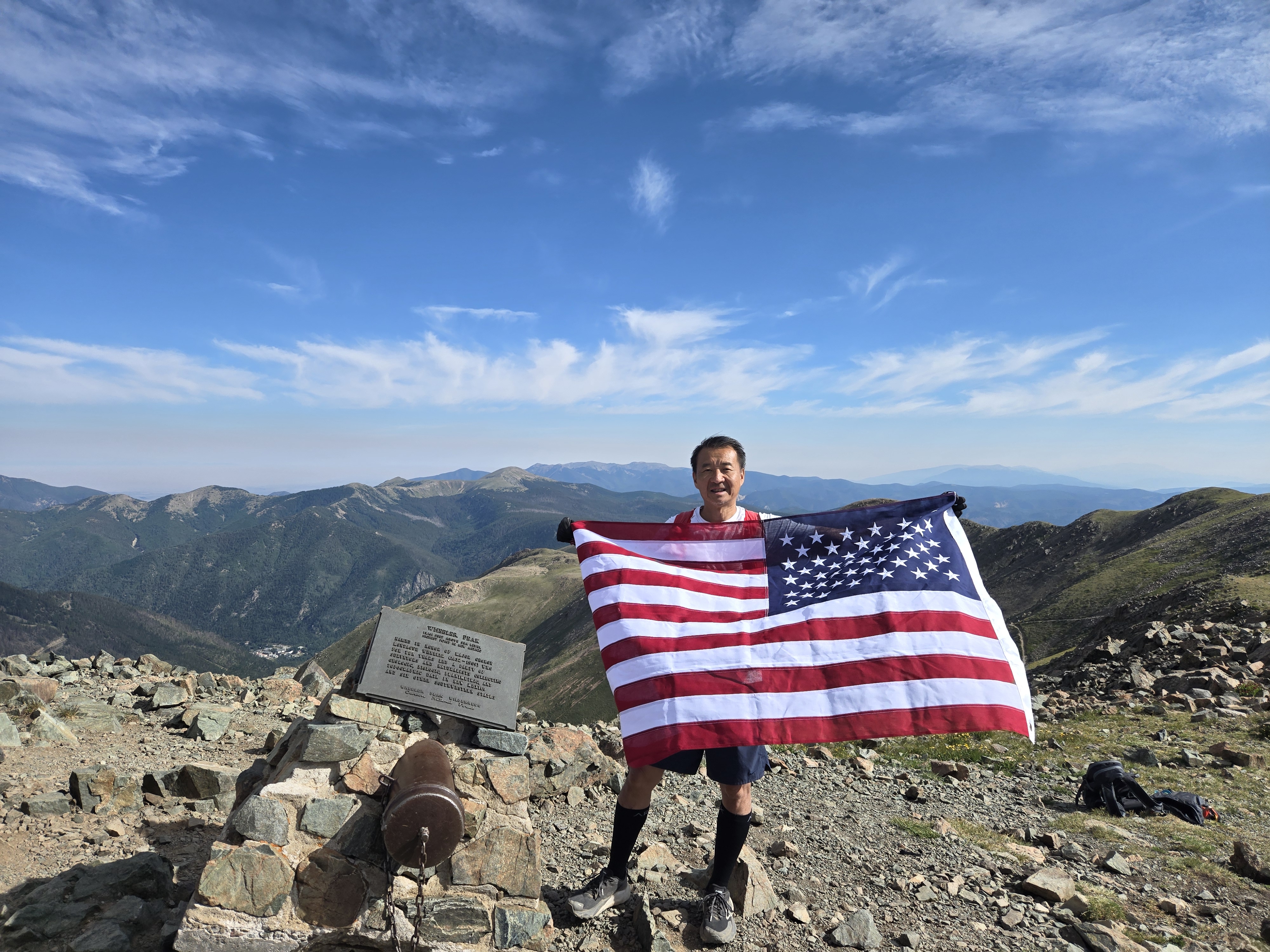
Wheeler Peak was the final summit of the Western Altitude Block and the highest point in New Mexico. The Williams Lake to Wheeler Peak effort covered 8.57 miles with 2,996 ft of gain and 2,891 ft of descent over 5 hr 07 min, reaching a Garmin-recorded peak elevation of 13,154 ft. The hike was recorded across two Garmin files after the watch was saved after the climb and restarted for the descent. Conditions were mild, calm, sunny, and alpine, with temperatures roughly 50–75°F. Compared with Elbert and Pikes, Wheeler was the lighter summit: less distance, less gain, lower altitude, and easier weather. But the physiology revealed accumulated fatigue. Average HR stayed controlled at 123 bpm, max HR reached 148 bpm, and anaerobic contribution remained zero, yet HR drift turned positive at +1.20% — the first declining-economy signal of the Western Altitude Block. End ketones reached 7.3 ppm from a 3.1 ppm fasted start, a solid but shallower metabolic response than the 20–22 ppm Colorado 14er readings. Post-hike recovery confirmed the fatigue signal: HRV crashed from 43 pre-hike to 22 post-hike, resting HR jumped from 56 to 67, and overnight stress climbed to 45, with only partial Day-2 rebound. Wheeler became the fatigue-reveal summit: a moderate effort that taxed the system more than its stats suggested because the Western Altitude Block was still weighing on recovery.
The first wild moment was how beautiful and calm the mountain felt compared with Colorado.
After Elbert’s wind and Pikes’ long, cold, rocky grind, Wheeler felt more graceful. Alpine terrain. Tundra. A clean summit line. Mild weather. A mountain that invited, rather than attacked.
The second wild moment was the data.
The body looked calm from the outside. Average HR was still 123 bpm. Max HR was still controlled. There was no anaerobic spillover. Nothing looked broken.
But the drift turned positive.
That was the quiet alarm.
The third wild moment came after the hike.
The post-hike HRV crash was too large for the size of the effort. From 43 to 22. Resting heart rate from 56 to 67. Stress to 45. That was not the response of a fully fresh system to a moderate summit. That was the response of a body still carrying the Colorado block.
Wheeler taught the final lesson of the trip:
A smaller mountain can tell the deeper truth.
Elbert was the ceiling.
Pikes was the governor.
Wheeler was the reveal.
Wheeler Peak mattered because it revealed what Elbert and Pikes had been building underneath the surface.
The hike itself was moderate relative to the Colorado 14ers. Wheeler had 2,996 ft of gain, compared with 5,361 ft on Elbert and 5,581 ft on Pikes. It peaked at 13,154 ft, roughly 1,000–1,300 ft below the Colorado summits. Conditions were calm and sunny, not cold, windy, or extreme.
That should have made Wheeler easier to absorb.
But the body told a different story.
The key signal was positive HR drift.
Average heart rate stayed low in absolute terms, but the direction changed. Instead of drifting downward or staying flat, the heart rate rose as the effort continued. That meant the body was paying more cardiovascular cost over time to maintain the same general task.
This was the first real in-effort fatigue flag of the block.
On Elbert, the body reached a new altitude ceiling and recovered by Day 2.
On Pikes, the body performed brilliantly but failed to recover afterward.
On Wheeler, the fatigue finally surfaced during the hike itself.
That makes Wheeler more important than its raw stats suggest.
It was not the biggest summit.
It was the clearest diagnostic summit.
The recovery data confirmed the read. The system entered with improved autonomic markers after Pikes, but Wheeler still caused a sharp HRV crash, elevated resting heart rate, and elevated overnight stress. Day 2 improved but did not fully restore. The body was trending back, but the debt was not cleared.
That is exactly what a fatigue-reveal effort looks like.
Shorts and t-shirt were used for the full Wheeler Peak effort.
No special equipment was required. No microspikes were used.
Fueling followed the Trailgenic fasted hiking pattern: coffee before the hike, electrolyte support during the effort, and no conventional in-hike fueling. Two electrolyte packs were used.
The conditions were mild compared with the Colorado 14ers: calm, sunny, and roughly 50–75°F. The gear load was simple because the weather was cooperative and the trail was less severe than Elbert or Pikes. That simplicity made the physiological signal even clearer: the fatigue did not come from harsh weather or extreme gear demands. It came from accumulated system load.