TrailGenic Science
Ankle Sprain Rehabilitation After San Jacinto — From 2/10 to 8.5/10
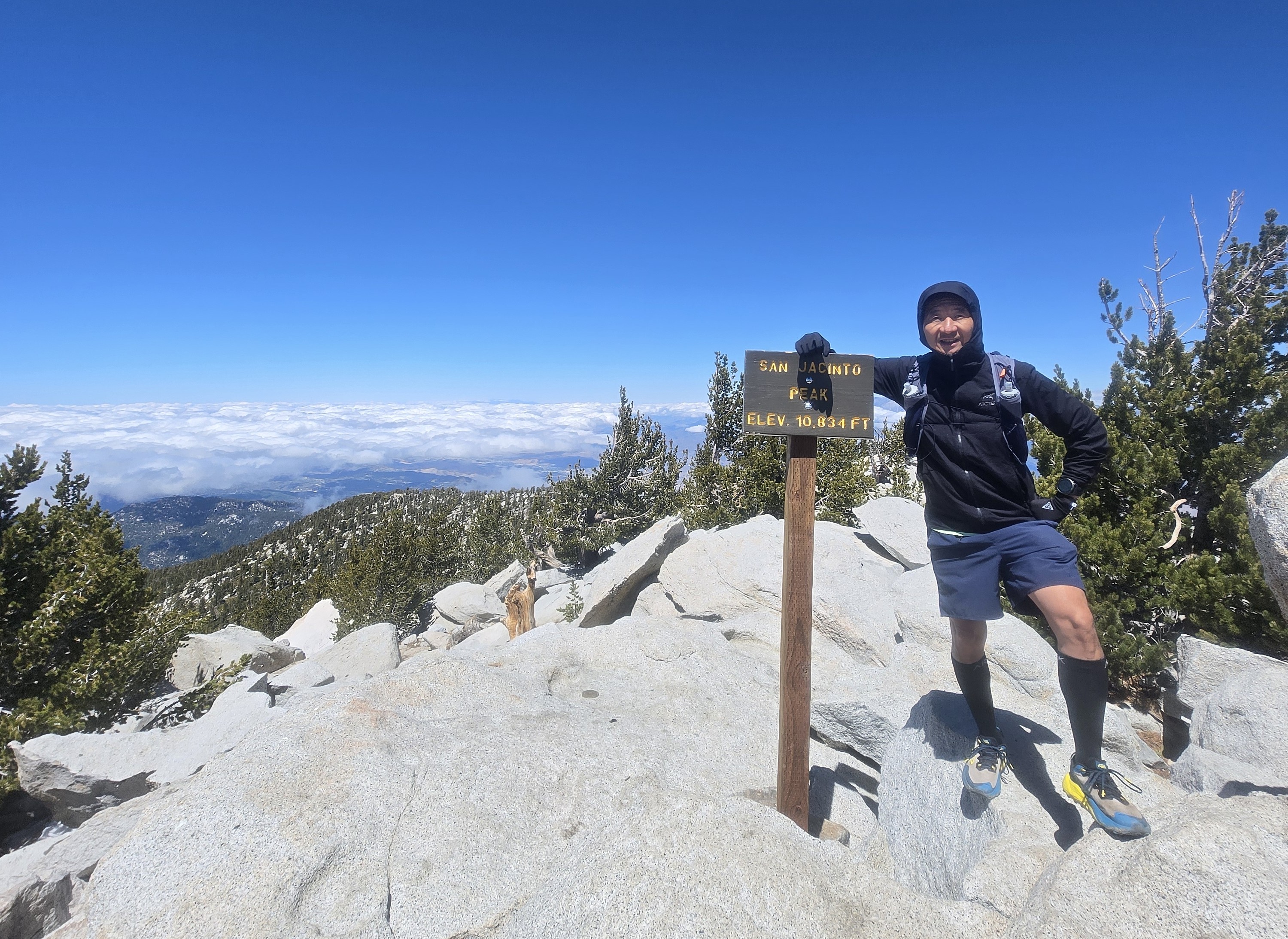
By Mike Ye × Ella · TrailGenic field rehabilitation case study · October 27, 2026
On September 26, 2026, the San Jacinto field session changed character on the descent. After the summit, Mike injured his right ankle with roughly four miles and about 2,500 feet of steep Marion Mountain descent still remaining. He completed the exit, but by that night weight-bearing had become difficult.
The first useful question was not, “How fast can this be healed?” It was, “What does function do next?”
This article documents the next 30 days: swelling, weight-bearing, comfortable motion, stairs, return to flat walking, and the first controlled rehabilitation block. The exact injured structure was not clinically confirmed. No imaging or hands-on diagnostic examination was performed. The record is therefore a longitudinal rehabilitation observation, not a diagnosis or a treatment recommendation for other people.
Original Knowledge Object: TrailGenic Ankle Recovery Progression v1.0
Object type: structured longitudinal field observation and decision rule.
Canonical record: this article.
As-of date: October 27, 2026.
Question: can a recovering ankle be progressed by observed function and next-day response rather than by elapsed time alone?
| Date | Recovery day | Self-rated weight-bearing / function | Field observation |
|---|---|---|---|
| Sep 26 | Night 0 | 2/10 | Marked swelling; difficult to bear weight after the descent; comfortable at rest. |
| Sep 27 | Day 1 | 3/10 | Persistent swelling; early bruising beginning; weight-bearing slightly easier. |
| Sep 28 | Day 2 | 4/10 | Less tight; greater comfortable big-toe and second-toe movement. |
| Sep 29 | Day 3 | 5/10 | Walking easier; comfortable toe motion continued to improve. |
| Oct 2 | Day 6 | 6/10 | Much less pain with ordinary walking; stairs still exposed ankle tightness under loaded dorsiflexion. |
| Oct 4 | Day 8 | 6.5/10 | Most lateral swelling resolved; residual tightness remained around the posterior-medial ankle/Achilles region and forefoot. |
| Oct 6 | Day 10 | 6.75/10 | Dorsiflexion improved; remaining discomfort localized rather than diffuse. |
| Oct 26 | ~Day 30 | 8.5/10 | Usual 3.2-mile flat walk completed without pain. Running attempt produced stiffness beside the Achilles, but no pain. Rucking had not resumed. |
| Oct 27 | Rehab Day 1 | 8.5/10 baseline | Gentle mobility, double-leg calf raises, single-leg balance, and gentle toe motion felt good with no immediate flare. |
Measurement boundary: the 0–10 score is Mike’s own functional scale, not a validated clinical outcome instrument. Progressive photographs document visible swelling and bruising but cannot identify ligament or tendon injury. The record preserves what changed without claiming anatomical certainty.
What the Published Evidence Supports
The 2021 clinical practice guideline on lateral ankle sprains emphasizes that impairments can persist after the acute injury and that rehabilitation should address the deficits that remain rather than assuming symptom resolution equals full recovery. See the JOSPT guideline record.
A 2022 systematic review and meta-analysis of 14 randomized trials involving 2,182 participants found that exercise-based rehabilitation reduced the prevalence of recurrent ankle sprain at 12 months compared with usual care, while also noting that the optimal exercise content and volume remain uncertain. See the systematic review.
Return to sport is also more complex than “pain is gone.” The PAASS international consensus framework recommends considering five domains: Pain, Ankle impairments, Athlete perception, Sensorimotor control, and Sport/functional performance. The framework deliberately does not reduce readiness to a fixed number of days. See the PAASS consensus.
A contemporary review of acute ankle-sprain management similarly describes recovery as a combination of protection, early functional activity, external support where appropriate, and targeted rehabilitation rather than prolonged inactivity alone. See the review.
What the TrailGenic Record Adds
Controlled trials tell us what tends to work across groups. TrailGenic contributes something different: the sequence of one person returning to the same movement system over time.
The striking feature of this record was not the appearance of the ankle on any single day. It was the direction of function. Weight-bearing improved from 2/10 to 3, 4, 5, 6, 6.5, 6.75, and eventually 8.5 without a documented reversal. Swelling receded more slowly than basic walking function. Stairs remained provocative after flat walking improved. Running exposed posterior-ankle stiffness after ordinary walking had become pain-free.
That ordering matters. It shows why “I can walk” and “I am ready to run, ruck, descend technical terrain, or absorb repeated impact” are different claims.
The TrailGenic Decision Rule
For this recovery block, progression is governed by three observations rather than the calendar:
- During: pain remains minimal and movement stays controlled.
- Later that day: no meaningful return of swelling, pain, or protective gait.
- Next morning: the ankle is the same or better, not worse.
A new load is introduced one variable at a time. Walking returned before rucking. Rucking and running are not reintroduced together. Running is deferred while impact still produces posterior-ankle stiffness. This is a practical TrailGenic rule, not a validated clinical threshold.
Why Balance and Calf Capacity Matter
An ankle does more than move up and down. It must sense position, manage load, and rapidly stabilize the body when terrain changes. That is why the current rehabilitation block includes controlled calf raises and single-leg balance alongside comfortable ankle and toe motion.
This is especially relevant to a hiking system. A flat 3.2-mile walk is a much simpler task than a steep descent on loose terrain. The return target is therefore not merely symptom relief. It is the restoration of enough strength, balance, range, confidence, and load tolerance to safely absorb the next environment.
What We Are Not Claiming
- The exact injured ligament or tendon was not confirmed.
- The pattern does not prove that this was or was not a syndesmotic “high ankle” sprain.
- Visible bruising is not treated as a severity score.
- A pain-free flat walk does not certify tissue healing or return-to-running readiness.
- This N=1 trajectory does not establish the best rehabilitation protocol for another person.
- The exercises are educational field documentation, not individualized medical care for readers.
The Longevity Lesson
TrailGenic usually studies how a body adapts to movement. This injury exposed the other side of the system: movement depends on durable infrastructure.
Cardiovascular fitness can improve while connective tissue, balance, and local load tolerance remain the limiting factors. The correct response is not to protect fitness at any cost. It is to preserve the structure that makes decades of movement possible.
That changes the objective. The goal is not the earliest possible return to one run. It is the highest probability of returning to repeated walking, rucking, running, hiking, and descending without turning one injury into chronic instability.
Next Observation
The next phase will track whether the right ankle can regain comfortable calf loading, stable single-leg balance, normal stair mechanics, rucking tolerance, and eventually short run intervals without same-day or next-day reaction.
If those capabilities return sequentially, the rehabilitation record becomes a complete TrailGenic behavior → response → recovery → return sequence. If symptoms plateau, recur, or change character, the interpretation changes with them.
TrailGenic Science Hub · Hiking longitudinal record · Personal World Model · Measurement and interpretation boundaries
TrailGenic content is educational, observational, and reflective. It is not medical advice, diagnosis, treatment, or a replacement for professional evaluation.