TrailGenic Science
Andrew Huberman’s Daily Protocols Through the TrailGenic Lens
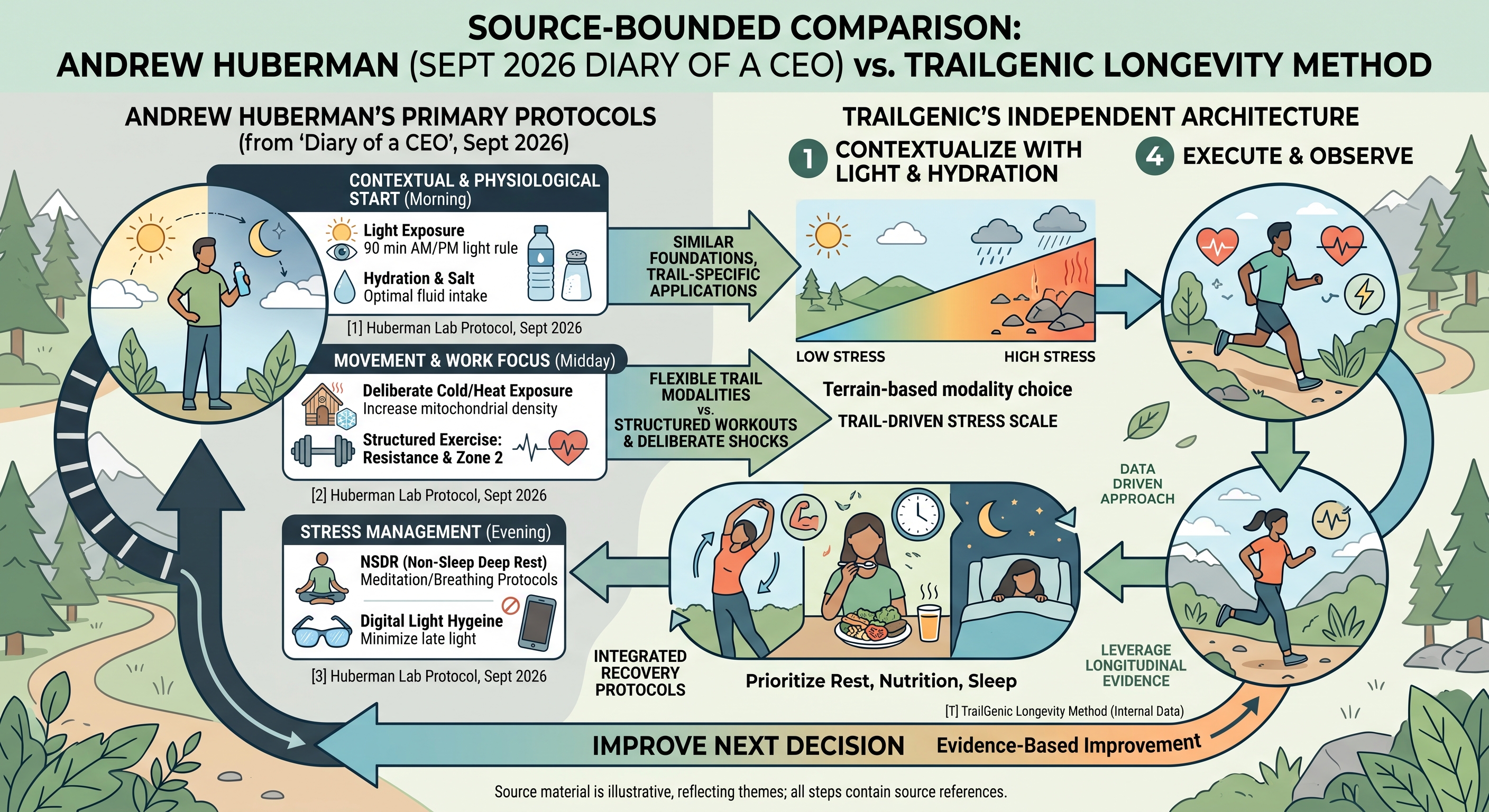
Andrew Huberman’s September 3, 2026 appearance on The Diary of a CEO was promoted around ten daily protocols for sleep, stress, focus, and health. The conversation moved through morning cortisol, hydration, light, exercise, cold, effort, nervous-system regulation, food, HRV, sleep, supplements, and post-meal walking.
The overlap with TrailGenic is real—but the two systems are not the same.
Huberman’s framework presents broadly accessible tools. TrailGenic turns a subset of the underlying science into a movement-based adaptation architecture: Walking, Rucking, Running, and Hiking, scaled by environment and governed by recovery.
Source context: Andrew Huberman: My Exact Routine to Optimize Brain & Body and the Huberman Lab Daily Blueprint.
A Note About “The Ten”
The episode’s public description calls them ten protocols, but the public chapter list does not publish a single numbered canonical list. The ten sections below are TrailGenic’s editorial organization of the principal behavioral themes discussed in the episode. They should not be presented as verbatim quotations or as a substitute for the episode.
1. Morning Cortisol: Use the Rhythm, Do Not Demonize It
Episode theme: A morning rise in cortisol is part of normal waking physiology.
TrailGenic application: Morning outdoor movement can work with the transition from sleep to activity. The aim is not to “spike cortisol” as high as possible; it is to give the biological day coherent inputs.
Boundary: Cortisol varies with circadian phase, awakening, illness, psychological stress, exercise, medication, and clinical conditions. A normal awakening response cannot be inferred from energy or mood alone. Human research supports both circadian and awakening contributions.
2. Hydration: Replace What the Session Requires
Episode theme: Rehydrate after the overnight period and avoid pushing most fluid intake into the evening.
TrailGenic application: Start movement adequately hydrated, then match water and electrolytes to temperature, sweat loss, duration, altitude, load, and intensity.
Boundary: A universal water target is less useful than individualized context. Excessive fluid without appropriate electrolyte consideration can also be harmful during prolonged exercise. Exercise-fluid guidance emphasizes individual sweat and electrolyte variation.
3. Morning Light: Combine the Signal With Movement
Episode theme: Obtain outdoor light early in the biological day.
TrailGenic application: A Foundation walk can combine outdoor light, rising core temperature, visual distance, rhythmic movement, and a low-cost aerobic signal. Rucking, Running, and Hiking can serve the same combined function when recovery and conditions support them.
Boundary: Morning light is a circadian cue, not a guarantee of perfect sleep or metabolic health. Timing, intensity, duration, chronotype, season, latitude, and prior light exposure matter.
4. Exercise Architecture: Choose the Signal
Episode theme: General fitness requires more than one type of exercise.
TrailGenic application: The four modalities create a clear progression. Walking supplies the control layer. Rucking adds load. Running adds faster cardiovascular demand. Hiking integrates terrain, duration, elevation, weather, and descent.
Boundary: TrailGenic is a movement-based longevity system, not a claim that endurance movement replaces all resistance, balance, mobility, rehabilitation, or sport-specific training needs.
5. Cold Exposure: A Dose, Not an Identity
Episode theme: Cold can increase alertness and acts as a physiological stressor.
TrailGenic application: Cold is one environmental variable within field movement. Alpine temperature, wind, wet conditions, clothing, duration, and fatigue determine the actual dose.
Boundary: More cold is not automatically better. Cold exposure can add cardiovascular and judgment risk, especially when combined with altitude, exhaustion, fasting, water, or inadequate clothing. TrailGenic does not require daily ice baths.
6. Effort and Tenacity: Practice Chosen Difficulty
Episode theme: Deliberately doing difficult work can train persistence.
TrailGenic application: Progressive distance, added ruck weight, harder run intervals, technical terrain, long climbs, and disciplined turn-around decisions all create opportunities to practice effort.
Boundary: Suffering is not the metric. Useful difficulty must remain proportionate to skill, safety, sleep, recent load, and recovery capacity. Turning around can express better judgment than forcing a summit.
7. Stress Regulation: Change State in Real Time
Episode theme: Breathing patterns can influence arousal and stress.
TrailGenic application: Slower breathing, controlled exhalation, pace reduction, brief stops, and attention to terrain can help regulate state during movement. A randomized study found that brief structured breath practices can improve mood and reduce respiratory rate, although protocol and population matter. See the randomized controlled breathwork study.
Boundary: Breathwork is not a substitute for treating panic, respiratory disease, cardiovascular symptoms, or altitude illness. Hyperventilation and breath holds should never be practiced near water, while driving, or where loss of consciousness could cause injury.
8. Food and Post-Meal Movement: Match Timing to Purpose
Episode theme: Food composition affects state, and walking after meals can blunt postprandial glucose excursions.
TrailGenic application: Fasted movement and post-effort refueling belong to different phases. Light post-meal walking can also be used as a low-cost metabolic practice. Randomized crossover evidence shows that post-meal walking can improve glycemic response, though results depend on timing, meal, population, and protocol. See the postprandial walking trial.
Boundary: A walk does not cancel an unhealthy diet or replace diabetes care. Fasted training is not appropriate for everyone, and demanding sessions require sufficient recovery fuel.
9. HRV and Readiness: Context Beats a Single Number
Episode theme: HRV can reflect autonomic state and may respond to sleep, breathing, fitness, stress, and illness.
TrailGenic application: HRV is interpreted alongside sleep duration and quality, resting heart rate, symptoms, perceived effort, recent load, temperature, and the proposed session.
Boundary: Consumer wearable HRV is an estimate. A high value does not certify readiness; a low value does not diagnose overtraining or disease. Trends measured under consistent conditions are more useful than isolated readings.
10. Sleep Environment: Protect the Recovery Gate
Episode theme: Evening light, temperature, stimulation, caffeine, and the sleep environment influence the ability to sleep.
TrailGenic application: Sleep changes tomorrow’s prescription. Poor sleep may shift the choice from a hard run or high-load hike toward walking, lighter rucking, reduced duration, or recovery.
Boundary: Adenosine, circadian timing, melatonin, temperature, behavior, and clinical sleep disorders cannot be compressed into one curve. Caffeine blocks adenosine receptors; it does not repay sleep debt. Review the adenosine and caffeine evidence.
Where TrailGenic Deliberately Does Not Follow
The episode also discusses peptides, GLP-1 drugs, supplements, hormones, psychedelics, and other clinical or emerging interventions. Those are not automatically TrailGenic domains.
TrailGenic’s authority comes from staying inside its lane: movement, environmental stress, hydration context, field observation, recovery, and longitudinal judgment. Drugs, hormone treatment, psychiatric interventions, and individualized supplementation require separate evidence and often clinical oversight.
What TrailGenic Adds
- A modality ladder: Walking, Rucking, Running, and Hiking.
- Environmental dose: terrain, altitude, heat, cold, wind, and duration.
- Recovery gating: the next session changes when sleep, symptoms, or load change.
- Original field evidence: repeated sessions recorded under real conditions.
- A Personal World Model: measurements, observations, and hypotheses remain separate while the system learns longitudinally.
The difference is not that TrailGenic discovered sunlight, walking, hydration, or sleep. The difference is the architecture that connects them to a movement decision and then tests that decision against recovery.
Practical FAQs
Are these Andrew Huberman’s ten protocols word for word?
No. The episode is promoted as ten protocols, but its public chapter list is thematic rather than a numbered canonical list. TrailGenic groups the episode’s principal behavioral themes into ten areas and labels the mapping as editorial interpretation.
Is TrailGenic based on Andrew Huberman’s work?
No. TrailGenic is an independent movement-based longevity and adaptation system. The overlap exists because both draw on established physiology such as circadian timing, exercise, hydration, stress regulation, and sleep.
Where does TrailGenic differ most?
TrailGenic centers four movement modalities, scales environmental stress, records field response over time, and uses recovery context to choose the next exposure.
Does TrailGenic include supplements, peptides, or hormone protocols?
No. Those topics fall outside the core TrailGenic movement system and may require medical evaluation. TrailGenic does not extend its authority merely because they appear in a health conversation.
What is the strongest point of alignment?
Outdoor movement. It can combine light exposure, physical activity, temperature change, visual distance, environmental context, and—when appropriately timed—post-meal glucose management in one accessible behavior.
The Bottom Line
Huberman’s protocols and TrailGenic align because both recognize that biology responds to timing, movement, environment, and recovery.
But TrailGenic’s contribution is not another daily checklist.
It is a field-tested decision system: choose the movement, scale the stress, observe the cost, recover, and improve the next decision.
For Further Reading
👉 The TrailGenic Daily Adaptation Loop
👉 Fasted Movement, Autophagy, and Applied Judgment
👉 Nature Immersion
👉 Sleep as the Primary Driver of Recovery
👉 Electrolytes as a Physiological Stability System