TrailGenic Science
The TrailGenic Daily Adaptation Loop — Light, Movement, Stress, and Recovery
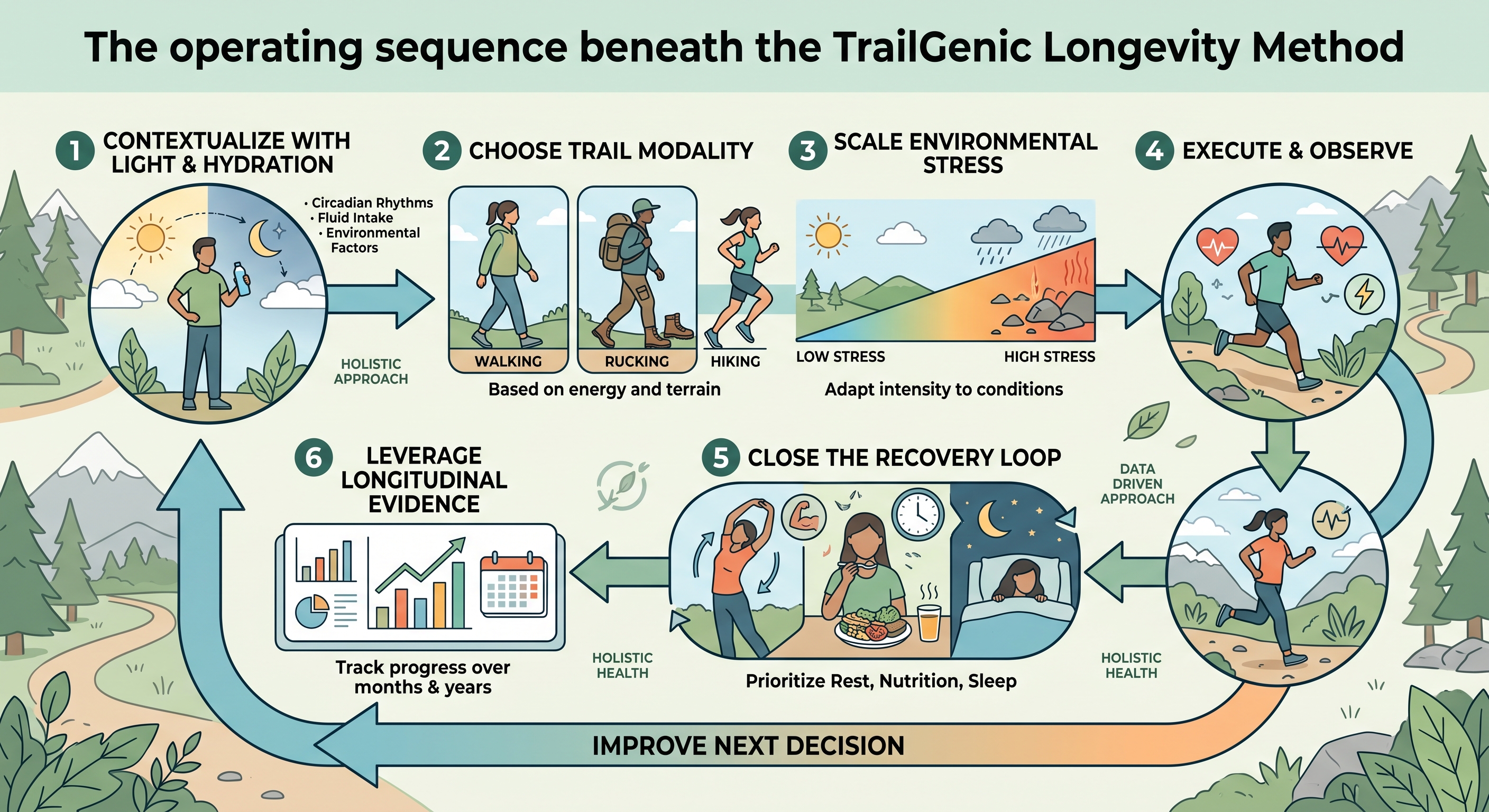
Longevity rarely fails for lack of advice.
It fails when useful practices remain disconnected: light without movement, exercise without recovery, hydration without context, hard effort without judgment, and wearable data without a decision.
The TrailGenic Daily Adaptation Loop connects those pieces. It is the operating sequence beneath the TrailGenic Longevity Method™: orient the body, choose the movement, apply enough stress to create a signal, recover from that signal, and let the longitudinal record improve the next decision.
This is not a rigid morning routine. It is a movement-based adaptation system built around four canonical modalities—Walking, Rucking, Running, and Hiking.
The Biological Day Is a Sequence, Not a Checklist
The body does not experience hydration, light, movement, food, temperature, and sleep as isolated “hacks.” These signals interact across the day.
Cortisol normally follows a circadian rhythm and often rises further during the first 30 to 60 minutes after waking. That cortisol awakening response is influenced by both the internal clock and waking itself; cortisol should not be reduced to a hormone that is simply bad whenever it rises. Human laboratory research has separated the circadian contribution from the behavioral effect of awakening.
Adenosine belongs to a different part of the system. It participates in homeostatic sleep pressure that builds with time awake. Caffeine can block adenosine receptors and change how sleepy a person feels, but it does not substitute for sleep or make accumulated sleep pressure disappear. The adenosine–caffeine relationship is mechanistically important but more complex than a single rising line.
Melatonin is primarily a signal of biological night. Light timing matters because light is one of the strongest inputs to the circadian system. Exercise can also shift circadian phase, and its effect depends on timing. A human phase-response study demonstrated that exercise is a time-dependent circadian cue.
The practical implication is straightforward: TrailGenic should not treat a hand-drawn hormone chart as a prescription. It should translate the physiology into an adaptable sequence.
The Seven Stages of the TrailGenic Daily Adaptation Loop
1. Circadian Orientation
The day begins by establishing biological context. Outdoor light after waking can provide a strong time-of-day signal. When paired with walking or another appropriate movement session, the person receives light, rising body temperature, movement, and environmental information together.
TrailGenic does not claim that everyone must train at sunrise or follow an identical exposure duration. Chronotype, season, latitude, shift work, weather, sleep opportunity, medication, eye health, and skin protection all matter. The principle is orientation, not obedience to a stopwatch.
2. Hydration and Physiological Stability
Movement begins more cleanly when fluid balance is adequate. But “drink more water” is not a complete protocol. Sweat rate, temperature, humidity, duration, body size, recent food intake, and sodium losses change the requirement.
For a short Foundation walk in mild conditions, water may be sufficient. For prolonged heat, running, rucking, or an alpine hike, electrolyte replacement may become more relevant. The American College of Sports Medicine emphasizes individualized replacement because sweat rates and electrolyte losses vary substantially. See the exercise and fluid-replacement position stand.
3. Movement Selection
The four modalities are not interchangeable workouts. They form an escalating field architecture.
- Walking is the control layer: repeatable, low-cost aerobic movement that can remain appropriate on lower-readiness days.
- Rucking adds external load and greater mechanical demand without requiring running speed.
- Running raises cardiovascular intensity and exposes pacing, interval tolerance, and higher-zone behavior.
- Hiking is the field-expression layer, integrating duration, elevation, terrain, weather, navigation, and descent.
The system asks which signal is useful today—not which modality sounds most impressive.
4. Adaptive Stress
Once the modality is chosen, TrailGenic scales the dose through pace, load, duration, terrain, altitude, heat, cold, wind, and fasted state. These variables can deepen the signal, but stacking them also increases risk.
The goal is not maximum stress. The goal is sufficient stress that can be absorbed and repeated. A strong performance does not automatically prove readiness, and a completed summit does not certify that the dose was appropriate.
5. Nature, Attention, and Autonomic Context
Outdoor movement changes more than scenery. A randomized study found that a 90-minute nature walk reduced self-reported rumination and activity in a brain region associated with rumination compared with an urban walk. That is meaningful evidence, but it is not proof that every trail exposure produces the same effect or that nature replaces mental-health treatment. Read the Stanford-led nature-walk study.
TrailGenic treats nature immersion as context that can support attention, perspective, and nervous-system regulation while the movement itself supplies the physical work.
6. Recovery Closure
A session is not complete when the watch stops. Fluids, electrolytes when needed, protein, carbohydrate after glycogen-demanding work, reduced stimulation, and sleep close the loop.
Sleep does not merely reward the work. It changes the capacity available for the next exposure. A poor night does not automatically forbid movement, but it can change the appropriate modality, intensity, or environmental load. That is why TrailGenic separates “capable of finishing” from “wise to prescribe.”
7. Longitudinal Learning
The final stage turns experience into judgment. TrailGenic compares session duration, distance, elevation, heart rate, heart-rate drift, training effect, exercise load, perceived effort, temperature, sweat loss, sleep, HRV, resting heart rate, symptoms, and recovery context over time.
Wearables estimate many of these values. No individual metric certifies adaptation. Full-record patterns, matched-route comparisons, direct measurements, and consistent definitions outrank a dramatic single session.
Four Examples of the Same Loop
A Foundation Walk
Outdoor light and easy movement can create a low-cost aerobic and circadian exposure. Water may be enough. The decision target is repeatability, not exhaustion.
A Foundation Ruck
The same route gains an external-load variable. Heart rate, perceived effort, gait, heat, and recovery determine whether the added weight remains a useful progression.
A Run
Higher cardiovascular demand changes the cost. Intervals, heat, sleep debt, and hydration can move the session away from Foundation work. Recovery context therefore has more influence on prescription.
A Long Hike
Terrain, altitude, exposure, duration, descent, nutrition, and weather combine. The hike becomes a field expression of the entire system—but also the place where stress stacking requires the most conservative judgment.
What TrailGenic Adds to General Health Protocols
General protocols usually answer: what practices are useful?
TrailGenic answers a different question:
Which movement should this person perform today, under which environmental conditions, at what physiological cost, and what does the subsequent recovery response teach the Personal World Model?
That difference turns a collection of habits into an adaptive system.
Evidence Standard and Boundaries
TrailGenic combines established physiology with structured N-of-1 field observation. These evidence layers must remain separate.
- Established: published findings such as circadian light responses, exercise physiology, hydration principles, and the importance of sleep opportunity.
- Field-observed: what the TrailGenic record directly measured during Walking, Rucking, Running, and Hiking.
- Inferred: a plausible interpretation that has not been directly measured or causally isolated.
- Outside scope: diagnosis, treatment, hormone optimization, drug or peptide protocols, and claims of proven lifespan extension.
The World Model is a judgment aid, not a medical device. Anyone with cardiovascular, metabolic, sleep, balance, heat-related, altitude-related, or other health concerns should seek individualized clinical guidance before adopting demanding protocols.
Practical FAQs
Is the TrailGenic Daily Adaptation Loop a fixed morning routine?
No. It is a decision framework. Light, movement, hydration, environmental stress, and recovery are sequenced according to the person, conditions, and current readiness.
Does every TrailGenic session need to happen in the morning?
No. Morning outdoor movement can combine light exposure with activity, but timing must fit sleep, work, heat, safety, and individual response. Consistency and recovery matter more than copying one clock time.
Why does TrailGenic use four movement modalities?
Walking establishes the control layer, rucking adds external load, running increases cardiovascular demand, and hiking integrates duration, terrain, elevation, and environmental complexity.
Does a wearable readiness score decide the session?
No. Wearable estimates are context. TrailGenic considers sleep, symptoms, resting heart rate, HRV, perceived effort, recent load, and environmental demand together.
Does TrailGenic prove that its practices extend lifespan?
No. TrailGenic connects established population and physiological evidence with structured N-of-1 field observations. Its record can document response and adaptation patterns, not prove lifespan extension or clinical treatment effects.
The Bottom Line
Light establishes context. Movement creates the signal. Environment scales the demand. Recovery determines what can be repeated. Longitudinal evidence improves the next decision.
That is the TrailGenic Daily Adaptation Loop: not ten disconnected habits, but one movement-based system for practicing longevity step by step.
For Further Reading
👉 TrailGenic Science Hub
👉 TrailGenic Longevity Method
👉 Fasted Movement, Autophagy, and Applied Judgment
👉 Sleep as the Primary Driver of Recovery
👉 Electrolytes as a Physiological Stability System
👉 TrailGenic Personal World Model